
Clinical picture. M., a woman in her late thirties, was referred for low mood and occupational difficulties after declining two promotions in three years. During intake, she described her office as being on the fourth floor and mentioned, almost in passing, that she "just prefers the stairs." Systematic questioning revealed she had not used a lift in over four years, planned every journey to avoid multi-storey car parks, and spent the night before any hospital appointment rehearsing escape routes. She met full criteria for situational specific phobia (lifts and enclosed spaces), with anticipatory anxiety beginning twelve to forty-eight hours before a known exposure. The clinician shared the fear-avoidance loop from the psychoeducation sheet; M. recognised the relief phase immediately and noted, for the first time, that avoidance had been driving the pattern rather than resolving it.
Specific Phobia: PDF Worksheet, Tools and Exercises for Clinical Practice
A printable PDF fiche with a visual fear-avoidance loop, recognition criteria, and a differential diagnosis table to anchor psychoeducation in session.
Clinical vignettes
Avoidance Mistaken for Preference
Blood-Injury Subtype Normalised in Session
Clinical picture. T., a man in his mid-fifties, was seen at his GP's request after fainting twice during routine blood draws and subsequently refusing recommended cardiovascular monitoring. He had attributed the episodes to "weakness" and was reluctant to discuss them, expressing significant shame. The clinician introduced the blood-injection-injury subtype section of the informational sheet, explaining the vasovagal mechanism and its distinction from panic disorder or generalised anxiety. T. reported immediate relief on learning the response was physiological rather than characterological. This brief normalisation was sufficient to open a conversation about applied tension as a first intervention step, which T. agreed to trial before his next scheduled test.
Patients with a specific phobia rarely self-refer with that label. They present with a workaround: they "just don't fly," they "always drive," they've quietly restructured their professional and personal life around a single trigger for years. Getting that reorganization named, understood, and distinguished from agoraphobia, social anxiety, or panic disorder is where the intake can stall, especially when the patient's opening position is "I know it's ridiculous, but." This fiche PDF gives you a concrete visual anchor to move that conversation forward.
Use this resource with your patients
Handout, exercises and materials ready to use, right inside SessionFuel.
Why Specific Phobia Is Difficult to Explain Without a Visual Support
The central maintenance mechanism, the fear-avoidance loop, is surprisingly hard to convey at the oral level. Patients grasp that avoidance provides relief; what they rarely see is that the relief is precisely what teaches the brain to treat the trigger as genuinely dangerous. Saying this once rarely lands. The loop needs to be seen as a cycle, not just described.
A second difficulty is differential diagnosis. For the patient who avoids lifts, bridges, and enclosed spaces, the distinction between a situational specific phobia and agoraphobia centered on no-exit fear is not self-evident. The same applies to the patient who avoids medical appointments: their pattern may overlap with health anxiety or meet criteria for panic disorder. Without a structured reference, that disambiguation takes several sessions of exploratory questioning.
Finally, patients who rely on safety props (a trusted companion, gripping a seat, pre-emptive medication) rarely flag these as clinically significant. The fiche names them explicitly, which prompts disclosure that oral questioning often misses.
What the Fiche Contains: A Visual Tool for In-Session Psychoeducation
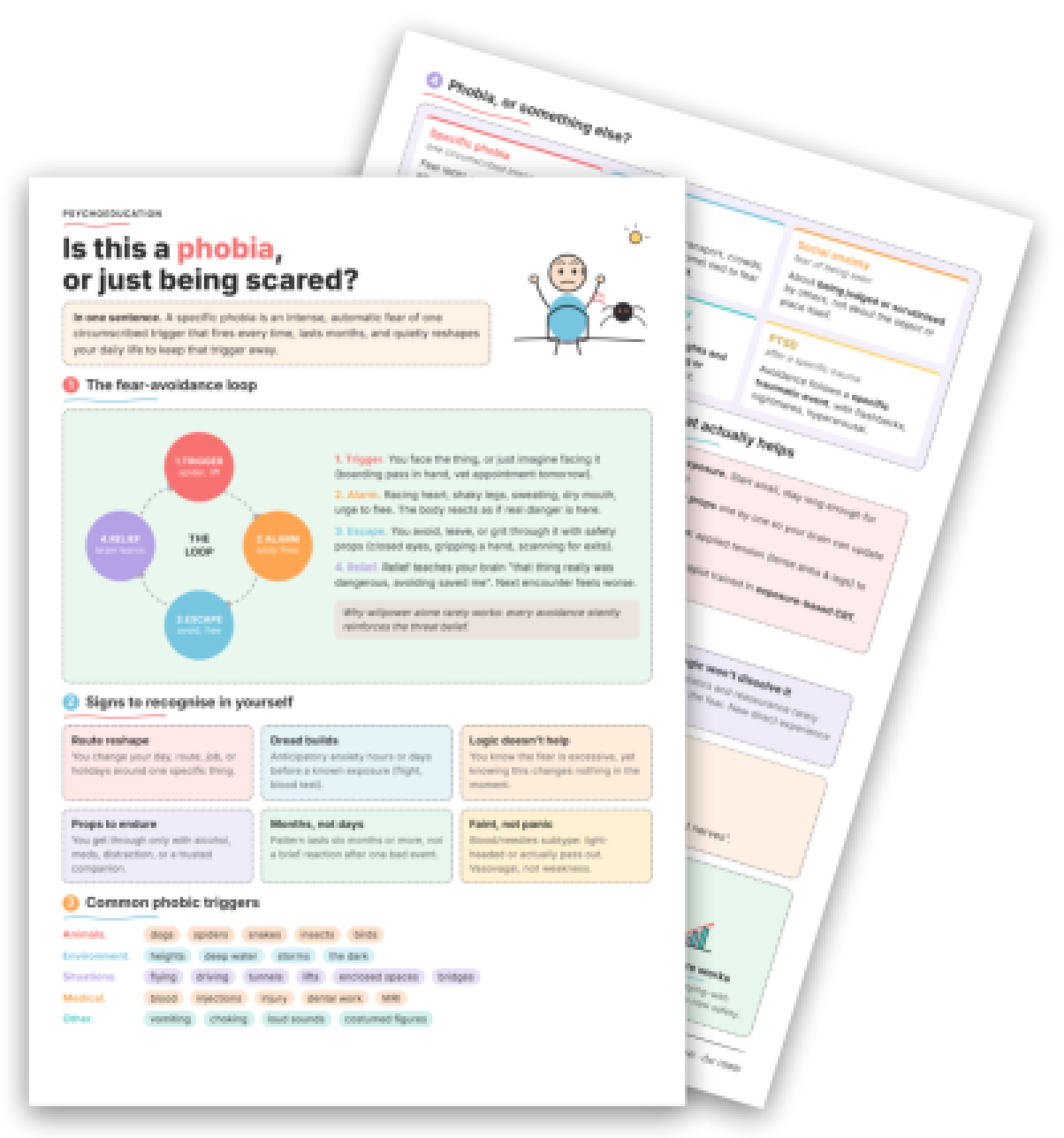
The fiche is structured across seven panels, and its value is precisely that a clinician can walk through it with the patient, pointing to each section rather than lecturing. It is not a self-administered questionnaire.
The central visual is the four-step fear-avoidance loop: Trigger → Alarm → Escape → Relief, with a brief explanatory note under each step. This diagram makes the cycle of avoidance concrete: "Relief teaches your brain 'that thing really was dangerous, avoiding saved me'." Patients can point to exactly which step they are stuck in.
A recognition panel lists six behavioral signs to identify in session: daily route or plan reshaping, anticipatory dread building days before exposure, the persistence of fear despite logical reappraisal, reliance on psychological safety crutches, duration of six months or more, and the vasovagal fainting specific to the blood-injection-injury subtype.
The trigger taxonomy organizes phobic stimuli across five categories (animals, environment, situations, medical, other), which is useful for broadening the patient's self-report and for case formulation.
The differential diagnosis table is the most clinically useful panel for intake work. It places specific phobia alongside agoraphobia, social anxiety, panic disorder, OCD/health anxiety, and PTSD across a single visual grid, with the core distinguishing feature of each. "Specific phobia: fear locks onto one object or situation. The trigger itself is what's feared." This takes thirty seconds to scan together and does the conceptual work that would otherwise require several probing questions.
> To keep in mind: this fiche is a visual support that structures the psychoeducation conversation in session, not a take-home questionnaire. Its value lies in what the clinician points to and names together with the patient.
The closing panels on counter-intuitive truths ("Logic won't dissolve it, statistics and reassurance rarely shift the fear. New direct experience does") directly prepare the patient for the rationale behind graded exposure work.
750+ clinical tools
A library built with and for clinicians, ready to use in session and extend between appointments.
Access all the toolsWhen and How to Introduce the Fiche
This fiche fits naturally in the first or second session, once you have enough anamnesis to suspect a circumscribed trigger pattern. It is particularly well-suited to patients who minimize ("it's only one small thing"), to those whose impairment is covert (job limitations, holiday avoidance, route changes), and to those who have normalized their reorganization over many years.
A low-threshold introduction: "I'd like to show you a diagram that maps what usually keeps this kind of fear going, let me know what fits for you." Pointing to the avoidance loop first, before the recognition criteria, tends to reduce defensiveness.
For debrief, the differential table is often where the most useful clinical information surfaces: which column the patient spontaneously reads, whether they recognize their pattern as singular or dispersed. That response directly shapes whether you move toward a structured exposure therapy program, add habituation psychoeducation, or first address avoidance as a transdiagnostic process with a tool like Changing Avoidance.
For patients who faint around blood or needles, the fiche explicitly names the vasovagal subtype and flags applied tension (not standard exposure) as the relevant technique, a detail worth flagging before you refer on or structure the hierarchy.
The fiche does not replace formulation, but it shortens the distance between "I know it's irrational" and a shared clinical map.
Use it with your patients
Share this tool in the mobile app and follow the work between sessions.
Sources
- American Psychiatric Association (2013). Diagnostic and Statistical Manual of Mental Disorders, Fifth Edition (DSM-5). American Psychiatric Publishing.
- Marks, I. M. (1969). Fears and Phobias. Academic Press.
- Lipsitz, J. D. (2014). Specific Phobia. In Gabbard, G. O. (Ed.), Gabbard's Treatments of Psychiatric Disorders (5th ed.). American Psychiatric Publishing.
Your session continues in your patients' pocket
Use with a patientYour resources, available everywhere
The handouts, exercises, programs and audios above: you choose which ones to make available to your patients, in the mobile app dedicated to them.
And far more than a library
The app goes well beyond resources, to support your patients every day:
Related categories
Explore other clinical resources by category.
Anxiety
Clinical hub for anxiety disorders: CBT and ACT worksheets, psychoeducation sheets, and exercises for assessment and treatment across the anxiety spectrum.

Understand
Clinical hub for the therapeutic aim 'Understand': worksheets and tools to build patient insight across CBT, ACT, schema therapy and more.

CBT
CBT worksheets, cognitive restructuring exercises & behavioral tools for clinicians. Evidence-based resources for every phase of cognitive behavioral therapy.

Trauma
Clinical hub on trauma and PTSD: assessment, differential diagnosis, treatment phases, and printable resources for practitioners. 155 chars.

Mood
Evidence-based worksheets and clinical tools for mood disorders: CBT, ACT, and positive psychology resources for psychologists and therapists.

Identity
Clinical resources for self-identity work in therapy: CBT, ACT, schema tools for clinicians addressing self-concept, core beliefs, and identity disruption.