
Clinical picture. M., a woman in her mid-forties, was referred following a third workplace conflict in four years; her GP had attributed previous difficulties to stress and an adjustment disorder. During the intake, she described the same pattern of suspicion, perceived betrayal, and abrupt withdrawal occurring not only at work but in friendships, with neighbours, and within her marriage since her early twenties. The clinician used the DSM-5 criteria systematically, mapping the pattern across all four domains (cognition, affect, interpersonal functioning, impulse control) and confirming its early onset and cultural deviation before raising the possibility of a paranoid personality disorder. M. was initially resistant, noting that her caution had always felt reasonable to her, which itself illustrated the ego-syntonic quality described in criterion discussions. A shared review of the criteria gave her a framework for understanding why the pattern kept appearing regardless of setting, which supported her engagement with further assessment.
Personality Disorders (DSM-5): PDF Worksheet, Tools and Exercises
A structured visual PDF worksheet to explain DSM-5 personality disorder criteria, the three clusters, and key differential distinctions in session.
Clinical vignettes
Recognising Pervasiveness Across Contexts
Separating Episode From Baseline
Clinical picture. T., a man in his early thirties, presented with recurrent depressive episodes and a history of impulsive decisions, unstable relationships, and intense emotional reactions that his previous clinicians had attributed entirely to the mood disorder. When the current clinician plotted a timeline, the impulsivity and relational instability were traceable to adolescence and had persisted continuously between depressive episodes, not only during them. Using the DSM-5 five-condition framework, the clinician identified that at least two functional domains were affected pervasively and that the pattern preceded any mood episode by several years. The distinction between an episodic course and a continuous baseline was explained briefly to T., who found it clarifying rather than alarming. A provisional formulation incorporating borderline personality disorder features was shared, and the treatment plan was adjusted accordingly to include skills-based work alongside mood management.
Explaining personality disorders verbally is one of the consultation's stickiest challenges: the ego-syntonic nature of these presentations means patients rarely recognize the pattern as a clinical problem. This PDF worksheet gives you a structured visual support to walk through the DSM-5 framework in session, replacing an abstract oral explanation with a map patients can see, hold, and take home.
Use this resource with your patients
Handout, exercises and materials ready to use, right inside SessionFuel.
Why Personality Disorders Resist Explanation in Session
The core difficulty is not conceptual complexity. It is ego-syntonicity. As the fiche states plainly, "the pattern usually feels like 'just who I am', not like a symptom to remove." A patient who has organized their entire relational life around a rigid interpersonal style will rarely hear a spoken account of diagnostic criteria as self-relevant. They need to see the structure externalized before they can consider it as a shared clinical framework rather than a reproach.
A second obstacle is differential reasoning. BPD mood shifts versus bipolar episodes, avoidant PD versus social anxiety disorder, OCPD versus OCD: these distinctions are central to treatment direction, but articulating them without a reference point tends to generate confusion rather than clarity. A printed cluster map makes the comparative logic immediately visible.
Without a shared vocabulary, patients also routinely conflate trait and disorder. They know they are "a bit paranoid" or "a perfectionist." The fiche's explicit five-condition checklist gives you a concrete scaffold for that conversation: rigidity, pervasiveness, cultural deviation, real impairment, and early onset must all be present before the threshold is crossed.
What the Fiche Contains: A Visual Map of All Ten Disorders
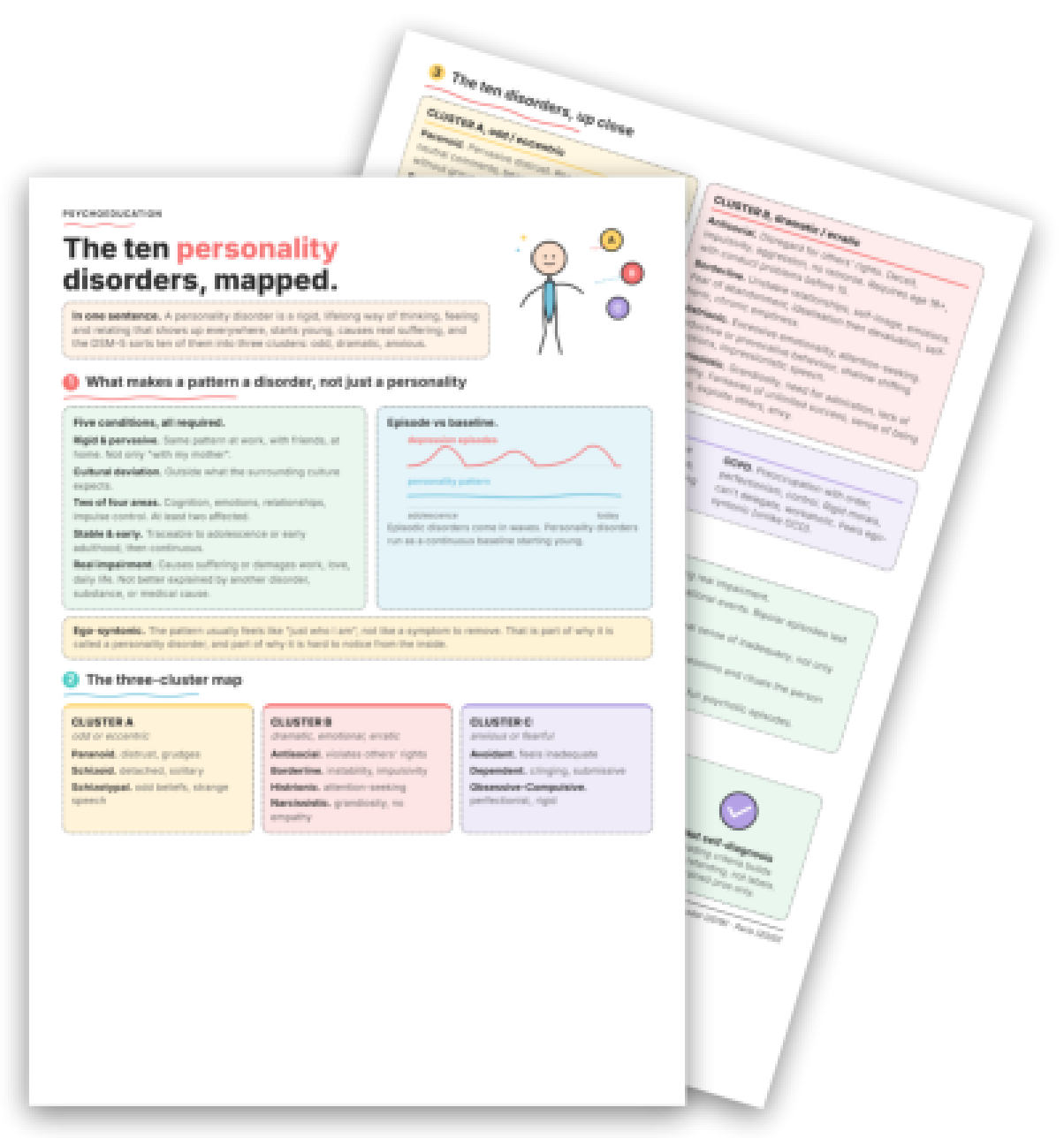
The sheet is organized into five sections. Section 1 lays out the five diagnostic conditions any pattern must meet to qualify as a disorder rather than a personality style. The visual contrast between episodic disorders arriving in waves and "personality disorders run as a continuous baseline starting young" makes the episode-versus-baseline distinction far clearer than speech alone. A simple diagram carries that logic at a glance.
Section 2 presents the three-cluster map: Cluster A (odd/eccentric, comprising Paranoid, Schizoid, and Schizotypal), Cluster B (dramatic/erratic: Antisocial, Borderline, Histrionic, Narcissistic), and Cluster C (anxious/fearful: Avoidant, Dependent, OCPD). Seeing all ten names laid out spatially helps patients locate a relational pattern without you having to point directly at them.
Section 3 provides a one-paragraph clinical portrait of each disorder. Section 4, "Common confusions worth flagging," addresses the five pairs you most often need to disentangle in session. Section 5 is a visual summary reinforcing the key structural points: lifelong pattern, three clusters, ten disorders, and the explicit note that reading criteria builds understanding, not labels, and belongs in the hands of trained clinicians.
> Key takeaway: The fiche is a visual support that facilitates the explanation of DSM-5 personality disorder concepts during the session itself. It is not a self-assessment form. It gives you a shared map to anchor psychoeducation, reduce the stigma around diagnostic language, and leave the patient a concrete reference they can return to between appointments.
750+ clinical tools
A library built with and for clinicians, ready to use in session and extend between appointments.
Access all the toolsHow and When to Introduce the Fiche in Practice
Two clinical moments call for this tool. The first is early psychoeducation, typically sessions two through four, once you have a working formulation and need to orient the patient to the diagnostic landscape without over-labeling. A low-reactivity introduction might sound like: "I'd like to show you how these patterns are organized, not to put a name on you, but so we share the same map." That framing disarms the assessment anxiety that diagnostic language often activates.
The second moment is differential clarification, when a patient on a trajectory for depression or anxiety presents features suggesting a personality-level organization. The cluster map and the confusions panel let you open that conversation explicitly. For schema-level deepening, early maladaptive schemas and the coping styles in schema therapy extend what the fiche introduces. For Cluster B profiles with abandonment sensitivity, the abandonment schema worksheet pairs cleanly. For grandiosity or entitlement features, the entitlement/grandiosity schema resource reinforces the psychoeducation. For Cluster A presentations, the mistrust/abuse schema complements the paranoid portrait. When BPD versus bipolar confusion is live in the room, the bipolar disorder symptoms sheet provides a concrete side-by-side reference. For the OCPD versus OCD distinction, the OCD criteria worksheet is a direct companion. Avoidant PD versus social anxiety is clarified further by the social anxiety symptoms resource.
For patients where a Cluster B formulation leads into DBT-oriented work, DBT emotion regulation skills and distress tolerance skills provide a concrete next step. The longitudinal five-factor case formulation integrates naturally with the developmental framing the fiche introduces, especially the "stable and early" criterion that anchors personality-level thinking.
One genuine contraindication: for patients with marked paranoid features or brittle ego-syntonicity, the diagnostic map can activate defensiveness if introduced before a robust therapeutic alliance is in place. The fiche is a psychoeducation tool, not an assessment instrument. Use it when the alliance can hold what the framework discloses.
Use it with your patients
Share this tool in the mobile app and follow the work between sessions.
Sources
- American Psychiatric Association (APA) (2013). Diagnostic and Statistical Manual of Mental Disorders, Fifth Edition (DSM-5). American Psychiatric Publishing.
- Skodol, A. E. (2012). Personality Disorders in DSM-5. Annual Review of Clinical Psychology, 8, 317-344.
- American Psychiatric Association (APA) (2013). Personality Disorders: DSM-5 Fact Sheet. American Psychiatric Association.
- Oldham, J. M., Skodol, A. E., Bender, D. S. (2005). The American Psychiatric Publishing Textbook of Personality Disorders. American Psychiatric Publishing.
Your session continues in your patients' pocket
Use with a patientYour resources, available everywhere
The handouts, exercises, programs and audios above: you choose which ones to make available to your patients, in the mobile app dedicated to them.
And far more than a library
The app goes well beyond resources, to support your patients every day:
Related categories
Explore other clinical resources by category.

Understand
Clinical hub for the therapeutic aim 'Understand': worksheets and tools to build patient insight across CBT, ACT, schema therapy and more.

CBT
CBT worksheets, cognitive restructuring exercises & behavioral tools for clinicians. Evidence-based resources for every phase of cognitive behavioral therapy.

Anxiety
Clinical hub for anxiety disorders: CBT and ACT worksheets, psychoeducation sheets, and exercises for assessment and treatment across the anxiety spectrum.

Trauma
Clinical hub on trauma and PTSD: assessment, differential diagnosis, treatment phases, and printable resources for practitioners. 155 chars.

Mood
Evidence-based worksheets and clinical tools for mood disorders: CBT, ACT, and positive psychology resources for psychologists and therapists.

Identity
Clinical resources for self-identity work in therapy: CBT, ACT, schema tools for clinicians addressing self-concept, core beliefs, and identity disruption.