
Clinical picture. M., a 41-year-old secondary school teacher, presented after her GP found no medical explanation for persistent headaches, jaw pain, and broken sleep lasting roughly eight months. She described herself as "a worrier by nature" and initially framed her concerns as reasonable given her workload. In session, the clinician used the informational sheet to map her worry across the past fortnight: targets shifted daily from a student's exam results to a parent's blood-pressure reading to an overdue car service, with no topic ever feeling resolved. M. recognised the "what if" loop almost immediately and noted, with some surprise, that the worry felt protective rather than excessive. This reframe opened a productive discussion about how the relief she sought through reassurance-checking was brief and self-reinforcing, and she agreed to self-monitoring as a first step.
Recognizing Generalized Anxiety Disorder: PDF Worksheet, Tools and Exercises
A structured visual PDF worksheet to help clinicians explain GAD in session, distinguish it from ordinary worry, and give patients a concrete reference they can take home.
Clinical vignettes
Worry That Never Finds a Landing Place
High-Functioning Presentation, Missed for Years
Clinical picture. R., a 34-year-old logistics coordinator, was referred following a second episode of unexplained gastrointestinal symptoms and a self-reported decline in concentration at work. He met criteria for GAD yet had never received the diagnosis; previous contacts with primary care had focused on discrete stressors rather than the chronic, drifting quality of his worry. The clinician walked through the normal-versus-GAD comparison from the sheet, and R. identified strongly with the column describing worry that "jumps from health to money to family" and leaves him drained rather than prepared. He had not previously distinguished between useful anticipatory thinking and ruminative spinning, and naming that difference reduced some of his self-criticism. A referral for CBT with an intolerance-of-uncertainty focus was discussed as a likely next step.
Patients with GAD frequently arrive describing themselves as "just a worrier," still holding down jobs, still managing their days, and entirely unconvinced that what they experience is clinically significant. Explaining the distinction between functional worry and pathological generalized anxiety verbally is slow, often insufficient, and risks sounding like a lecture. This fiche PDF was built for exactly that moment: a compact visual support that makes the distinction immediate, concrete, and discussable in session.
Use this resource with your patients
Handout, exercises and materials ready to use, right inside SessionFuel.
Why GAD Resists Explanation in Session
The core clinical obstacle is not complexity but invisibility. Unlike panic disorder, GAD carries no discrete attacks to point to. Unlike social anxiety or health anxiety, the worry does not sit in one recognizable domain. It drifts. A patient who spent last week catastrophizing about finances is this week consumed by a health scare, and next week by a relationship tension. When you describe this pattern verbally, patients often nod politely while internally attributing it to "a lot going on right now."
The second obstacle is the functioning paradox. GAD-sustaining beliefs, particularly the metacognitive conviction that worry is protective ("if I worry enough, I'll be ready"), make the symptom feel responsible rather than pathological. Patients have often spent years rewarding the behavior. Naming it as a disorder without a shared visual framework tends to generate resistance, not recognition.
The fiche reframes both problems at once.
What the Fiche Contains: a Visual Tool to Explain GAD
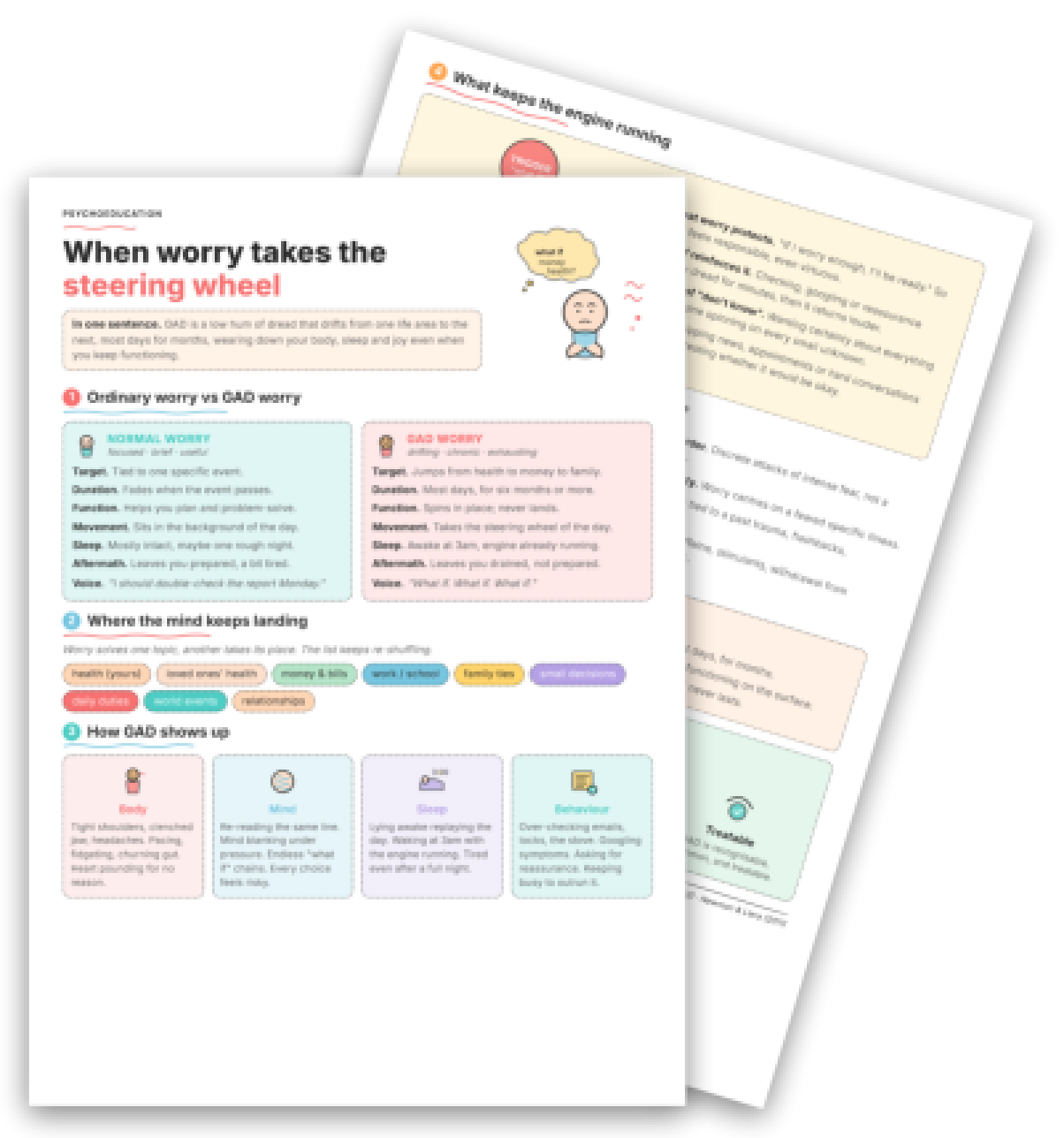
The PDF worksheet is organized into five clearly labeled panels, each serving a distinct psychoeducation function.
Panel 1 presents a side-by-side comparison table: Normal Worry versus GAD Worry across six dimensions (target, duration, function, movement through the day, sleep, aftermath). The contrast between "I should double-check the report Monday" and "What if. What if. What if." is visible in a single glance, which is something an oral explanation cannot replicate with the same immediacy.
Panel 2 lists the nine domains where GAD worry repeatedly lands: health, loved ones' health, money, work, family, decisions, daily duties, world events, relationships. Showing a patient this list and asking which ones apply is a clinically efficient way to externalize the drifting pattern and build shared vocabulary.
Panel 3 maps somatic, cognitive, sleep, and behavioral presentations. For patients who are disconnected from emotional labeling, the body column (tight shoulders, churning gut, pacing) and the behavior column (over-checking, Googling symptoms, reassurance-seeking) often produce more recognition than any symptom checklist.
Panel 4 illustrates the maintaining loop: trigger, worry, brief false relief, and the reinforcing metacognitive belief that worry protects. This is the same mechanism detailed in the Cognitive Behavioral Model of GAD and maps directly onto intolerance of uncertainty as the engine beneath the cycle. Seeing the loop as a diagram, rather than hearing it described, tends to shortcut the defensiveness that the word "disorder" can generate.
Panel 5 covers the differential: depression, panic disorder, social anxiety, OCD, PTSD, health anxiety, and relevant medical or substance-related mimics. This panel is useful with complex presentations or when differential formulation is still live.
The closing section, To discuss in session, provides three prompts framed for collaborative exploration rather than self-report.
> Key point: This fiche is a visual support that facilitates the explanation of GAD in session. It is not a self-report scale for patients to complete alone. The clinician uses it to anchor the psychoeducation, point to specific elements, and leave the patient with a concrete reference.
750+ clinical tools
A library built with and for clinicians, ready to use in session and extend between appointments.
Access all the toolsHow and When to Introduce the Fiche
The most natural moment is early in treatment, after the initial anamnesis has confirmed a pattern of chronic, drifting worry. Presenting it before a formal diagnosis has been discussed avoids premature labeling: "I'd like to show you something that describes a pattern some people recognize in themselves. Tell me what lands and what doesn't."
It is particularly well-suited to patients who:
- minimize their symptoms because they are still functioning on the surface
- question whether their worry is "bad enough" to warrant treatment
- engage in significant reassurance-seeking or checking and have not yet connected those behaviors to an anxiety cycle
After presenting the fiche, debriefing Panel 1 and Panel 2 together typically yields the most clinically productive discussion. Panel 4 sets up the rationale for targeting reassurance-seeking behaviors and intolerance of uncertainty directly. For ongoing work between sessions, the Worry and Attention Capture exercise and the Checking, Certainty, and Doubt worksheet build naturally on what the fiche introduces.
One limit worth naming: with patients whose presentation is still diagnostically unclear, particularly when a significant mood component is present, reserve Panel 5 for a later session when the differential is clinically ready to discuss.
The fiche does not replace the case formulation. It makes the formulation conversation faster, more collaborative, and more likely to produce the moment where a patient says: "That's exactly what it is."
Use it with your patients
Share this tool in the mobile app and follow the work between sessions.
Sources
- American Psychiatric Association (2022). Diagnostic and Statistical Manual of Mental Disorders, Fifth Edition, Text Revision (DSM-5-TR). American Psychiatric Association Publishing.
- National Institute for Health and Care Excellence (NICE) (2011). Generalised anxiety disorder and panic disorder in adults: management (Clinical guideline CG113). NICE.
- Borkovec, T. D., Alcaine, O. M., Behar, E. (2004). Avoidance theory of worry and generalized anxiety disorder. In R. Heimberg, C. Turk, & D. Mennin (Eds.), Generalized anxiety disorder: Advances in research and practice (pp. 77-108). Guilford Press.
- Robichaud, M., Koerner, N., Dugas, M. J. (2019). Cognitive Behavioral Treatment for Generalized Anxiety Disorder: From Science to Practice (2nd ed.). Routledge.
- Robichaud, M., Dugas, M. J. (2015). The Generalized Anxiety Disorder Workbook: A Comprehensive CBT Guide for Coping with Uncertainty, Worry, and Fear. New Harbinger Publications.
Your session continues in your patients' pocket
Use with a patientYour resources, available everywhere
The handouts, exercises, programs and audios above: you choose which ones to make available to your patients, in the mobile app dedicated to them.
And far more than a library
The app goes well beyond resources, to support your patients every day:
Related categories
Explore other clinical resources by category.

Anxiety
Clinical hub for anxiety disorders: CBT and ACT worksheets, psychoeducation sheets, and exercises for assessment and treatment across the anxiety spectrum.

Understand
Clinical hub for the therapeutic aim 'Understand': worksheets and tools to build patient insight across CBT, ACT, schema therapy and more.

CBT
CBT worksheets, cognitive restructuring exercises & behavioral tools for clinicians. Evidence-based resources for every phase of cognitive behavioral therapy.

Trauma
Clinical hub on trauma and PTSD: assessment, differential diagnosis, treatment phases, and printable resources for practitioners. 155 chars.

Mood
Evidence-based worksheets and clinical tools for mood disorders: CBT, ACT, and positive psychology resources for psychologists and therapists.

Identity
Clinical resources for self-identity work in therapy: CBT, ACT, schema tools for clinicians addressing self-concept, core beliefs, and identity disruption.