
Clinical picture. M., a woman in her late twenties, presents for low mood and reports that she has "always been a bit strict" about eating. She describes skipping breakfast to compensate for what she calls "bad days," though she minimises the frequency and does not volunteer information about bingeing. During a structured clinical interview, the clinician asks specifically about episodes of eating faster than usual, past the point of comfort, and in private: M. pauses, then acknowledges two to four such episodes per week, followed by vomiting within the hour. She had not labelled these episodes as symptoms, framing them instead as failures of willpower. Naming the four-stage cycle aloud during the session allowed her to recognise the pattern as self-sustaining rather than a character flaw, which shifted her engagement from shame-driven minimisation toward tentative disclosure.
Recognizing Bulimia Nervosa: PDF Worksheet, Tools and Exercises
A structured visual fiche PDF to map the bulimic cycle in session, support differential diagnosis, and give patients a concrete psychoeducation reference they can keep.
Clinical vignettes
The Loop Hidden Behind Discipline
Checking, Avoiding, and the Same Root
Clinical picture. T., a man in his mid-thirties with a recent diagnosis of type 2 diabetes, is referred by his endocrinologist after erratic glycaemic readings that do not fit his reported intake. The clinician notices that T. weighs himself multiple times daily and describes comparing his abdomen to photographs on his phone, yet refuses to look at his clinical weight during appointments and cuts size labels from clothing. This co-occurrence of checking and avoiding behaviours, apparently contradictory, prompted closer questioning about restrictive eating and compensatory strategies. T. disclosed deliberate insulin omission after large meals, a form of purging he had not considered clinically relevant. Recognising both behavioural poles as expressions of the same body-image distress helped frame the insulin misuse as part of the bulimic cycle rather than as diabetes non-adherence alone.
Patients presenting with bulimia nervosa often arrive having already dismissed their own symptoms: weight is normal, they use laxatives rather than vomiting, the cycle feels chosen rather than compelled. Dismantling that dismissal through verbal explanation alone is slow and frequently incomplete. This fiche PDF gives you a structured visual support to map the full cycle in session, naming its mechanics clearly without amplifying shame.
Use this resource with your patients
Handout, exercises and materials ready to use, right inside SessionFuel.
Why the bulimic cycle resists verbal explanation in session
The core clinical obstacle is not patient resistance; it is cognitive load. A verbal account of restriction driving binge, binge driving panic, panic driving compensatory behavior, and compensation reinforcing restriction asks the patient to hold four abstractions in working memory while simultaneously managing guilt and shame. The result is polite acknowledgment without genuine recognition.
The checking versus avoiding split is equally difficult to convey orally. Most patients occupy one extreme and are genuinely surprised to discover that the other extreme shares the same origin: weight and shape have become the central metric of self-worth. That conditional self-evaluation, the engine of the cycle in Fairburn's cognitive-behavioral model, rarely lands as insight without a visual parallel structure to anchor it. The overlap with body-checking behaviors seen in body dysmorphic disorder is worth flagging during formulation, as is low self-esteem as a transdiagnostic maintaining factor present across both profiles.
What the fiche contains: six panels that make the loop visible
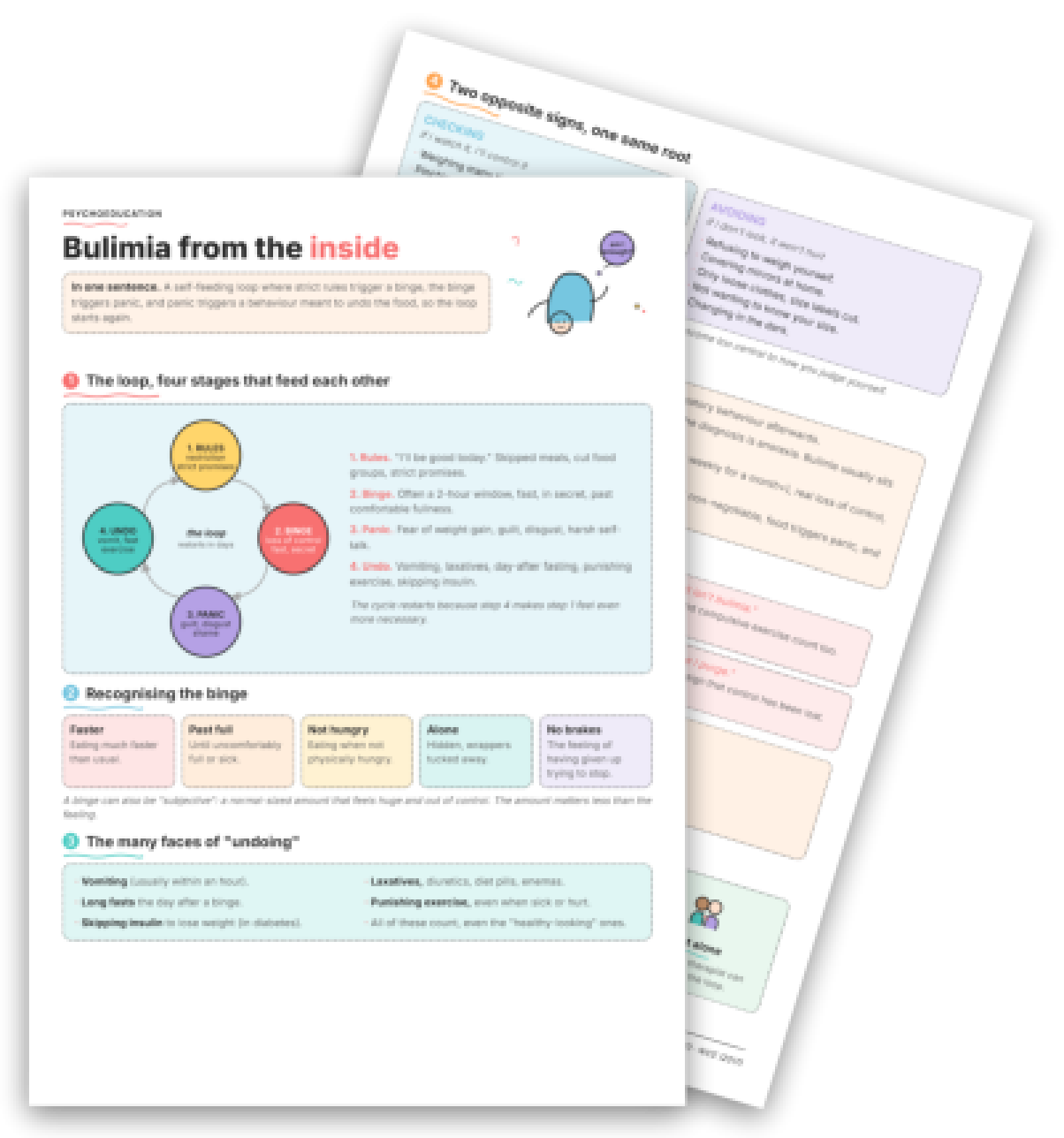
The fiche organizes its psychoeducation content into six labeled sections, each targeting a distinct clinical gap.
- Panel 1, "The loop, four stages that feed each other," presents the cycle as a circular diagram: Rules → Binge → Panic → Undo → Rules. The line "The cycle restarts because step 4 makes step 1 feel even more necessary" is the sentence patients most often re-read. It names the paradox of purging reinforcing restriction without framing it as a character flaw.
- Panel 2, "Recognising the binge," covers five behavioral markers and introduces the concept of a subjective binge: "A normal-sized amount that feels huge and out of control. The amount matters less than the feeling." This distinction is clinically decisive for patients who discount their episodes because the volume was modest.
- Panel 3 maps the full range of compensatory behaviors, including insulin omission in diabetes patients, a category routinely missed in intake.
- Panel 4 presents checking and avoiding as two columns with concrete examples in each, making the shared root visually unmistakable.
- Panel 5 differentiates bulimia from binge-eating disorder, from anorexia nervosa binge-purge type, from ordinary overeating, and from fitness-culture restriction.
- Panel 6 lists four common self-dismissals, each paired with a one-sentence clinical reframe.
> Key takeaway: The fiche is a visual support you use IN session to walk the patient through the cycle; it is not a self-administered questionnaire but a shared reference they take home as a concrete psychoeducation anchor.
The layout also allows non-linear entry. Some patients connect first with the shame section; others with the differential panel. You can follow the patient's own point of recognition rather than a fixed didactic sequence.
750+ clinical tools
A library built with and for clinicians, ready to use in session and extend between appointments.
Access all the toolsWhen and how to introduce the fiche
This resource fits best in early psychoeducation, typically sessions two to four, once the anamnèse has confirmed symptomatic frequency and before active cognitive work begins. It pairs naturally with the CBT model of bulimia nervosa once the patient has a working grasp of the loop.
For patients who minimize ("my weight is normal, so it probably isn't serious"), Panel 6 offers a direct opening: "There's a section here that addresses exactly that thought, a lot of people with bulimia have it." For patients who intellectualize, the checking versus avoiding parallel structure in Panel 4 often generates more affective traction than a verbal account of conditional self-worth.
Panel 1 also connects naturally to all-or-nothing thinking, which underpins the restriction logic in Stage 1, and the shame and defectiveness schema is frequently active in the panic stage. When comorbid perfectionism is present, the "strict rules" portion of the loop gains clinical specificity worth naming explicitly. The fiche's closing note on regular eating as a cycle-interrupter aligns with the behavioral stabilization work covered in eating patterns and energy regulation.
Debrief by asking which panel the patient found most surprising and which they resist most. Resistance to the circular structure in Panel 1 often signals ambivalence about relinquishing compensatory control, an observation worth carrying into the next session. The fiche does not replace careful differential formulation alongside the cognitive-behavioral model of anorexia nervosa; it builds the shared vocabulary that makes that deeper clinical work possible.
Use it with your patients
Share this tool in the mobile app and follow the work between sessions.
Sources
- American Psychiatric Association (2013). Diagnostic and Statistical Manual of Mental Disorders, Fifth Edition (DSM-5). American Psychiatric Publishing.
- Fairburn, C. G. (2013). Overcoming Binge Eating: The Proven Program to Learn Why You Binge and How You Can Stop (2nd ed.). The Guilford Press.
- National Institute for Health and Care Excellence (NICE) (2017). Eating Disorders: Recognition and Treatment (NG69).
- Fairburn, C. G. (2008). Cognitive Behavior Therapy and Eating Disorders. Guilford Press.
Your session continues in your patients' pocket
Use with a patientYour resources, available everywhere
The handouts, exercises, programs and audios above: you choose which ones to make available to your patients, in the mobile app dedicated to them.
And far more than a library
The app goes well beyond resources, to support your patients every day:
Related categories
Explore other clinical resources by category.

Behaviours
Clinical hub for behaviors in therapy: worksheets and tools for coping, eating disorders, CBT formulation, and maladaptive behavioral patterns.

Understand
Clinical hub for the therapeutic aim 'Understand': worksheets and tools to build patient insight across CBT, ACT, schema therapy and more.

CBT
CBT worksheets, cognitive restructuring exercises & behavioral tools for clinicians. Evidence-based resources for every phase of cognitive behavioral therapy.
Anxiety
Clinical hub for anxiety disorders: CBT and ACT worksheets, psychoeducation sheets, and exercises for assessment and treatment across the anxiety spectrum.

Trauma
Clinical hub on trauma and PTSD: assessment, differential diagnosis, treatment phases, and printable resources for practitioners. 155 chars.

Mood
Evidence-based worksheets and clinical tools for mood disorders: CBT, ACT, and positive psychology resources for psychologists and therapists.