
Clinical picture. A., a 24-year-old woman referred by her GP, presented with a two-year history of severe dietary restriction, BMI 15.8, and near-total identity fusion with perceived eating control. In the second session, the clinician introduced the CBT maintenance cycle using the informational sheet, walking through each node: over-evaluation of weight and shape, rigid rules, low weight read as proof of success, and the predictable cognitive narrowing produced by chronic undernutrition. A. paused at the starvation-brain segment and noted, unprompted, that her difficulty concentrating and persistent cold intolerance had started after restriction intensified, not before. This small reattribution did not dissolve the over-evaluation, but it opened a tentative distinction between her chosen values and symptoms driven by an underfed brain, which the pair returned to across subsequent sessions.
Cognitive Behavioral Model of Anorexia Nervosa: PDF Worksheet, Tools and Exercises
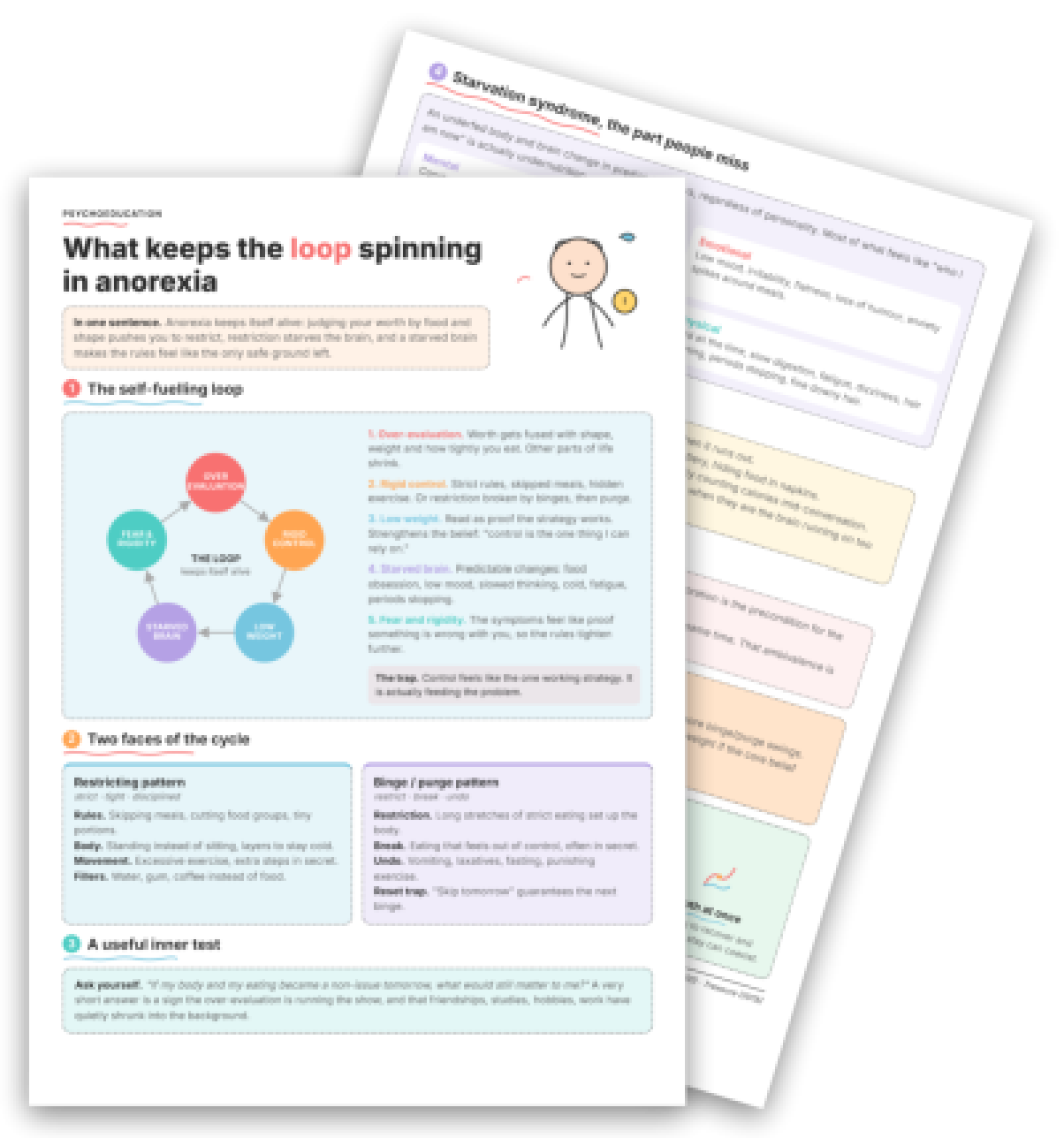
A visual psychoeducation tool helping clinicians explain the self-maintaining loop of anorexia nervosa in session, covering over-evaluation, starvation effects, and therapeutic ambivalence.
Clinical vignettes
Psychoeducation Shifts a Rigid Frame
Naming the Reset Trap in a Binge-Purge Pattern
Clinical picture. T., a 31-year-old man, described a pattern of strict daytime fasting followed by evening episodes of rapid, secretive eating and compensatory exercise; he attributed the eating episodes to moral failure rather than physiological rebound. The clinician used the two-faces section of the sheet to map T.'s week visually, showing how each day of restriction set the biological conditions for the evening break. T. recognised the reset trap as accurate to his experience, specifically the nightly plan to "skip tomorrow" that guaranteed the cycle continued. He remained ambivalent about change, yet agreed that framing the pattern as a self-fuelling loop, rather than a character flaw, was worth testing as a working hypothesis going forward.
In sessions with patients presenting anorexia nervosa, explaining the cognitive-behavioral maintenance model verbally tends to fall flat. The patient nods, yet the connection between over-evaluation of shape and weight and the starvation-driven rigidity that locks the disorder in place rarely clicks without a visual scaffold. This fiche PDF is built for exactly that moment: a structured psychoeducation support the clinician uses in session to make the loop visible, nameable, and discussable.
Use this resource with your patients
Handout, exercises and materials ready to use, right inside SessionFuel.
Why the CBT model of anorexia resists oral explanation
The core mechanism Fairburn (2008) describes is counterintuitive: the strategies the patient experiences as protective (restriction, rigid rules, hidden exercise) actively fuel the neurological and psychological conditions that make recovery feel impossible. Said verbally, this risks being heard as one more criticism of their coping. The concept of the starved brain is particularly hard to transmit without a diagram. Patients consistently attribute cognitive narrowing, obsessive food thoughts, affective flatness, and all-or-nothing thinking to their personality or a permanent defect, not to the predictable physiological consequences of undernutrition as documented in Keys (1950).
The over-evaluation itself is equally slippery at the oral level. Without a visual circuit showing the chain of consequences downstream, patients struggle to see the link between a self-worth fused to weight and shape and the tightening of behavioral control. What looks from the outside like a cluster of symptoms reads to the patient as separate, poorly managed behaviors, not as expressions of a single self-maintaining loop.
Therapeutic ambivalence compounds this further. A patient can verbally agree the loop exists while every part of their functioning works to protect it. The motivational discrepancy work that often follows is only possible once the model is genuinely internalized, not simply recited back.
What the fiche contains: a visual scaffold for the maintenance cycle
The fiche is organized around six panels that build the model progressively, grounded in Fairburn (2008) and Treasure (2015).
The opening panel renders the self-fuelling loop as a visual circuit with five labelled nodes: over-evaluation, rigid control, low weight, starved brain, and fear and rigidity, with arrows closing the circle. Seeing it diagrammed is, for many patients, the first moment the trap becomes legible: "Control feels like the one working strategy. It is actually feeding the problem."
The second panel distinguishes the two faces of the cycle side by side: the restricting pattern (strict rules, food group elimination, hidden exercise, fillers like gum and coffee) and the binge/purge pattern (restriction setting up the break, then undoing behaviors and the "reset trap" of skipping tomorrow). This layout helps you and the patient quickly identify which face is currently dominant, a clinically important distinction that patients often resist articulating without a concrete prompt. It connects directly to the separate work available in the CBT model of bulimia nervosa for patients who oscillate between both patterns.
A third panel offers a useful inner test: "If my body and my eating became a non-issue tomorrow, what would still matter to me?" A very short answer signals the degree to which the over-evaluation has contracted other life domains. You can use this prompt directly in session to open values clarification work.
The starvation syndrome panel is often the most therapeutically potent element of the fiche. It maps predictable consequences across four domains: mental (food obsession, narrowed focus, decisional paralysis), emotional (irritability, flatness, anxiety spikes around meals), social (avoidance, loss of interest in closeness), and physical (cold intolerance, fatigue, hair thinning, amenorrhea). Presenting these explicitly as undernutrition effects, not personality traits, directly addresses the self-blame and the low self-esteem dynamics that reinforce the disorder. It also creates an opening for discussing perfectionism co-occurrence, common in this presentation.
The closing section includes a "To discuss in session" prompt list and a four-point "Remember" summary (It's a loop / Not personality / Eating first / Both at once), giving you ready-made debrief anchors.
> Key takeaway: This fiche is a visual support that facilitates the explanation of the CBT model of anorexia nervosa in session. The clinician uses it as a shared reference during psychoeducation; it is not a self-administered questionnaire, but a tool for building a common vocabulary and leaving the patient with a portable, concrete map of the loop.
750+ clinical tools
A library built with and for clinicians, ready to use in session and extend between appointments.
Access all the toolsWhen and how to introduce the fiche in session
This tool fits best in the early psychoeducation phase, once the alliance is solid enough to name the disorder directly and the patient has some capacity for reflective engagement. For patients in acute medical compromise, the starvation syndrome panel serves as a lower-threat entry point: you are not yet asking them to challenge over-evaluation, only to recognize a documented list of physiological consequences visible in the anorexia signs checklist.
A useful introduction: "I'd like to show you a diagram of how this tends to keep itself going. We don't need to agree with all of it today. I just want us to have the same map." Framing it as a shared reference, not a verdict, lowers defensive reactivity. For patients who also meet criteria for BDD-adjacent body image distortion, the body dysmorphic disorder resource can complement the over-evaluation panel.
Debrief by asking which node of the loop feels most recognizable and which one they find least convincing. When the inner test prompt surfaces a very thin answer, that is your signal to move toward identifying what genuinely matters once weight restoration creates the cognitive space to do so.
The "Both at once" point in the "Remember" summary matters clinically. Naming ambivalence explicitly, rather than treating it as resistance, often preserves the alliance through the most destabilizing phases of refeeding. The fiche does not close the loop for the patient; it makes the loop visible enough, and consensual enough, to begin the work.
Use it with your patients
Share this tool in the mobile app and follow the work between sessions.
Sources
- Fairburn, C. G. (2008). Cognitive Behavior Therapy and Eating Disorders. Guilford Press.
- Keys, A., Brozek, J., Henschel, A., Mickelsen, O., Taylor, H. L. (1950). The Biology of Human Starvation (2 vols.). University of Minnesota Press.
- National Institute for Health and Care Excellence (NICE) (2017). Eating disorders: recognition and treatment (NICE guideline NG69).
Your session continues in your patients' pocket
Use with a patientYour resources, available everywhere
The handouts, exercises, programs and audios above: you choose which ones to make available to your patients, in the mobile app dedicated to them.
And far more than a library
The app goes well beyond resources, to support your patients every day:
Related categories
Explore other clinical resources by category.

Behaviours
Clinical hub for behaviors in therapy: worksheets and tools for coping, eating disorders, CBT formulation, and maladaptive behavioral patterns.

Understand
Clinical hub for the therapeutic aim 'Understand': worksheets and tools to build patient insight across CBT, ACT, schema therapy and more.

CBT
CBT worksheets, cognitive restructuring exercises & behavioral tools for clinicians. Evidence-based resources for every phase of cognitive behavioral therapy.

Anxiety
Clinical hub for anxiety disorders: CBT and ACT worksheets, psychoeducation sheets, and exercises for assessment and treatment across the anxiety spectrum.

Trauma
Clinical hub on trauma and PTSD: assessment, differential diagnosis, treatment phases, and printable resources for practitioners. 155 chars.

Mood
Evidence-based worksheets and clinical tools for mood disorders: CBT, ACT, and positive psychology resources for psychologists and therapists.