
Clinical picture. A., a 24-year-old woman referred after a brief medical admission for low weight, presented with marked shame and a fixed belief that her difficulties reflected personal weakness rather than illness. She had avoided previous treatment, convinced that "real" anorexia only occurred in adolescents and that her own pattern did not qualify. The clinician introduced the informational sheet in session, reading through the starvation-loop diagram together and pausing at the statement that restriction is maintained by neurobiological effects rather than by moral failure. A. was visibly quiet for a moment, then said she had not previously understood why her thinking felt so rigid when her weight dropped. This reframe did not resolve ambivalence, but it opened a conversation about treatment options that had not been possible in earlier contacts.
Anorexia Nervosa: PDF Worksheet, Tools and Exercises for Clinical Practice
A printable PDF worksheet with tools and exercises to support psychoeducation on anorexia nervosa, designed for clinicians to use directly in session.
Clinical vignettes
Psychoeducation Reducing Shame in AN
Engaging a Reluctant Partner in Psychoeducation
Clinical picture. T., a 38-year-old man with a long history of restrictive eating, attended an initial assessment accompanied by his partner at his own request. The partner held a persistent view that T. was choosing not to eat and that firmer pressure at mealtimes would help. The clinician used the sheet's section on the restriction-starvation loop to illustrate how cognitive rigidity is a downstream effect of under-nutrition rather than a pre-existing personality trait. The partner asked several practical questions, and the tone of the session shifted from blame toward shared problem-orientation. T. later reported that the conversation had reduced conflict at home during the first week, which he described as a small but meaningful change.
Explaining the maintenance loop of anorexia nervosa to a patient who is only partially engaged with treatment rarely works at the verbal level alone. The interaction between extreme beliefs, behavioural restriction, and the cognitive and emotional effects of starvation is counterintuitive, and most patients, especially early in the alliance, cannot hold it together in working memory from one sentence to the next. This PDF worksheet is built to carry that explanation visually, giving you a concrete anchor during the psychoeducation phase.
Use this resource with your patients
Handout, exercises and materials ready to use, right inside SessionFuel.
Why Anorexia Nervosa Resists Explanation in Session
The core clinical difficulty is ambivalence, in the full motivational interviewing sense. The patient who sits in front of you may intellectually acknowledge that something is wrong while still experiencing restriction as functional, as a source of safety and self-worth. Oral explanations land on that ambivalence and tend to bounce off.
A second difficulty is the starvation effect on cognition itself. An under-nourished brain is more concrete, more fearful, and less able to tolerate uncertainty, which makes abstract reformulations feel immediately threatening rather than illuminating. What patients often hear in a verbal explanation is not a model of their disorder; they hear an invitation to give up their only reliable coping mechanism.
Third, the standard nosographic framing, focusing on weight thresholds and eating behaviours, misses what most patients actually experience: a system of meaning, where thinness is safety, control is self-worth, and any loosening of the rules feels catastrophic. Without naming that meaning system explicitly, psychoeducation remains external to the patient's lived experience.
What the Fiche Contains: A Visual Support for the Maintenance Loop
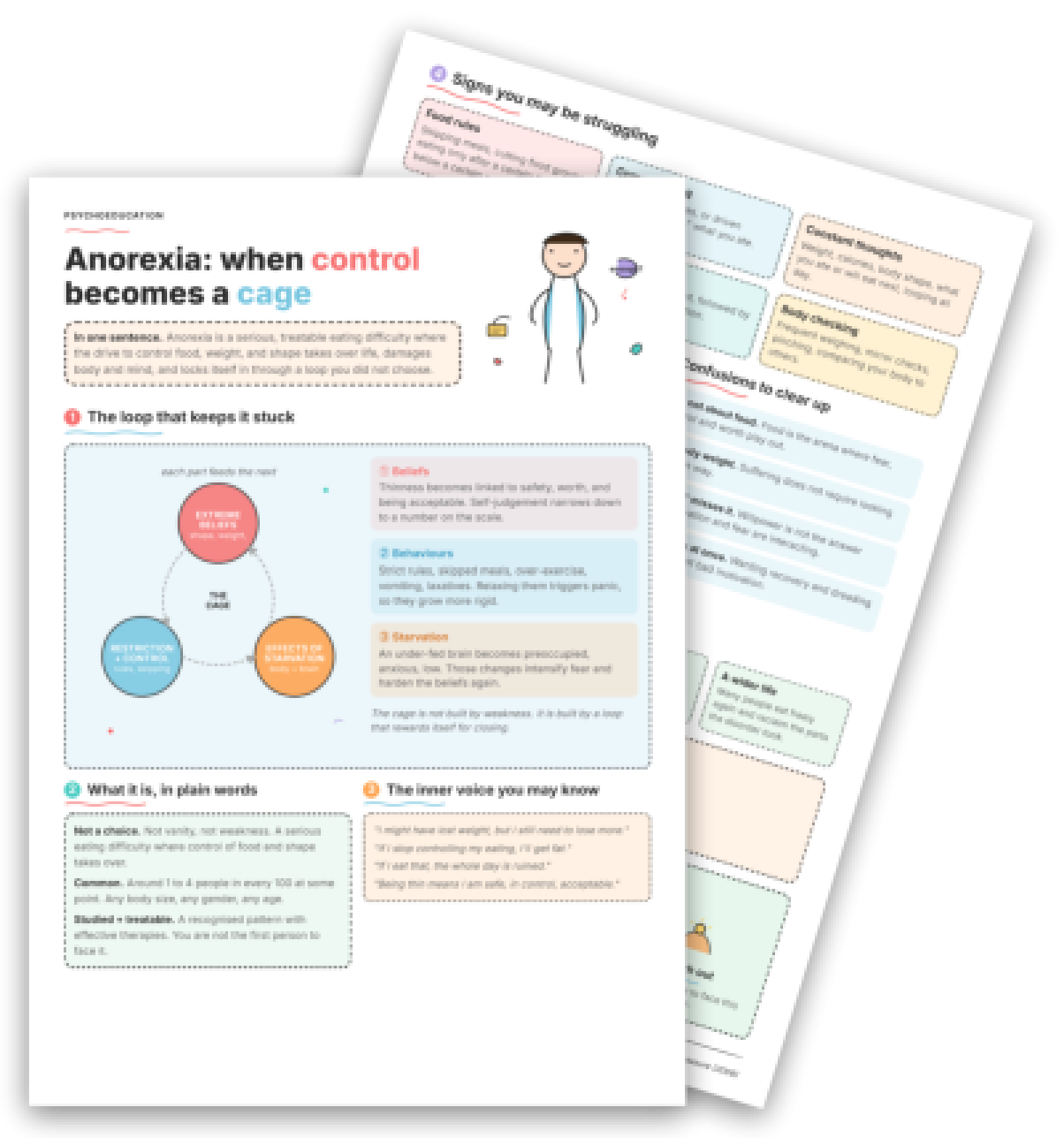
The fiche opens with a diagram of the maintaining loop, labelled "the cage," that maps three interlocking nodes: extreme beliefs (thinness linked to safety, worth, and acceptability), restriction and control behaviours (rigid food rules, over-exercise, compensatory behaviours), and the effects of starvation on body and brain. A caption makes the mechanism explicit: "each part feeds the next." This visual does something that oral explanation rarely achieves: it shows the patient that starvation does not solve the fear, it amplifies it, closing the loop tighter.
From there, the fiche moves through seven structured panels. Panel 2 reframes the disorder in plain language, directly countering common attributions to vanity or weak will, and normalises its prevalence. Panel 3 presents characteristic ego-syntonic cognitions verbatim, including "If I stop controlling my eating, I'll get fat" and "Being thin means I am safe", which serve as recognition prompts rather than assessments. Panel 4 lists six behavioural and cognitive signs, from food rules and compensatory behaviours to body-checking and social withdrawal. Panel 5 details what starvation concretely does to mood, digestion, concentration, and fear levels, grounding the loop diagram in physiological reality.
For clinicians working alongside the Cognitive Behavioral Model of Anorexia Nervosa or the Transdiagnostic CBT Model of Eating Disorders, the fiche's framing maps cleanly onto those frameworks without imposing a technical vocabulary on the patient. The Starvation Syndrome resource and the Eating and Your Energy Levels worksheet are natural complements for deepening this section.
> Key point: The fiche is a visual support that facilitates the explanation of anorexia's maintenance loop in session; it is not a self-administered questionnaire, but a shared reference point the clinician uses to anchor psychoeducation and leave the patient with something concrete to return to between appointments.
Panel 6 addresses common misconceptions directly, including the idea that "just eating" solves it and the normalisation of simultaneous recovery-desire and recovery-dread. Panel 7 briefly maps evidence-based treatment pathways (CBT-ED, family-based treatment, medical stabilisation) and closes with three phrases to hold onto, oriented toward loosening the rules rather than abandoning safety.
750+ clinical tools
A library built with and for clinicians, ready to use in session and extend between appointments.
Access all the toolsWhen and How to Propose It
This fiche fits best in the early-to-middle psychoeducation phase, once a sufficient working alliance is established, typically from the second or third session onward. It is particularly suited to patients who intellectualise or deflect, those with prominent ego-syntonic restriction, and contexts where the patient or their family is still framing the problem in terms of willpower or vanity.
For patients with comorbid perfectionism or low self-esteem, the beliefs section often resonates beyond the eating domain and can open a productive reframe. When working with adolescents or in family-based contexts, the Anorexia signs checklist and the Recognizing Anorexia Nervosa worksheet provide useful pre-session or family psychoeducation. For differential work, the Bulimia Nervosa resource and the Binge Eating Disorder worksheet are natural companions.
Introduce it without over-framing: "I want to show you a diagram that might make sense of some of what you're describing, not to label it, just so we can look at the same thing together." After working through the loop visually, debriefing the recognition prompts in Panel 3 is often the most clinically generative step. Ask which sentences the patient recognises, not which ones apply. That distinction keeps the patient in an observing rather than a defending position.
Where ambivalence is pronounced, combining the fiche with Motivation and Ambivalence or Building Discrepancy tools sharpens the motivational component without forcing premature commitment to change.
The fiche does not replace case formulation or the therapeutic relationship. What it does is give both clinician and patient a shared visual language for the loop, which is often the first step toward the patient genuinely seeing the disorder as a system rather than as part of who they are.
Use it with your patients
Share this tool in the mobile app and follow the work between sessions.
Sources
- American Psychiatric Association (2013). Diagnostic and Statistical Manual of Mental Disorders, Fifth Edition (DSM-5). American Psychiatric Publishing.
- National Institute for Health and Care Excellence (NICE) (2017). Eating disorders: recognition and treatment (NICE guideline NG69). NICE.
- Keys, A., Brozek, J., Henschel, A., Mickelsen, O., & Taylor, H. L. (1950). The Biology of Human Starvation. University of Minnesota Press.
Your session continues in your patients' pocket
Use with a patientYour resources, available everywhere
The handouts, exercises, programs and audios above: you choose which ones to make available to your patients, in the mobile app dedicated to them.
And far more than a library
The app goes well beyond resources, to support your patients every day:
Related categories
Explore other clinical resources by category.

Behaviours
Clinical hub for behaviors in therapy: worksheets and tools for coping, eating disorders, CBT formulation, and maladaptive behavioral patterns.

Understand
Clinical hub for the therapeutic aim 'Understand': worksheets and tools to build patient insight across CBT, ACT, schema therapy and more.

CBT
CBT worksheets, cognitive restructuring exercises & behavioral tools for clinicians. Evidence-based resources for every phase of cognitive behavioral therapy.

Anxiety
Clinical hub for anxiety disorders: CBT and ACT worksheets, psychoeducation sheets, and exercises for assessment and treatment across the anxiety spectrum.

Trauma
Clinical hub on trauma and PTSD: assessment, differential diagnosis, treatment phases, and printable resources for practitioners. 155 chars.

Mood
Evidence-based worksheets and clinical tools for mood disorders: CBT, ACT, and positive psychology resources for psychologists and therapists.