
Clinical picture. L., a 28-year-old graduate student, presented after six years of bingeing and self-induced vomiting, reporting she had never disclosed this to anyone because she assumed it reflected a personal failing. She described functioning well professionally, which she felt made her symptoms harder to take seriously. The clinician introduced the psychoeducation handout on bulimia in the second session, walking through the five-step cycle and emphasising that restriction, not a deficit of willpower, drives the binge. L. identified immediately with the "rules to pressure to binge" sequence, stating it was the first time the behaviour made sense to her as a mechanism rather than a moral lapse. This reframe did not resolve symptoms, but it reduced enough shame for her to engage more openly in subsequent sessions.
What Is Bulimia? PDF Worksheet, Tools and Exercises
A printable psychoeducation handout to explain bulimia's cycle and mechanisms clearly in session, with tools and exercises for clinical practice.
Clinical vignettes
Naming the Loop, Reducing Shame
Overvaluation of Shape as Entry Point
Clinical picture. M., a 34-year-old man, was referred following a GP visit where low potassium had raised clinical concern; he had not volunteered information about compensatory behaviours. When the clinician introduced the informational sheet, M. was initially dismissive, associating bulimia with a demographic he did not identify with. Reading the section on overvaluation of weight and shape aloud together, he recognised the belief that his professional credibility depended on his physical appearance, a connection he had not previously articulated. The handout gave the clinician a concrete map to return to across sessions, anchoring psychoeducation to a specific cognitive mechanism rather than general symptom description. M. agreed to self-monitoring as a next step, which he had refused at intake.
Explaining bulimia in session raises a particular challenge: patients who have lived with the disorder for years often have a deeply distorted understanding of what drives it. They attribute the cycle to weak willpower, not to a predictable mechanism. This fiche PDF serves as a visual anchor to shift that framing in one conversation, freeing up the rest of the session for clinical work rather than conceptual repair.
Use this resource with your patients
Handout, exercises and materials ready to use, right inside SessionFuel.
Why Bulimia Is Hard to Explain Without a Visual Support
The core difficulty is not patient resistance; it is the paradoxical logic of the disorder. Restriction causes bingeing, not the other way around. Yet most patients arrive convinced that they just need more control over eating, the very variable perpetuating the loop. Saying this aloud rarely lands: the patient nods, then carries on restricting.
Overvaluation of shape and weight is the other piece that slips through in purely verbal explanations. Patients know they care about their body, but they rarely see how completely self-worth has collapsed onto a single variable. Without a visual frame, the clinician spends the session explaining a concept that the patient is simultaneously demonstrating, but not seeing.
A further complication: purging as a permission slip. The belief that compensatory behaviour undoes a binge does not yield to rational argument alone. Patients need to see the mechanism mapped before they can begin to hold it critically.
> To note: this fiche is a visual support that facilitates the explanation of bulimia in session. It is not a questionnaire to hand the patient alone; it is a psychoeducation tool the clinician uses alongside the patient to make the cycle legible, establish a shared vocabulary, and leave a concrete reference to take home.
What the Handout Contains
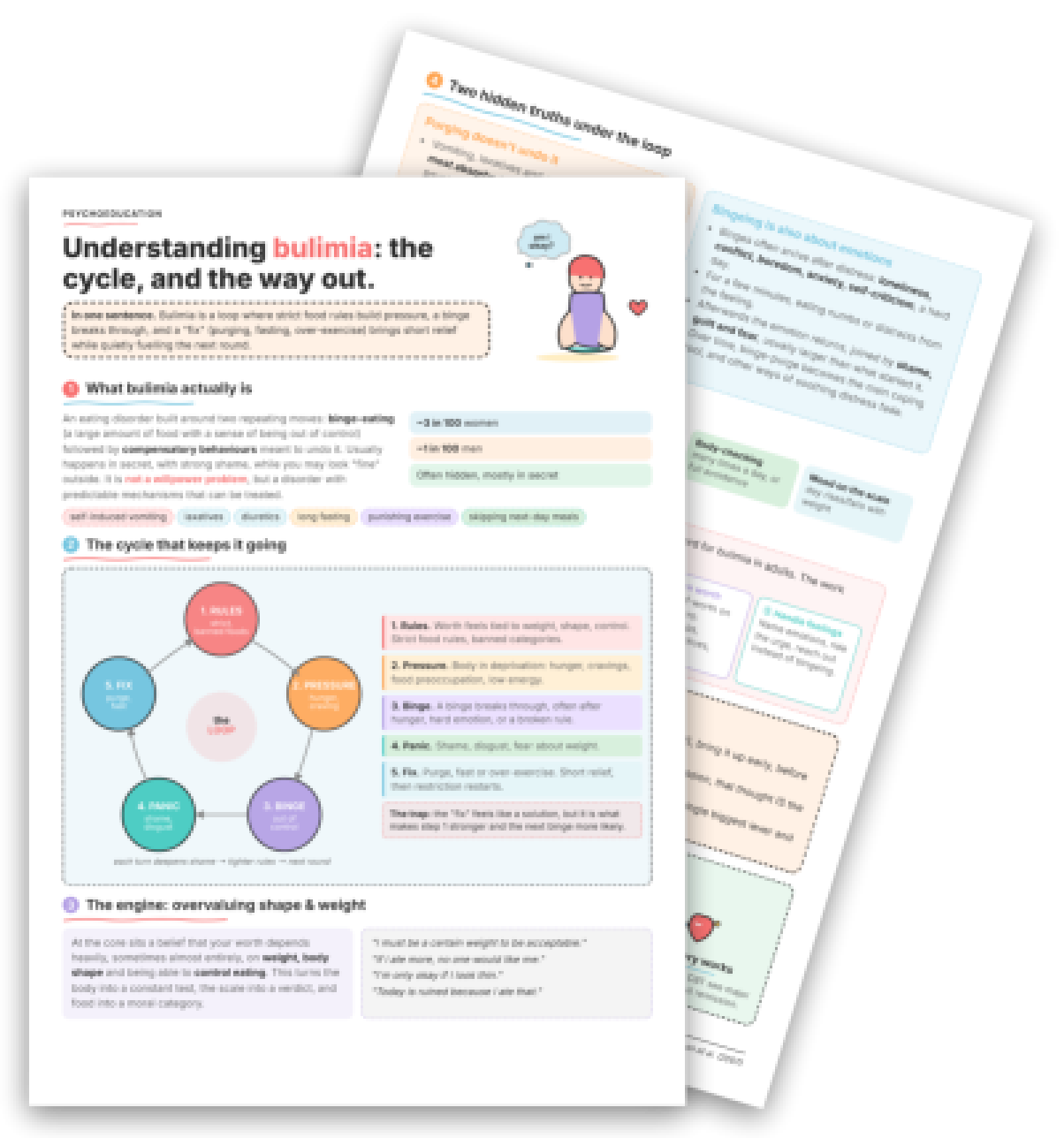
The fiche is built around six numbered panels. The centrepiece is a five-step loop diagram (labelled "the LOOP") mapping the full maintenance cycle: Rules → Pressure → Binge → Panic → Fix, with the explicit caption "each turn deepens shame → tighter rules → next round." Seeing this rendered visually does something a verbal description cannot: it externalises the cycle, making the patient an observer of a mechanism rather than a person defined by their eating.
Panel 1 grounds the disorder factually, including prevalence data and a list of compensatory behaviours, countering the secrecy and isolation typical of the presentation. Panel 3 maps the core cognitive driver with four verbatim belief examples: "I must be a certain weight to be acceptable", "Today is ruined because I ate that". These samples often function as recognition moments in session.
Panel 4 is particularly useful for the purging psychoeducation conversation: it unpacks, in plain language, why vomiting and laxatives do not undo absorbed calories and why they intensify subsequent hunger, then addresses the emotional function of bingeing (loneliness, conflict, boredom, self-criticism as frequent antecedents). Panel 6 outlines a five-block recovery model grounded in Fairburn's transdiagnostic CBT approach: monitoring, regular eating, rule-loosening, broadening worth, and emotion-handling. A "To discuss in session" section closes the handout with three concrete prompts the patient is asked to raise in the next appointment, extending the psychoeducation into the therapeutic alliance.
For the cycle diagram specifically, you may want to use this alongside the CBT Model of Bulimia Nervosa at a subsequent stage, once the patient has a working model of the maintenance loop.
750+ clinical tools
A library built with and for clinicians, ready to use in session and extend between appointments.
Access all the toolsWhen and How to Introduce This Handout
The fiche fits naturally after initial anamnesis, once the clinical picture is established, but before formulation work begins. For patients still ambivalent about their diagnosis, presenting it as "a map of how this tends to work for most people, let's see if it fits your experience" avoids labelling while opening the formulation space.
It is particularly well-suited to patients who present with perfectionism or unrelenting standards, where worth-contingency is a prominent maintaining factor, and to those in whom you suspect low self-esteem is driving the shape-overvaluation. For younger patients or adolescent presentations, the section on binge eating disorder may need separate clarification alongside this fiche.
Walk through the loop diagram together, panel by panel, inviting the patient to annotate their own version: which foods are banned, what the pressure feels like, what precedes a binge. The "To discuss in session" prompts serve as a debrief structure for the following appointment. When regular eating (three meals and two to three snacks daily) is introduced in Panel 6, pair it with the handout on eating and energy levels to make the biological rationale concrete.
One contraindication: in acute medical presentations with electrolyte imbalance or significant purging frequency, the starvation syndrome handout may need to precede this one, keeping the first session grounded in physical stabilisation rather than cognitive cycle work.
The fiche does not replace the CBT transdiagnostic model or a full recognising bulimia nervosa checklist used earlier in assessment. It sits between assessment and active treatment: a psychoeducation tool that makes the mechanism visible, gives the patient a vocabulary, and starts the work of externalising a cycle they have been living inside, often for years.
Use it with your patients
Share this tool in the mobile app and follow the work between sessions.
Sources
- Fairburn, C. G. (2013). Overcoming Binge Eating: The Proven Program to Learn Why You Binge and How You Can Stop (2nd ed.). Guilford Press.
- Fairburn, C. G. (2008). Cognitive Behavior Therapy and Eating Disorders. Guilford Press.
- National Institute for Health and Care Excellence (NICE) (2017). Eating Disorders: Recognition and Treatment (NG69).
- American Psychiatric Association (2013). Diagnostic and Statistical Manual of Mental Disorders, Fifth Edition (DSM-5). American Psychiatric Publishing.
Your session continues in your patients' pocket
Use with a patientYour resources, available everywhere
The handouts, exercises, programs and audios above: you choose which ones to make available to your patients, in the mobile app dedicated to them.
And far more than a library
The app goes well beyond resources, to support your patients every day:
Related categories
Explore other clinical resources by category.

Behaviours
Clinical hub for behaviors in therapy: worksheets and tools for coping, eating disorders, CBT formulation, and maladaptive behavioral patterns.

Understand
Clinical hub for the therapeutic aim 'Understand': worksheets and tools to build patient insight across CBT, ACT, schema therapy and more.

CBT
CBT worksheets, cognitive restructuring exercises & behavioral tools for clinicians. Evidence-based resources for every phase of cognitive behavioral therapy.

Anxiety
Clinical hub for anxiety disorders: CBT and ACT worksheets, psychoeducation sheets, and exercises for assessment and treatment across the anxiety spectrum.

Trauma
Clinical hub on trauma and PTSD: assessment, differential diagnosis, treatment phases, and printable resources for practitioners. 155 chars.

Mood
Evidence-based worksheets and clinical tools for mood disorders: CBT, ACT, and positive psychology resources for psychologists and therapists.