
Clinical picture. A. is a 24-year-old woman referred for bulimia nervosa, averaging five to six binge-purge episodes per week. She described her binges as evidence of poor willpower and resisted the idea that food restriction played any role, as she believed she was eating "enough" through two small meals a day with no carbohydrates. The clinician introduced the informational sheet on eating and energy levels during a session, walking through the three daily-energy profiles and the semi-starvation symptom list; A. identified cold hands, persistent food preoccupation, and low mood as daily experiences she had attributed to anxiety rather than low fuel. She agreed to trial a structured pattern of three meals and two snacks over the following week, primarily to test the hypothesis rather than as a committed change. At review, she reported two binge episodes and noted, with some surprise, that hunger pressure had been markedly lower on days when she had kept to the rhythm.
Eating and Your Energy Levels: PDF Worksheet, Tools and Exercises
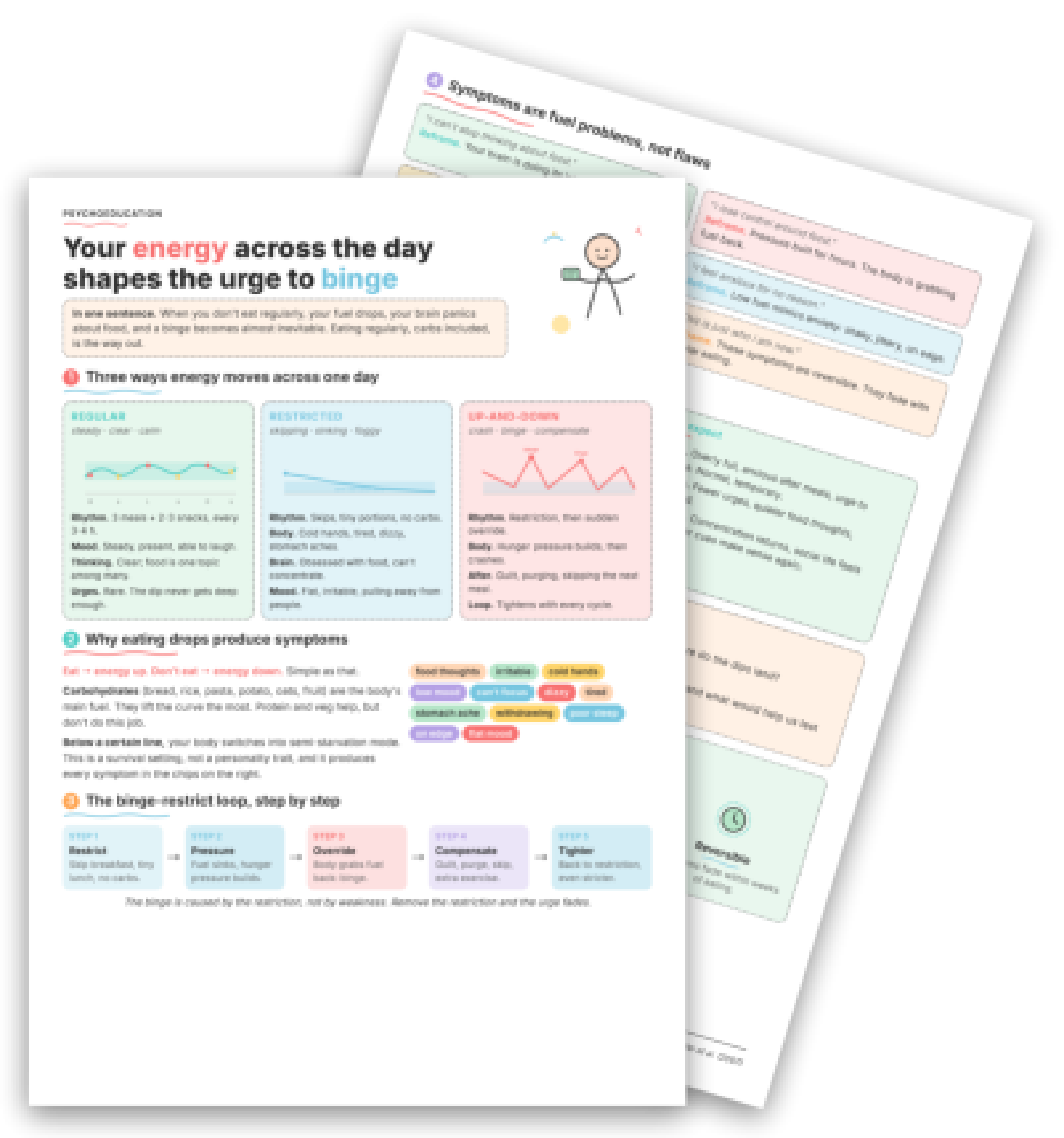
A visual psychoeducation sheet helping clinicians explain the restrict-binge cycle, semi-starvation symptoms, and regular eating, clearly, in session.
Clinical vignettes
Reframing Binges as Fuel Deficits
Normalising Carbohydrate Intake in Restriction
Clinical picture. T. is a 31-year-old man in outpatient treatment for an eating disorder with prominent dietary restriction, who presented with significant difficulty accepting any therapeutic rationale for reintroducing carbohydrates. During a psychoeducation session, the clinician used the sheet to explain the physiological basis of the binge-restrict cycle, focusing specifically on the role of carbohydrates as the primary fuel source and on the concept of semi-starvation mode as a survival mechanism rather than a personal failing. T. found the framing that "the binge is caused by the restriction, not by weakness" meaningful enough to record in his own words. He remained cautious about behavioural change, but subsequent sessions showed a modest reduction in the cognitive rigidity around carbohydrate avoidance, which the treatment team considered a workable starting point for exposure work.
Patients caught in the restrict-binge cycle rarely arrive with a coherent narrative about what is happening physiologically. They arrive with shame. Explaining the neurobiological and metabolic logic of that cycle verbally, in session, tends to produce polite agreement followed by no change in eating behaviour. This PDF worksheet gives you a visual architecture for that conversation, one the patient can take home.
Use this resource with your patients
Handout, exercises and materials ready to use, right inside SessionFuel.
Why the restrict-binge cycle is so hard to explain verbally
The central obstacle is moral attribution. Patients experiencing binge episodes almost universally attribute them to weakness, greed, or emotional dysregulation, a framing that intensifies guilt and tightens restriction in the next cycle. Oral psychoeducation alone rarely dislodges this attribution, because the words disappear as soon as shame re-enters the room.
A second obstacle is the symptom cluster. Cold hands, low mood, poor concentration, food preoccupation, social withdrawal: these symptoms arrive as a confusing, seemingly unrelated set of personal failings. Patients following all-or-nothing thinking patterns around food are especially prone to reading them as evidence of defectiveness rather than as signals of a fuel deficit. Without a single organising framework, the symptom list stays fragmented and self-incriminating.
750+ clinical tools
A library built with and for clinicians, ready to use in session and extend between appointments.
Access all the toolsWhat the fiche contains and what the visual layout achieves
The fiche is structured as five numbered panels, designed to be walked through together during a session, not completed independently by the patient.
Panel 1 presents three energy curves across a day, Regular, Restricted, and Up-and-Down, each with its associated rhythm, mood, cognition, and urge pattern. Seeing all three curves side by side is something no oral explanation replicates: the patient can immediately locate their own pattern without the clinician having to name it first.
Panel 2 introduces the semi-starvation concept as a physiological switch, not a moral category. The fiche names carbohydrates explicitly as the primary fuel source and lists the resulting symptom cluster visually: food thoughts, irritable, cold hands, low mood, can't focus, dizzy, tired, stomach ache, withdrawing, poor sleep, on edge, flat mood. Having this list printed in front of the patient externalises the symptom set and makes it discussable without defensiveness.
Panel 3 maps the five-step binge-restrict loop in sequence, culminating in the reframe the fiche states plainly: "The binge is caused by the restriction, not by weakness." That single sentence, visible on paper, tends to do more therapeutic work than any amount of verbal explanation.
Panel 4 presents six common self-critical statements ("I can't stop thinking about food," "I lose control around food") alongside a direct cognitive reframe for each: the brain scanning for fuel, pressure building over hours. This is a ready-made cognitive restructuring scaffold that you can use directly or expand in session.
Panel 5 specifies what regular eating actually looks like operationally: three meals plus two to three snacks, carbohydrates at each, eating by the clock rather than hunger signals, and eating after a binge to prevent restarting the loop.
> Key point: this fiche is a visual support for psychoeducation in session, not a self-monitoring form the patient fills in alone. Its value lies in giving the clinician a shared reference point and leaving the patient with a concrete, portable reframe after the appointment.
The fiche closes with three session discussion prompts, including: "When you map your last 24 hours, which of the three curves fits best, and where do the dips land?" This is a natural debrief anchor you can use immediately after introducing the sheet.
Use it with your patients
Share this tool in the mobile app and follow the work between sessions.
When and how to introduce this worksheet
This fiche is most useful in the early psychoeducation phase of work with patients presenting with bulimia nervosa, subclinical binge-restrict patterns, or significant dietary restriction. It pairs directly with the CBT model of bulimia nervosa and complements the anorexia nervosa CBT framework when energy dysregulation is part of the presentation.
Introduce it without diagnostic labelling: "I'd like to show you something about how fuel and eating rhythms affect the body and brain, it might help us make sense of some of what you've been describing." This framing sidesteps resistance and positions the fiche as explanatory rather than prescriptive.
For patients with maladaptive coping strategies organised around restriction as control, move slowly through Panel 5. The instruction to eat even after a binge will require explicit discussion, not just reading. For adolescent presentations, Panel 1's three-curve visual is often the most accessible entry point, and you can pair it with anxiety psychoeducation if hypervigilance around food is driving avoidance.
One limit worth naming: the fiche covers the physiological and cognitive layer of the cycle, not the relational or schema-level drivers. For patients with defectiveness-shame schemas intertwined with eating behaviour, this sheet is a first step, not a complete formulation. Use it to build a shared vocabulary, then let that vocabulary carry into deeper work.
The fiche does not replace clinical judgment about medical risk, but it gives patients a rigorous, non-shaming account of what their body is doing, and that account, in print, is often what finally makes regular eating feel worth attempting.
Your session continues in your patients' pocket
Use with a patientYour resources, available everywhere
The handouts, exercises, programs and audios above: you choose which ones to make available to your patients, in the mobile app dedicated to them.
And far more than a library
The app goes well beyond resources, to support your patients every day:
Related categories
Explore other clinical resources by category.

Behaviours
Clinical hub for behaviors in therapy: worksheets and tools for coping, eating disorders, CBT formulation, and maladaptive behavioral patterns.

Understand
Clinical hub for the therapeutic aim 'Understand': worksheets and tools to build patient insight across CBT, ACT, schema therapy and more.

CBT
CBT worksheets, cognitive restructuring exercises & behavioral tools for clinicians. Evidence-based resources for every phase of cognitive behavioral therapy.

Anxiety
Clinical hub for anxiety disorders: CBT and ACT worksheets, psychoeducation sheets, and exercises for assessment and treatment across the anxiety spectrum.

Trauma
Clinical hub on trauma and PTSD: assessment, differential diagnosis, treatment phases, and printable resources for practitioners. 155 chars.

Mood
Evidence-based worksheets and clinical tools for mood disorders: CBT, ACT, and positive psychology resources for psychologists and therapists.