
Clinical picture. T., a woman in her late twenties, presented with a several-year history of bulimia nervosa and expressed frustration that she could not identify a single cause for her episodes. She described feeling stuck because she had "no real trauma to point to." The clinician introduced the four-petal model during session, framing the work as locating the current fuel rather than reconstructing the ignition. T. quickly recognized her own sequence: a skipped lunch, a rigid rule about dinner portions, a binge that evening, and vomiting that she described as "resetting the counter." Identifying purging as the petal that granted permission for the next binge shifted her focus from self-blame to a specific behavioral target, and she agreed to trial delaying purging by ten minutes as a first interruption point.
What Keeps Bulimia Going: PDF Worksheet, Tools and Exercises
A visual psychoeducation PDF worksheet to map the four maintaining loops of bulimia nervosa and use them as concrete levers for change in CBT practice.
Clinical vignettes
Naming the Loop, Not the Origin
Self-Worth, Rules, and the What-the-Hell Effect
Clinical picture. M., a man in his early thirties, initially described his binge episodes as random and uncontrollable. A structured review of the preceding 48 hours consistently revealed a common antecedent: weighing himself in the morning and interpreting any upward fluctuation as evidence of personal failure. The clinician used the worksheet to map how that belief directly generated a stricter eating rule for the day, which built hunger pressure by mid-afternoon and reliably broke down under the what-the-hell effect by evening. M. had not previously connected the morning weigh-in to the evening binge, and he found the four-petal diagram useful as a non-shaming account of the pattern. He agreed to remove the bathroom scale for two weeks as a low-threshold way to interrupt petal one without needing to address all four loops simultaneously.
Patients with bulimia often arrive with a degree of self-awareness about their binge-purge cycle, yet that awareness changes very little. The clinical challenge is not information; it is making the self-perpetuating structure of the disorder visible enough to actually interrupt. This PDF worksheet gives that structure a concrete, portable form.
Use this resource with your patients
Handout, exercises and materials ready to use, right inside SessionFuel.
Why the maintaining loops of bulimia resist verbal explanation
Bulimia nervosa is, from a CBT standpoint, four reinforcing loops rather than one. Patients understand this abstractly when you name it. What they typically miss, and what verbal explanation alone rarely conveys, is the reciprocal quality: each loop fuels the others, so the cycle repairs itself even when one element weakens temporarily. Patients who intellectually grasp the restriction-binge connection will still purge, because the purging loop operates on its own permission-granting logic: "I'll just get rid of it." That secondary logic does not surface in a spoken explanation unless you slow the cycle down visually and point to it directly.
A second obstacle is the worth-equals-weight petal. When self-worth is organised almost entirely around shape and weight, all-or-nothing thinking around food rules becomes structurally overdetermined; patients do not experience it as a cognitive distortion but as a simple reality. Naming that dynamic in session requires a shared diagram, not a lecture. Without a visual anchor, patients tend to nod and then re-enter the loop unchanged.
What the fiche contains: a four-petal model as a session tool
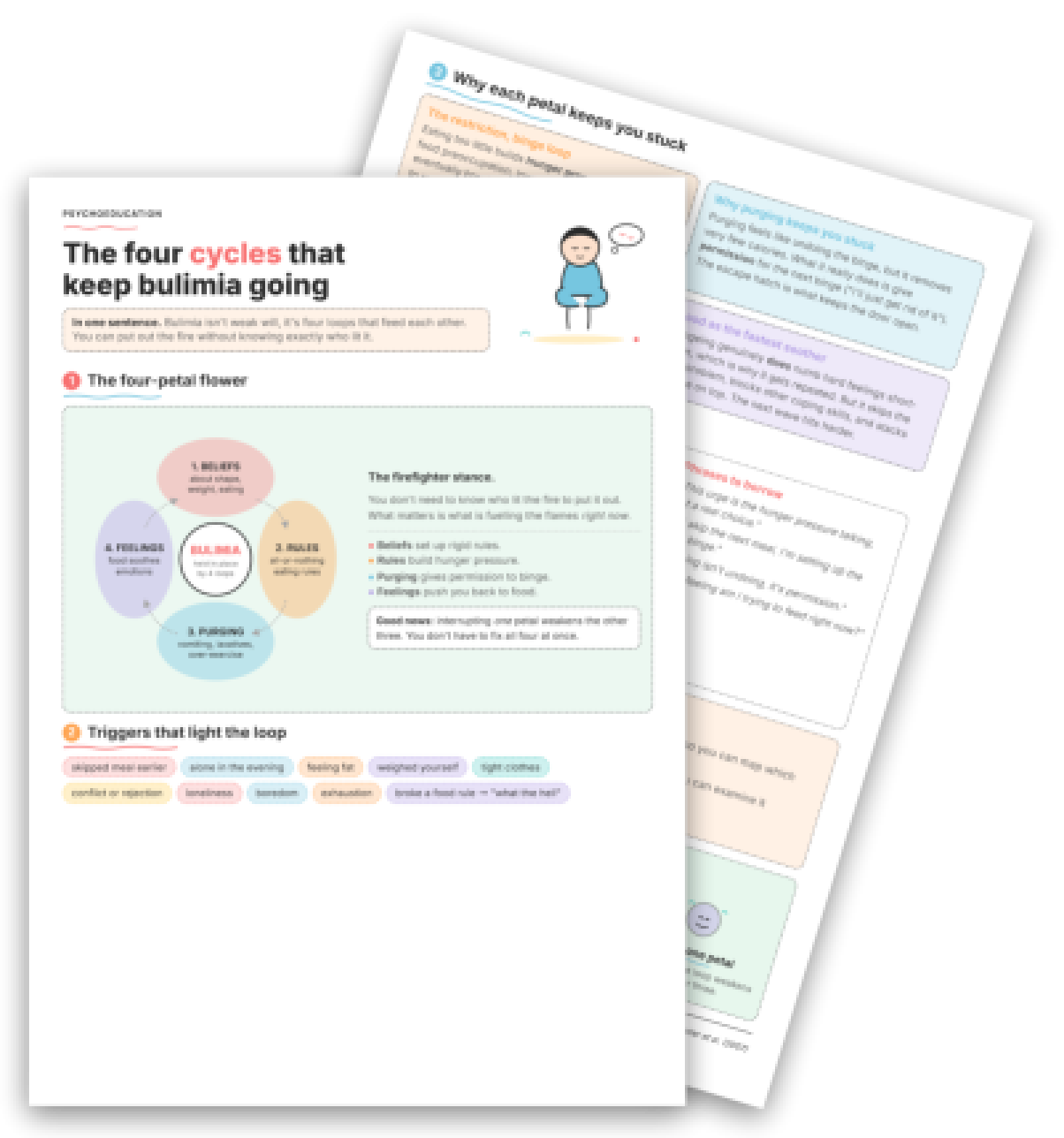
The fiche is structured across four numbered panels, each doing a distinct psychoeducational job. The opening panel introduces the four-petal flower: beliefs about shape and weight, all-or-nothing eating rules, purging behaviours, and food as emotional soother. The line "Good news: interrupting one petal weakens the other three" is placed there deliberately; it reframes the model from overwhelming to tractable before the patient has even read the mechanism explanations.
Panel two lists common triggers organised in plain language: skipped meal, feeling fat, weighed yourself, conflict or rejection, broke a food rule followed by the classic "what the hell" escalation. You can point to these with the patient and ask which ones lit up most recently, without requiring the patient to generate the vocabulary themselves.
Panel three walks through each petal mechanistically, including a precise framing of why purging maintains rather than cancels: "The escape hatch is what keeps the door open." This single sentence does work that several minutes of oral explanation often cannot, because the visual layout holds the patient's attention on the paradox. Alongside this, the fiche addresses the starvation syndrome dynamics that fuel the restriction-binge loop, grounding hunger pressure in physiology rather than moral failure.
Panel four maps where the cycle can break, ranked by clinical leverage. Regular eating (three meals plus two snacks, regardless of the previous binge or purge) is listed first and explicitly marked as the strongest lever. Clinicians familiar with the Fairburn protocol will recognise this sequencing immediately. The closing section, "To discuss in session," provides the patient with three concrete prompts to bring back next appointment, keeping the fiche as an active clinical bridge rather than an inert handout.
> Key point: this is a visual psychoeducation tool for the clinician to use with the patient during session, not a self-completion questionnaire. The four-petal diagram makes the reciprocal maintaining structure of bulimia concrete in a way that spoken formulation rarely achieves, and it leaves the patient with a physical reference point between appointments.
750+ clinical tools
A library built with and for clinicians, ready to use in session and extend between appointments.
Access all the toolsWhen and how to introduce the fiche
This worksheet fits best in early-to-mid formulation work, once the initial assessment is complete and the therapeutic alliance is established. Introducing it before the patient has articulated the cycle in their own words risks feeling premature; introducing it much later misses its primary utility as a shared map.
A low-inference framing works well for most patients: "I'd like to show you a diagram that captures what keeps this going structurally. It's not about willpower; it's about four loops that reinforce each other. Let's look at it together and see which ones feel most familiar." For patients with low self-esteem organised heavily around body image, the explicit "not a moral failing" messaging at the top of the fiche deserves a deliberate pause.
The fiche pairs directly with the more detailed CBT model of bulimia nervosa for clinicians who want a mechanistic formulation diagram alongside the psychoeducation sheet. When binge eating is a primary feature without purging, Binge Eating Disorder materials warrant separate consideration. For patients further along in treatment, lapse and relapse management and urge surfing resources pick up naturally where this fiche's lever section ends.
Debriefing the fiche at the following session around the "To discuss in session" prompts keeps the work grounded: which petal lit up first this week, what thought preceded the purge, which meal felt impossible to plan. When the pattern fits a broader transdiagnostic eating disorder picture, the fiche also articulates naturally with What Keeps Anorexia Going for patients moving between restrictive and bulimic presentations. The fiche does not replace the formulation work; it makes the formulation visible.
Use it with your patients
Share this tool in the mobile app and follow the work between sessions.
Sources
- Fairburn, C. G. (2008). Cognitive Behavior Therapy and Eating Disorders. Guilford Press.
- Fairburn, C. G. (2013). Overcoming Binge Eating (2nd ed.). Guilford Press.
- Waller, G., Cordery, H., Corstorphine, E., Hinrichsen, H., Lawson, R., Mountford, V., & Russell, K. (2007). Cognitive Behavioral Therapy for Eating Disorders: A Comprehensive Treatment Guide. Cambridge University Press.
- Waller, G., Mountford, V., Lawson, R., Gray, E., Cordery, H., & Hinrichsen, H. (2010). Beating Your Eating Disorder: A Cognitive-Behavioral Self-Help Guide for Adult Sufferers and their Carers. Cambridge University Press.
- National Institute for Health and Care Excellence (NICE) (2017). Eating Disorders: Recognition and Treatment (NG69).
Your session continues in your patients' pocket
Use with a patientYour resources, available everywhere
The handouts, exercises, programs and audios above: you choose which ones to make available to your patients, in the mobile app dedicated to them.
And far more than a library
The app goes well beyond resources, to support your patients every day:
Related categories
Explore other clinical resources by category.

Behaviours
Clinical hub for behaviors in therapy: worksheets and tools for coping, eating disorders, CBT formulation, and maladaptive behavioral patterns.

Understand
Clinical hub for the therapeutic aim 'Understand': worksheets and tools to build patient insight across CBT, ACT, schema therapy and more.

CBT
CBT worksheets, cognitive restructuring exercises & behavioral tools for clinicians. Evidence-based resources for every phase of cognitive behavioral therapy.

Anxiety
Clinical hub for anxiety disorders: CBT and ACT worksheets, psychoeducation sheets, and exercises for assessment and treatment across the anxiety spectrum.

Trauma
Clinical hub on trauma and PTSD: assessment, differential diagnosis, treatment phases, and printable resources for practitioners. 155 chars.

Mood
Evidence-based worksheets and clinical tools for mood disorders: CBT, ACT, and positive psychology resources for psychologists and therapists.