
Clinical picture. A., a woman in her late thirties, presents with persistent health anxiety centred on cardiac sensations. Each time she notices a skipped beat, she checks her pulse, seeks reassurance from her partner, and avoids physical exertion. The clinician introduces the vicious-cycle worksheet in session three, asking A. to fill in the three nodes herself: the triggering sensation, her checking and avoidance responses, and the two-timescale consequences. A. completes the diagram and pauses at the return arrow, observing aloud that the short-term relief from reassurance is precisely what prevents her from learning that the sensation is benign. By the end of the session she has identified the reassurance-seeking arrow as the point she is most willing to target first, which gives the subsequent exposure work a concrete rationale rather than an abstract instruction.
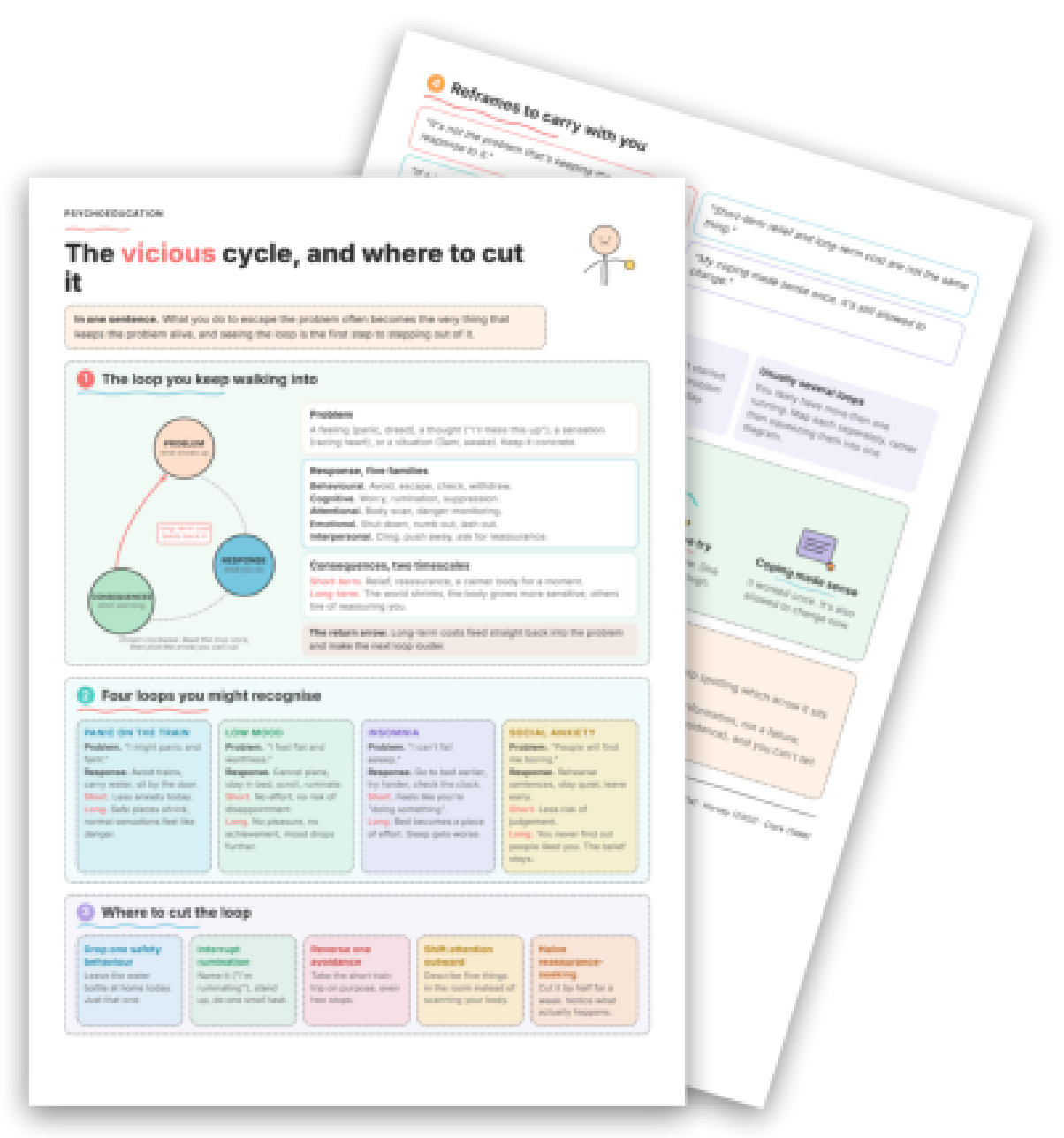
Vicious Cycle: Responses and Consequences, PDF Worksheet, Tools and Exercises
A visual psychoeducation tool to map the three-node maintenance loop in session and help patients see exactly where to cut it.
Clinical vignettes
Mapping the Loop in Health Anxiety
Insomnia Loop Made Visible
Clinical picture. T., a man in his mid-fifties referred for chronic insomnia following a period of work stress, reports going to bed at 9 p.m. and monitoring the clock through the night to calculate remaining sleep time. Using the worksheet as a shared reference, the clinician draws the loop with T. on a whiteboard: the problem node is labelled "lying awake, mind racing"; the response node captures early bedtimes, effortful relaxation attempts, and clock-checking; and the consequence column distinguishes the immediate sense of control from the long-term consequence of bed becoming a conditioned arousal cue. T. had not previously connected his early bedtime, which felt sensible, to the worsening of his sleep. Recognising the long-term consequence arrow feeding back into the problem shifted his stance from self-blame to curiosity about which response to modify, and he agreed to trial a provisional sleep-window restriction the following week.
Patients in CBT can correctly name their avoidance, their rumination, their reassurance-seeking, and still leave the session without grasping why the problem persists. The mechanism, coping as maintenance, is genuinely hard to convey at the oral level alone. This vicious cycle fiche PDF gives you a visual anchor to place between you and the patient while you explain it, turning an abstract structural argument into something they can literally point to.
Use this resource with your patients
Handout, exercises and materials ready to use, right inside SessionFuel.
Why the vicious cycle concept resists oral explanation
When the loop is described verbally, patients track the content of their responses ("yes, I do avoid trains") and miss the structural point: that short-term relief actively perpetuates the next iteration of the problem. The return arrow, "long-term costs feed straight back into the problem and make the next loop louder," rarely lands without a diagram. Without a visual, avoidance reads as a sensible precaution, reassurance-seeking reads as reasonable self-care, and checking reads as prudent preparation.
A second sticking point is the two-timescale distinction. Relief in the next hour and relief over the next month are not the same thing. Oral delivery collapses them; a diagram that explicitly separates short-term consequences from long-term consequences makes the contrast unavoidable. That separation is the hinge on which most CBT rationales for confronting avoidance depend.
What the fiche contains: a visual map of the maintenance loop
The fiche is built around a clockwise three-node diagram: Problem (a feeling, thought, sensation, or situation), Response (what the patient does), and Consequences (split across two timescales). A return arrow runs from long-term cost back into the problem. The caption reads: "Read the loop once, then pick the arrow you can cut." That single instruction reframes the exercise immediately: this is not an aetiological excavation, it is a map with intervention points already marked.
A second panel names five families of response: behavioural (avoid, escape, check, withdraw), cognitive (worry, rumination, suppression), attentional (body scan, danger-monitoring), emotional (shut down, numb out, lash out), and interpersonal (cling, push away, seek reassurance). This taxonomy helps differentiate the response types you are targeting, and connects naturally to work on safety behaviors, adaptive versus maladaptive coping patterns, and the maintaining processes described in CBT maintenance formulations.
A third panel offers four pre-populated loops, panic on the train, low mood, insomnia, and social anxiety, each in the same three-node format. These work as scaffolding: the patient reads a loop that is not theirs, grasps the structure, then maps their own. The cycle of avoidance in anxiety, the cycle of depression, and schema maintenance vicious cycles all extend this logic for more specific presentations.
Panel four gives five single-action intervention suggestions ("Leave the water bottle at home today. Just that one."). Panel five carries four brief reframes to share, plus a "Common confusions" section that addresses blame and origin, the two objections patients most reliably raise when they first encounter a maintenance model.
> Key point: The fiche is a visual support for psychoeducation, used in session. It is not a self-report form. Its clinical value lies in reading it together with the patient, pointing to the nodes that map their specific situation, before they take it home as a reference.
750+ clinical tools
A library built with and for clinicians, ready to use in session and extend between appointments.
Access all the toolsWhen and how to introduce it in session
This fiche fits the formulation phase of a CBT-informed treatment, once the anamnèse is complete and you have a working hypothesis about what is sustaining the problem. A low-threshold introduction: "I'd like to show you a diagram that captures why the problem tends to keep repeating." Pointing to the clockwise arrow as you speak grounds the explanation kinesthetically.
For patients with prominent sleep-monitoring, the pre-mapped insomnia loop on panel three often accelerates recognition, pair it with the CBT model of insomnia for a fuller psychoeducation sequence. For social presentations, the social anxiety loop bridges directly to the Clark and Wells model. Where psychological safety crutches are central to the formulation, the behavioural response family on panel two makes the overlap explicit. For healthy versus unhealthy coping strategies, this fiche provides the structural rationale that precedes any coping substitution work.
One clinical limit: with patients prone to self-blame or in an acute phase, the "Common confusions" section needs explicit in-session discussion before they read it alone. The model is not interested in why the loop started; it asks what is keeping it alive this week. That distinction is worth saying out loud before the patient takes the fiche home.
Use it with your patients
Share this tool in the mobile app and follow the work between sessions.
Sources
- Salkovskis, P. M. (1991). The importance of behaviour in the maintenance of anxiety and panic: A cognitive account. Behavioural and Cognitive Psychotherapy, 19, 6-19.
- Harvey, A. G., Watkins, E., Mansell, W., Shafran, R. (2004). Cognitive Behavioural Processes across Psychological Disorders: A Transdiagnostic Approach to Research and Treatment. Oxford University Press.
- Fennell, M. J. V. (1999). Overcoming Low Self-Esteem: A Self-Help Guide Using Cognitive-Behavioural Techniques. Constable Robinson.
Your session continues in your patients' pocket
Use with a patientYour resources, available everywhere
The handouts, exercises, programs and audios above: you choose which ones to make available to your patients, in the mobile app dedicated to them.
And far more than a library
The app goes well beyond resources, to support your patients every day:
Related categories
Explore other clinical resources by category.
Anxiety
Clinical hub for anxiety disorders: CBT and ACT worksheets, psychoeducation sheets, and exercises for assessment and treatment across the anxiety spectrum.

Mood
Evidence-based worksheets and clinical tools for mood disorders: CBT, ACT, and positive psychology resources for psychologists and therapists.

Behaviours
Clinical hub for behaviors in therapy: worksheets and tools for coping, eating disorders, CBT formulation, and maladaptive behavioral patterns.

Cognition
Printable cognitive therapy worksheets and clinical tools for therapists: CBT, ACT, schema work, defusion, distortions, and belief restructuring.
Health
Somatic health clinical resources for practitioners: worksheets, psychoeducation, and exercises for somatic symptom disorder, chronic pain, and more.

Understand
Clinical hub for the therapeutic aim 'Understand': worksheets and tools to build patient insight across CBT, ACT, schema therapy and more.