
Clinical picture. A patient in her late thirties, referred to here as M., presented with persistent health anxiety and a pattern of daily reassurance-seeking directed at her partner and her general practitioner. Between sessions, the clinician assigned the five-question exercise, asking M. to trace a recent episode in detail. She returned having noted that the relief following each reassurance call lasted no longer than two hours, and that she had phoned her GP three times within a single afternoon on one occasion. Reviewing her written responses together, M. acknowledged for the first time that the solicitations were accelerating rather than resolving her fear. This observation opened a productive discussion about the self-perpetuating function of the behaviour, without the clinician having to assert it prescriptively.
Reassurance-Seeking: A Guided Clinical Exercise for Anxiety
Help anxious patients examine the short-term relief and long-term cost of reassurance-seeking with a structured five-question homework exercise.
Clinical vignettes
Reassurance Loops in Health Anxiety
Repeated Checking in Relationship Anxiety
Clinical picture. T., a man in his mid-twenties with generalised anxiety and prominent relationship insecurity, habitually sought verbal reassurance from his partner several times each evening about whether she was angry with him. The clinician introduced the structured exercise as written homework, noting that T. tended to minimise the frequency of his requests when speaking from memory alone. Working through questions three and four in session, T. identified that the calm he felt after each reassurance rarely lasted beyond the next perceived ambiguity in her tone. He described, in his own words, a cycle in which asking for reassurance briefly quieted the doubt while simultaneously sharpening his vigilance for the next cue. The exercise provided a concrete basis for introducing a gradual delay protocol in subsequent sessions.
The Clinical Challenge: Why Reassurance-Seeking Is So Difficult to Address
Reassurance-seeking is one of the most self-reinforcing maintaining behaviors you encounter in anxious, OCD-spectrum, and health-anxious patients. The patient asks a partner, parent, or friend for confirmation that everything will be fine. They feel genuine, immediate relief. That relief is real, and that is precisely the problem: it makes the behavior impossible to discard through reasoning alone.
Explaining verbally that reassurance provides short-term comfort while feeding long-term intolerance of uncertainty rarely lands on the first attempt. Patients follow the logic without yet feeling it as their own lived truth. What shifts things is a structured opportunity to observe their own pattern with enough granularity to recognize the mechanism at work. The Psychological Safety Crutches fiche and the Safety Behaviors PDF Worksheet help you explain the maintaining loop conceptually. This exercise asks patients to locate that loop inside their own recent experience.
Use this resource with your patients
Handout, exercises and materials ready to use, right inside SessionFuel.
What the Exercise Contains
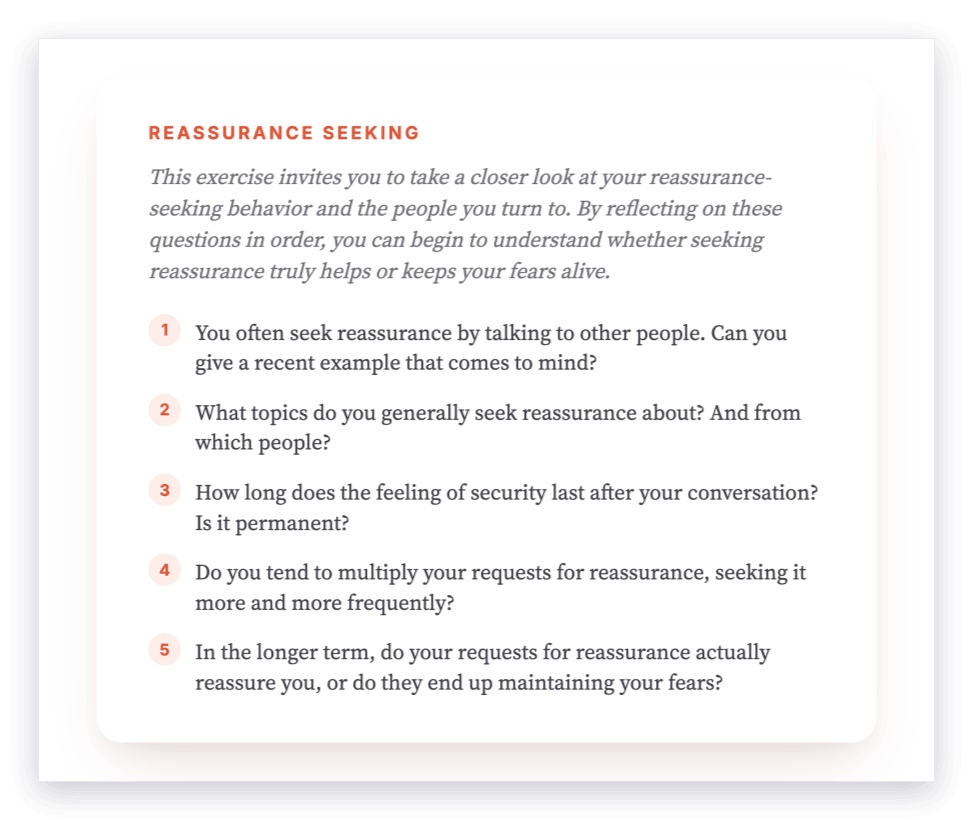
The five questions build progressive self-awareness in a deliberate sequence:
- A recent, specific example of reassurance-seeking
- The typical topics involved and the people the patient turns to
- An honest rating of how long the sense of safety actually lasts after the conversation
- Whether the requests are escalating, becoming more frequent or more urgent
- A direct functional question: does seeking reassurance ultimately reduce their fears, or sustain them?
The image above lists all five questions with a short introductory prompt. This is a static preview only. The full guided exercise, including patient-facing instructions and space to write answers, is experienced by the patient directly in the app on their own, between sessions, not in this image.
The progression moves from the descriptive (questions 1 and 2), through the evaluative (questions 3 and 4), to the functional (question 5). That arc mirrors the cognitive work you want to happen: from naming a behavior, to examining its mechanics, to weighing its actual utility. The same logic structures the Intolerance of Uncertainty guided exercise and the OCD Compulsions: Defining a Measurable Stopping Criterion exercise.
Key insight: Reassurance-seeking is a safety behavior that briefly neutralizes distress while reinforcing the belief that uncertainty is intolerable. A written exercise that asks the patient to track how long the relief actually lasts, and whether fears shrink or grow over time, is often more persuasive than any explanation you can give aloud.
This exercise is available to your patients through the mobile application that is the dedicated patient-side interface of SessionFuel: you assign it from your SessionFuel account, and your patient completes it directly on their phone, on their own, between appointments.
750+ clinical tools
A library built with and for clinicians, ready to use in session and extend between appointments.
Access all the toolsUse it with your patients
Share this tool in the mobile app and follow the work between sessions.
Integrating This as Between-Session Homework
Assign this exercise between two consultations when a patient already recognizes that they seek reassurance but has not yet connected that behavior to their anxiety maintenance cycle. It suits patients working on generalized anxiety, OCD with reassurance compulsions, health anxiety, or patterns of emotional dependency on specific people.
When you introduce it, frame the task neutrally: you are not yet asking them to stop seeking reassurance, only to observe it. That framing removes defensiveness and increases genuine engagement. You might pair it with the Checking, Certainty, and Doubt fiche or the Intolerance of Uncertainty PDF Worksheet as reading for the same interval.
When the patient returns, focus the debrief on question 5. Patients who honestly answer that reassurance maintains rather than reduces their fears have, in effect, built their own argument for behavioral change. Their words carry far more weight than yours. From there, you can connect the insight to approach work using the Anxiety Self-Reflection exercise or deepen the tolerance of uncertainty angle with the Fear of Uncertainty exposure fiche. For patients whose reassurance-seeking is tied to a specific relationship, the Emotional Dependency guided exercise makes a natural follow-up.
Questions 2 and 4 often surface additional material: who the patient turns to, and how the urgency escalates. This can reveal relational configurations and co-maintaining dynamics worth exploring alongside the The Need to Control Everything exercise or the CBT Maintaining Processes fiche. What starts as a simple homework task frequently opens the most productive lines of work in the sessions that follow.
Your session continues in your patients' pocket
Use with a patientYour resources, available everywhere
The handouts, exercises, programs and audios above: you choose which ones to make available to your patients, in the mobile app dedicated to them.
And far more than a library
The app goes well beyond resources, to support your patients every day:
Related categories
Explore other clinical resources by category.

Anxiety
Clinical hub for anxiety disorders: CBT and ACT worksheets, psychoeducation sheets, and exercises for assessment and treatment across the anxiety spectrum.

Identity
Clinical resources for self-identity work in therapy: CBT, ACT, schema tools for clinicians addressing self-concept, core beliefs, and identity disruption.

Emotions
Clinical resources on emotion regulation: worksheets, coping tools, CBT, REBT, and ACT exercises for therapists working across diagnoses and age groups.

Relationships
Clinical worksheets and tools on relational functioning: attachment, schemas, assertiveness, and communication skills for therapists. Printable PDF resources.

Cognition
Printable cognitive therapy worksheets and clinical tools for therapists: CBT, ACT, schema work, defusion, distortions, and belief restructuring.

Build awareness
Clinical worksheets and tools to build awareness in therapy: cognitive distortions, schemas, emotions, ACT and CBT resources for practitioners.