
550 psychoeducation handouts, ready to share
From panic attacks to grief, illustrated handouts that make complex ideas easy to grasp and easy to remember. You go through them together in session, and your patient can reread them at home.
Psychoeducation
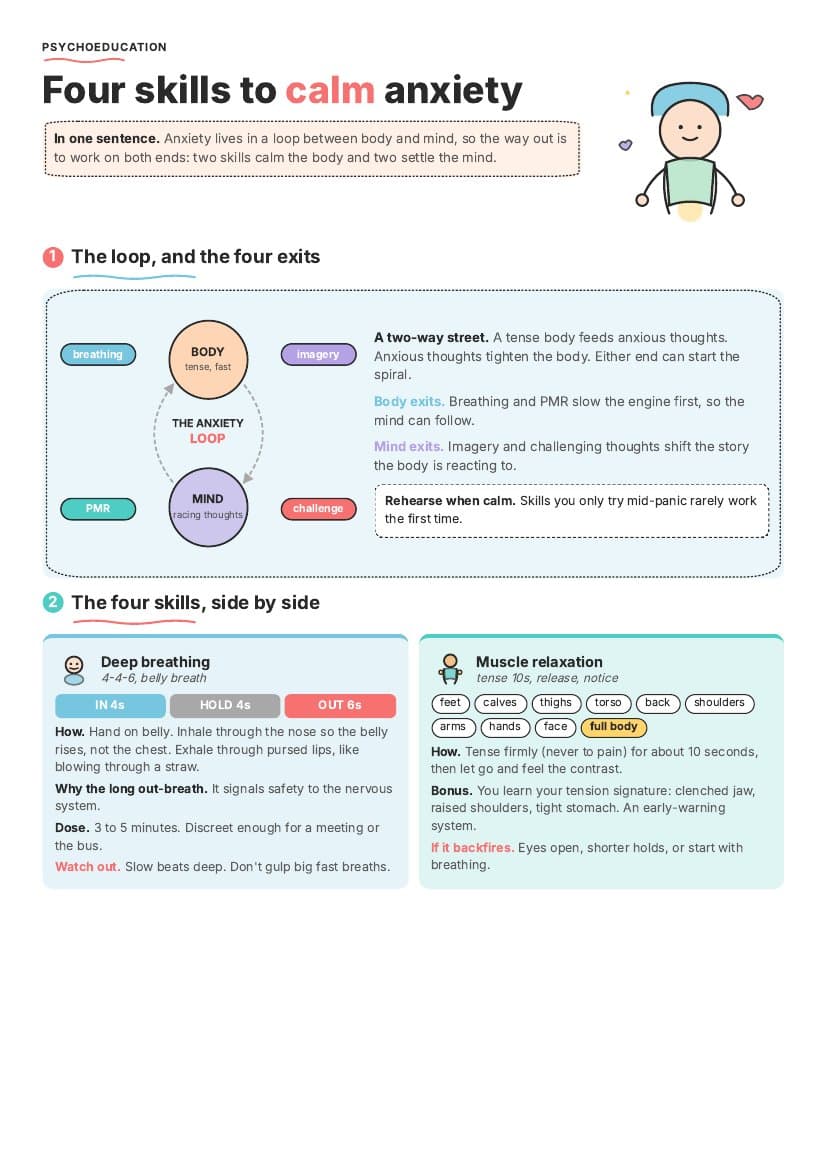
Four skills to calm anxiety
In one sentence. Anxiety lives in a loop between body and mind, so the way out is to work on both ends: two skills calm the body and two settle the mind.
1The loop, and the four exits
Body
tense, fast
Mind
racing thoughts
A two-way street. Either end can start the spiral.
→ Rehearse when calm. Skills you only try mid-panic rarely work the first time.
2The four skills, side by side
Deep breathing 4‑4‑6
belly breath
→ Why the long out-breath. It signals safety to the nervous system.
Muscle relaxation
tense 10s, release, notice
There's a method behind every handout.
Open “Four skills to calm anxiety”: your patient gets it from the very first sentence, sees the mechanism in a diagram and leaves with skills they can use that same evening.
Clear from the first line
Every handout opens with a one-sentence summary: “Anxiety lives in a loop between body and mind, so the way out is to work on both ends: two skills calm the body and two settle the mind.” Your patient knows where they're headed before they read on.
The mechanism at a glance
The diagram links BODY (tense, fast) and MIND (racing thoughts): “A tense body feeds anxious thoughts. Anxious thoughts tighten the body. Either end can start the spiral.” What ten minutes of explaining struggles to get across fits in a single diagram.
Ready to use the same evening
“Deep breathing 4-4-6”: in for 4 seconds, hold for 4, out for 6. And the handout explains why the out-breath is longer: “It signals safety to the nervous system.” Your patient never gets an instruction without the reason behind it.
How to use it, spelled out up front
“Rehearse when calm. Skills you only try mid-panic rarely work the first time.” No more picking up the pieces after a skill was misused between sessions.
And in the footer, its sources: Bourne (2020) · Davis, Eshelman & McKay (2019) · Beck (2011). You're sharing solid material, with the references to back it up.
The handout you're looking for already exists.
550 handouts cover common concerns and niche ones alike: from panic attacks to emetophobia, from grief to ADHD in children. No more cobbling something together the night before a session.
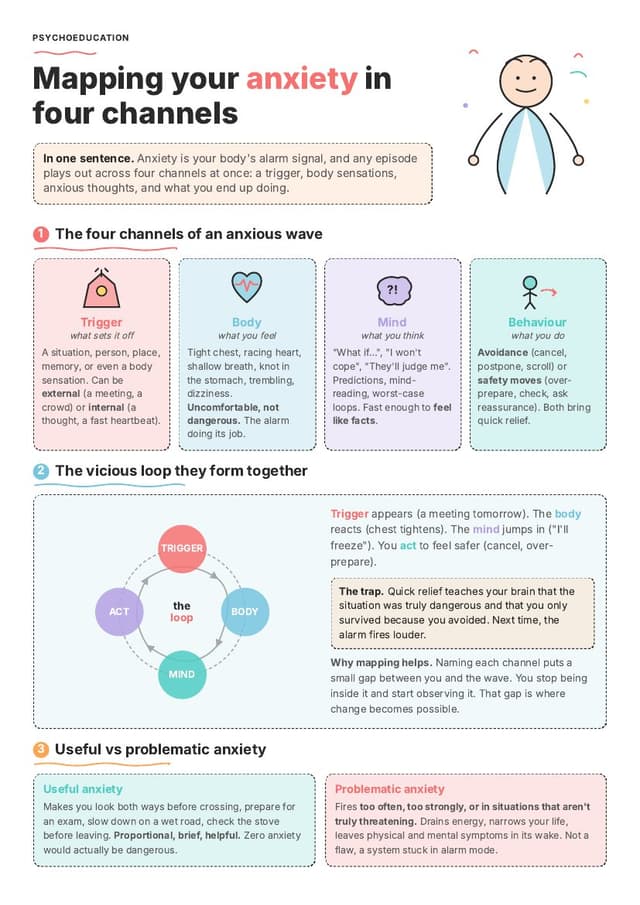
Mapping your anxiety
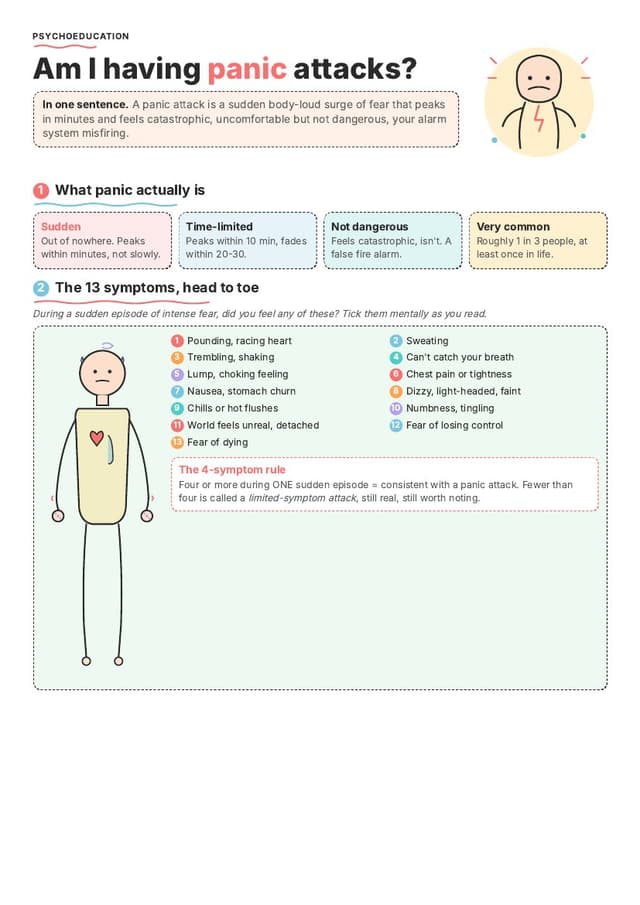
Am I having panic attacks?
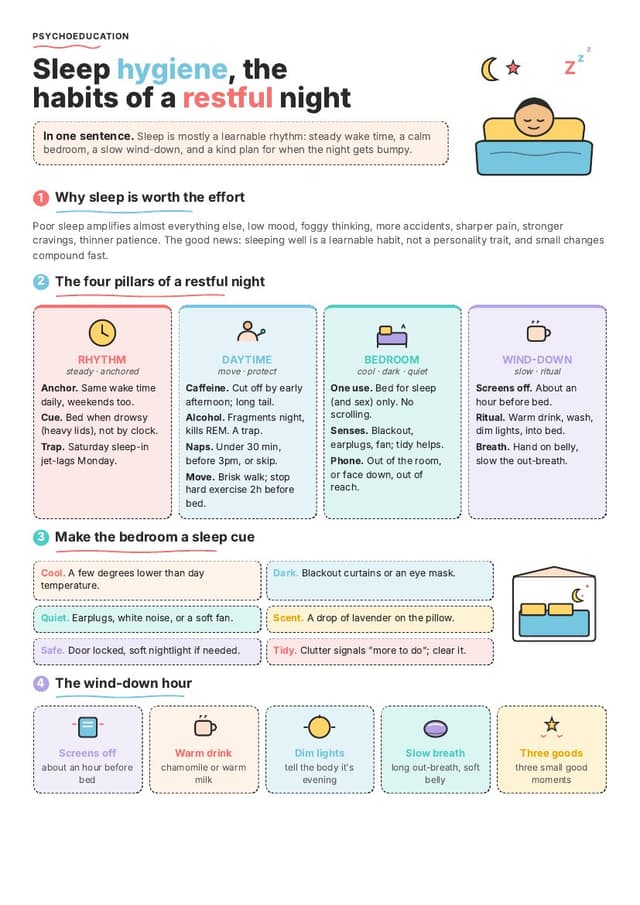
Sleep hygiene
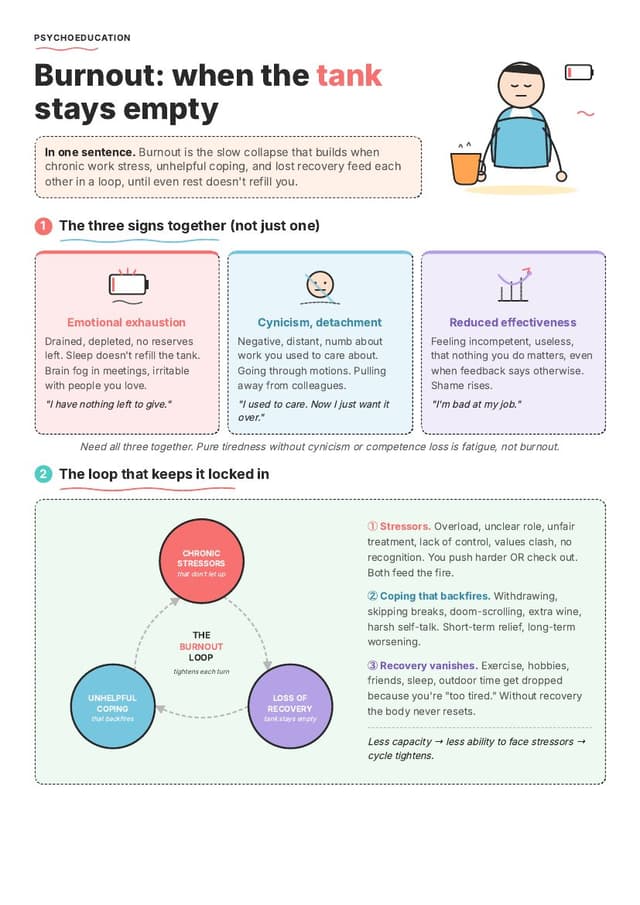
Burnout: when the tank stays empty
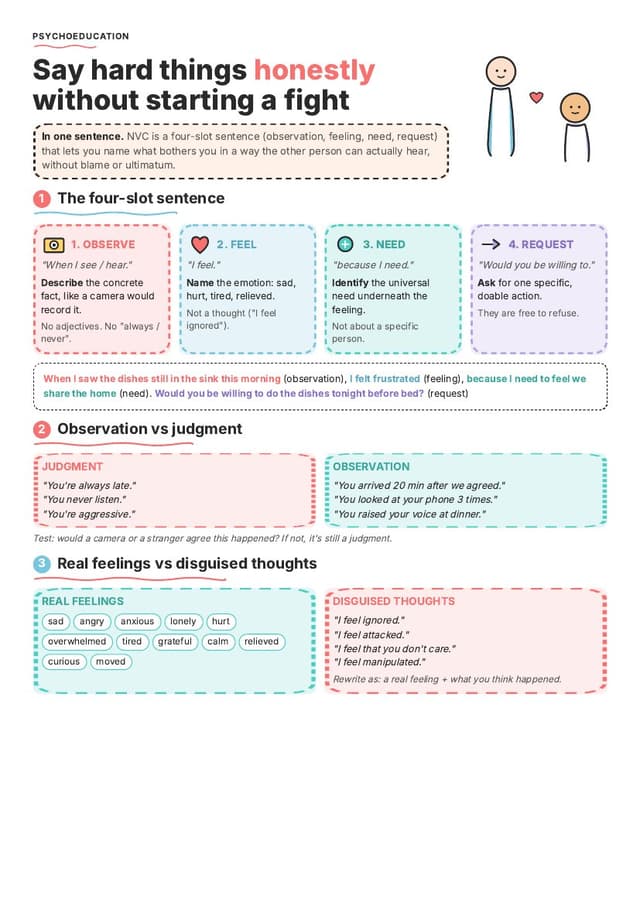
Nonviolent communication (NVC)
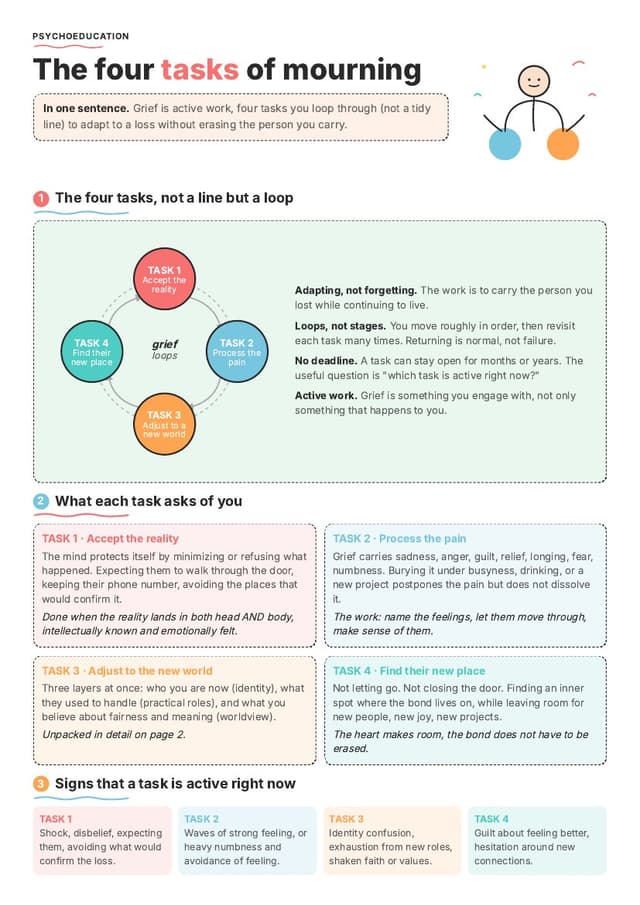
The four tasks of mourning (Worden)
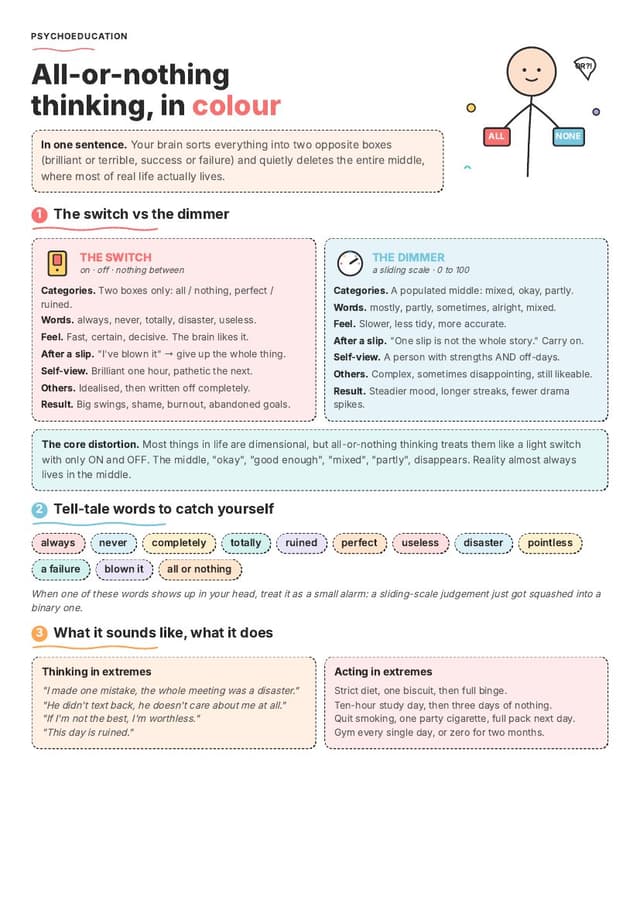
All-or-nothing thinking
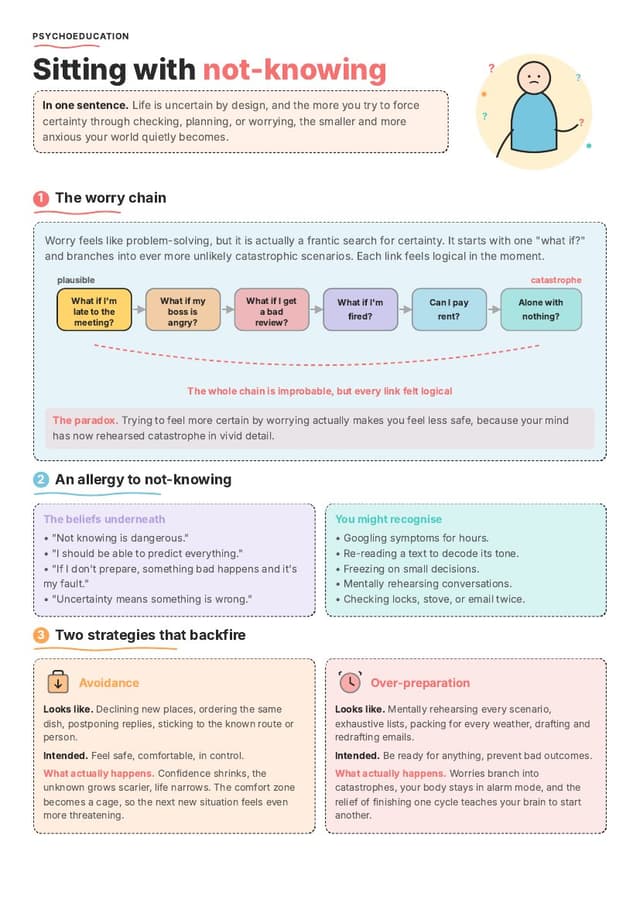
Intolerance of uncertainty
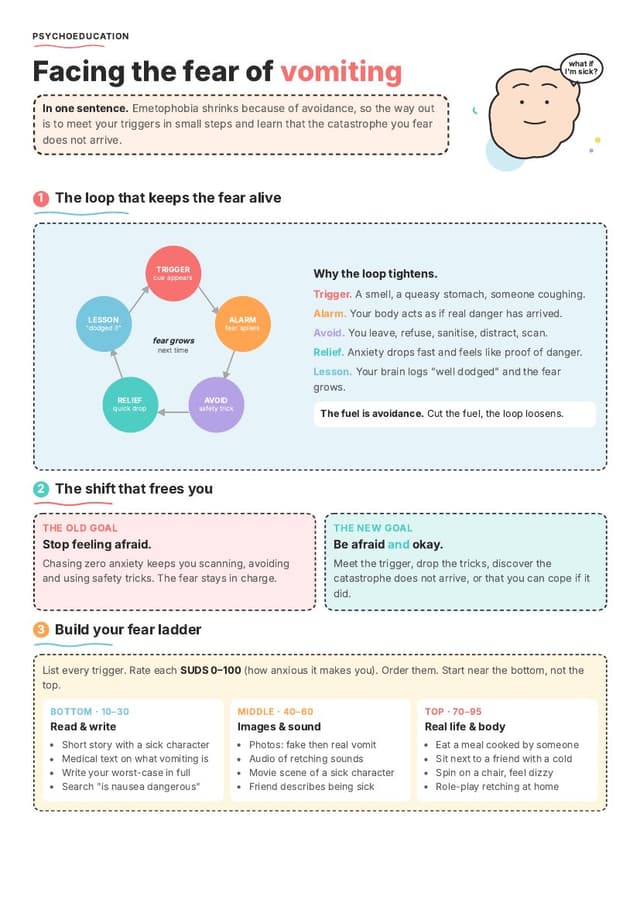
Facing the fear of vomiting
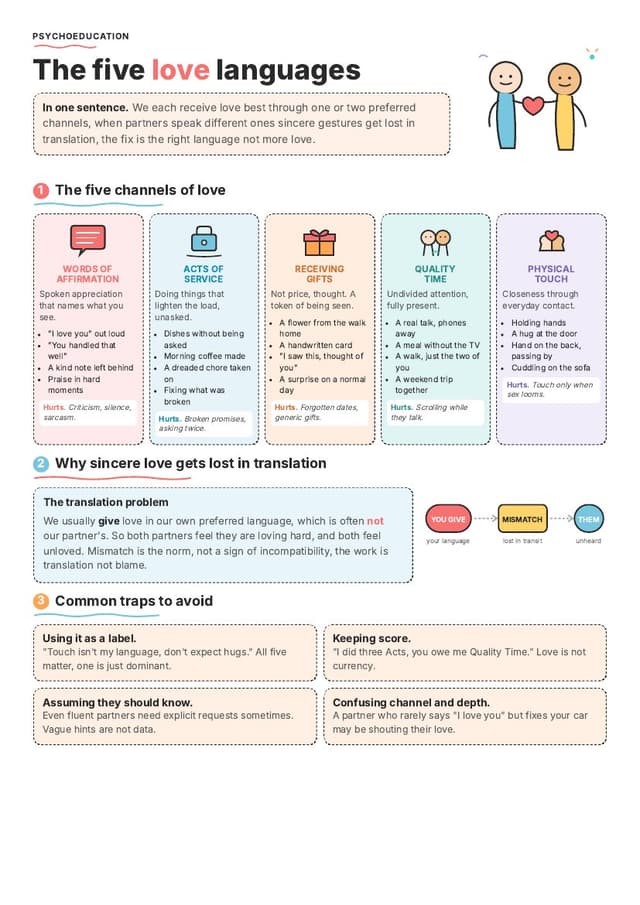
The five love languages
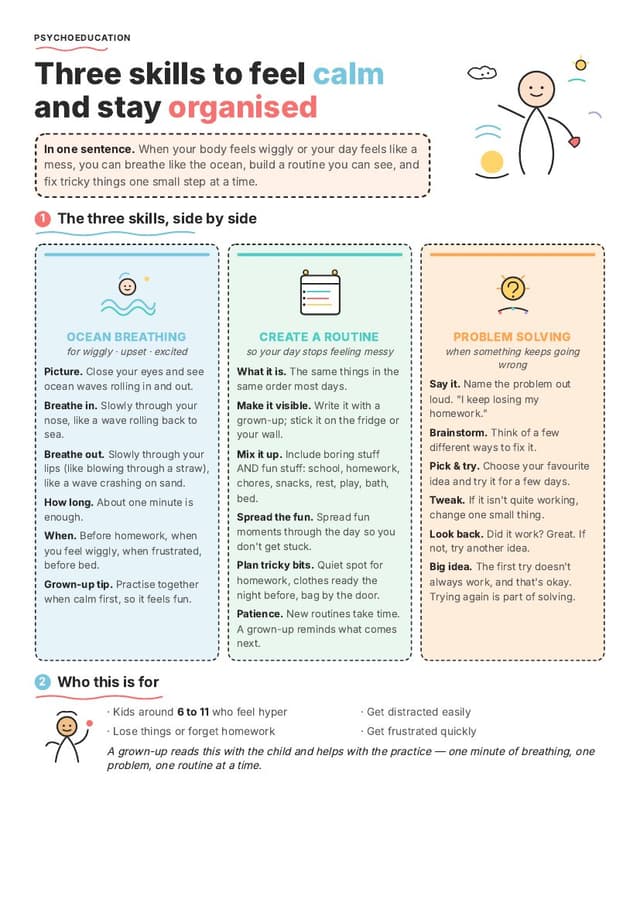
ADHD in children
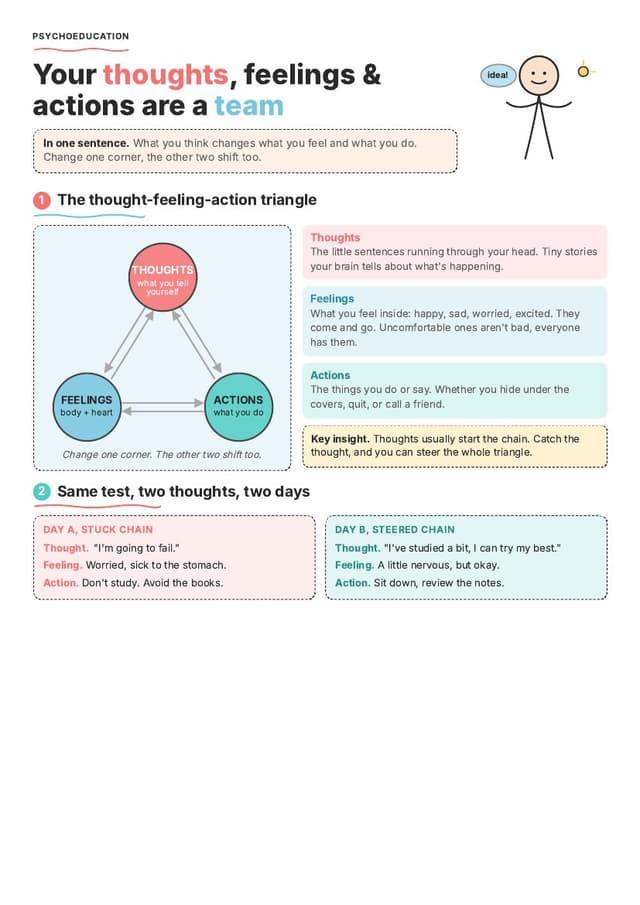
The thought-feeling-action triangle
…and 538 more, as print-ready PDFs in English and French, each with its own diagrams.
The right handout, while your patient is still with you.
13 clinical themes, with every handout tagged. One click on “Anxiety” brings up 263 handouts, from panic to graded exposure. Search does the rest.
Mapping your anxiety
PsychoeducationAm I having panic attacks?
PsychoeducationWhat keeps panic going
PsychoeducationWhat keeps fears and phobias going
PsychoeducationFear hierarchy
PsychoeducationFear of vomiting (emetophobia)
PsychoeducationOne click opens a preview of the handout; the “+” adds it to the next session's homework. All without leaving your session prep.
You don't talk to kids the way you talk to adults.
Handouts for young people are written for them from the start: simple words, a warm tone, drawings made for their age. One section title says it all: “Phrases for your pocket.”
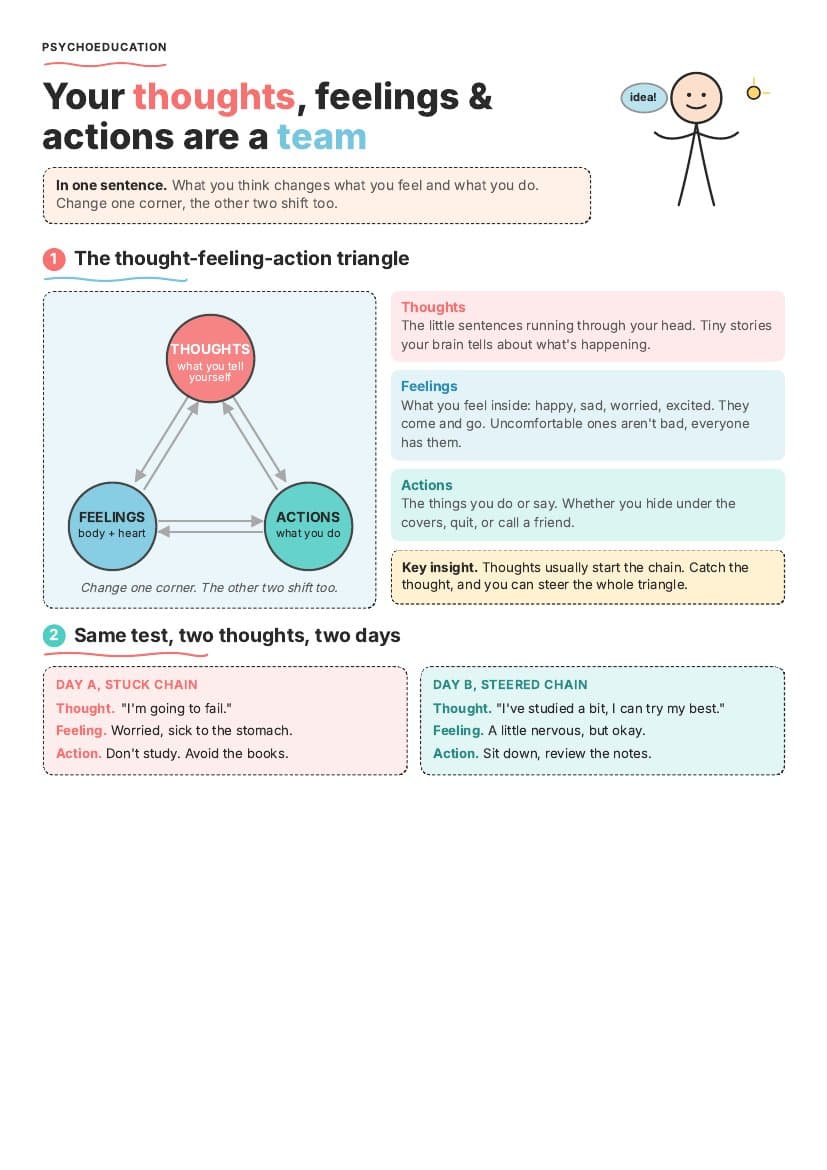
“What you think changes what you feel and what you do. Change one corner, the other two shift too.”
A handout for kids: “Your thoughts, feelings & actions are a team”
Behind every handout, a clinical article.
Why the tool works, when to bring it out, what it looks like in session: every PDF is backed by an article written for clinicians, case vignettes included.
The article behind “Mapping your anxiety”
“Explaining anxiety in session is rarely the bottleneck. The real friction comes earlier: patients listen, nod, and leave without a workable map of what is actually happening to them. This PDF worksheet gives the explanation a structure they can hold onto, follow with their eyes, and take home, without you needing to sketch it from scratch every time.”
The case vignette
“Naming the loop in social anxiety. M., a man in his mid-thirties, presents with longstanding social anxiety centred on work meetings […]. In session, the clinician introduces the four-channel mapping framework, walking M. through a recent episode: an unplanned team meeting (trigger), chest tightness and dry mouth (body), the thought ‘I will go blank and they will see it’ (mind), and a last-minute request to dial in by phone instead (behaviour). M. recognised quickly that the phone workaround had felt like a solution but had kept the alarm cycle intact.”
No more handouts lost at the bottom of a bag.
Added to homework in one click, the handout lands in your patient's portal, where they can reread or download it months later, in English or French.
Pick it in session
One “+” on the card is all it takes: the handout joins next session's homework, alongside tests and exercises. No exporting, no attachments.
Your patient gets it at home
The handout appears in their portal before the next session. What you explained in session is still there on Wednesday night, when the anxiety comes back.
They keep it
Every handout you share stays in their portal, to read or download anytime, even once the homework is done. Psychoeducation adds up instead of getting lost.
Frequently asked questions
Who writes the handouts?
They're part of our own editorial collection: written, illustrated and reviewed, in language patients can follow, with the published references in the footer (Bourne, Linehan, Beck…).
How do I share them?
In one click from the library: as homework for the next session, or straight to your patient's portal.
Is there a printable version?
Yes, every handout comes as a clean PDF that's ready to print or email, in addition to a version that reads well on a phone.
Does the patient keep the handouts?
Yes: every handout you share stays in their patient portal, to read or download anytime, including those from homework they've already finished.
Put SessionFuel to work in your next session.
Create your account, add your patients and assign their first homework in minutes.
50,000+ patients supported · 4.7/5 satisfaction · GDPR & HIPAA compliant