
Clinical picture. M., a 38-year-old manager, presents with persistent anxiety and reports exhaustion from monitoring every detail of her team's output. She describes checking emails late at night and rewriting colleagues' reports to avoid any possibility of error. Working through the four guided questions, she articulates that the underlying uncertainty is fear of being judged as incompetent by senior leadership, and she recognises, with some surprise, that her checking behaviour has not reduced that fear at all. By the final question she identifies that her over-control has damaged two working relationships and is sustaining, rather than containing, her anxiety. The exercise does not resolve her pattern in one session, but it gives her a structured map she can bring back for ongoing work.
Compulsive Control: A Guided Exercise for Anxiety Work
Help patients map their control-seeking patterns, identify the uncertainties driving them, and examine the real cost of over-control.
Clinical vignettes
Mapping Control in a Work Context
Control Behaviour and Relationship Strain
Clinical picture. T., a man in his mid-forties with generalised anxiety disorder, describes organising the family's schedule in minute detail and becoming visibly distressed when plans shift unexpectedly. Guided through the exercise questions in session, he identifies that the core uncertainty is a fear that something harmful will happen to his children if he relaxes vigilance. He acknowledges that his partner has started withholding ordinary information to avoid triggering a planning discussion, which has introduced a new source of anxiety rather than reducing it. The clinician notes this feedback loop without amplifying it, and T. agrees to observe one instance of unplanned change before the next appointment. The exercise provides a concrete reference point rather than a solution, which suits the pace of his engagement.
The Clinical Challenge: When Control Becomes the Problem
Control-seeking is one of the most clinically slippery presentations in anxiety work. Patients rarely describe themselves as "controlling." They describe relentless planning, persistent checking, difficulty delegating, or attempts to manage what others say or do. The underlying mechanism, intolerance of uncertainty, is well-documented in generalized anxiety and anxiety more broadly, yet naming it verbally in a consultation rarely produces the same shift as having the patient observe it in a real, recent episode of their own life.
What resists oral explanation alone is the patient's awareness of the circular logic sustaining the pattern: control attempts reduce distress momentarily, but reinforce the belief that certainty is both necessary and achievable. This is a textbook CBT maintenance cycle, yet it stays invisible until the patient is asked to slow down and examine it for themselves. The Intolerance of Uncertainty fiche and the Control, Influence, Accept worksheet give patients a conceptual framework. This exercise does something complementary: it asks them to look at a live example drawn from their own experience.
Use this resource with your patients
Handout, exercises and materials ready to use, right inside SessionFuel.
What the Exercise Contains
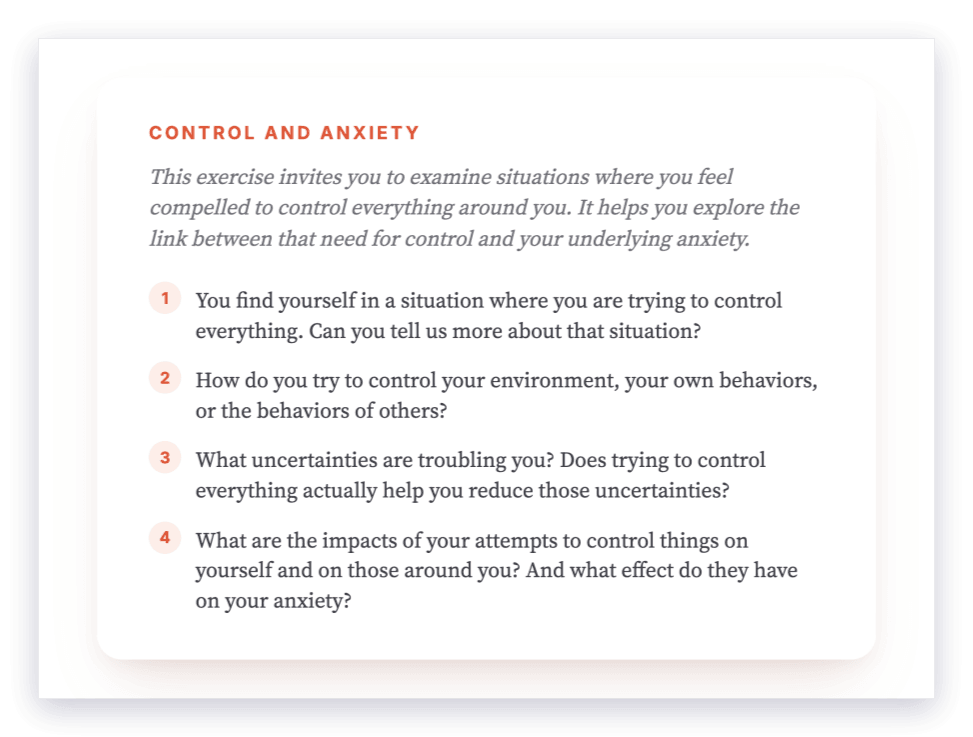
The exercise is structured around four sequential questions that move the patient from description to analysis.
The first question anchors the work in a concrete, recent situation where the patient found themselves trying to control everything. This specificity blocks abstract self-labelling and keeps the exercise clinically usable.
The second question asks the patient to name exactly how they attempt to exert control, whether over their environment, their own behavior, or the behavior of others. The responses here produce a granular behavioral inventory that feeds directly into subsequent work on safety behaviors and psychological safety crutches.
The third question introduces the uncertainty axis: what specific uncertainties are driving the control attempt, and whether control actually succeeds in reducing them. This is the pivotal question. It invites the patient to test their own logic rather than simply act on it, a move closely aligned with the Intolerance of Uncertainty: A Guided Clinical Exercise and the Embracing Uncertainty psychoeducation fiche.
The fourth question turns to impact: the effects of control-seeking on the patient, on those around them, and on anxiety itself. This question frequently surfaces relational costs the patient had not connected to the pattern, opening the door to cost-benefit reasoning developed in the Coping Strategy Effectiveness worksheet.
Key insight: The clinical value of this exercise lies in its sequence. Situation first, then mechanism, then the logic of uncertainty, then consequences. That order prevents rationalization and moves the patient from observation toward genuine insight.
The image above lists the four questions as they appear in the exercise.
Important: this image is a static preview of the questions only. The full guided exercise, including patient-facing instructions and space to write responses, is experienced by the patient on their own in the app, not here.
This exercise is available to patients through the mobile application that is the dedicated patient-side interface of SessionFuel: the clinician assigns it directly from their SessionFuel account, and the patient completes it autonomously on their phone, between sessions.
750+ clinical tools
A library built with and for clinicians, ready to use in session and extend between appointments.
Access all the toolsUse it with your patients
Share this tool in the mobile app and follow the work between sessions.
Integrating It as Between-Session Homework
Which patients does it suit? This exercise is well-suited to patients presenting with generalized anxiety, reassurance-seeking patterns, OCD-adjacent checking behaviors, or relational tension rooted in control dynamics. It also extends naturally from work with patients whose anxiety self-reflection has already surfaced avoidance or control as dominant coping strategies, and it pairs well with fear of uncertainty exposure work and the Stop Overthinking fiche.
How to introduce it. Assign it after a session in which the control pattern has been named but not yet mapped. A plain framing works: "Before our next meeting, I would like you to choose one recent moment when you felt that pull to manage everything, and work through these questions honestly. There is no right answer."
What to do with what the patient brings back. The written responses give you behavioral specifics for question two, a direct test of the patient's uncertainty logic in question three, and relational or somatic impact data in question four. Use these as the starting point for deeper work with the Intolerance of Uncertainty for GAD model, the CBT Maintaining Processes framework, or the Coping Strategies Map, depending on where the patient's own words lead.
Your session continues in your patients' pocket
Use with a patientYour resources, available everywhere
The handouts, exercises, programs and audios above: you choose which ones to make available to your patients, in the mobile app dedicated to them.
And far more than a library
The app goes well beyond resources, to support your patients every day:
Related categories
Explore other clinical resources by category.

Anxiety
Clinical hub for anxiety disorders: CBT and ACT worksheets, psychoeducation sheets, and exercises for assessment and treatment across the anxiety spectrum.

Identity
Clinical resources for self-identity work in therapy: CBT, ACT, schema tools for clinicians addressing self-concept, core beliefs, and identity disruption.

Emotions
Clinical resources on emotion regulation: worksheets, coping tools, CBT, REBT, and ACT exercises for therapists working across diagnoses and age groups.

Behaviours
Clinical hub for behaviors in therapy: worksheets and tools for coping, eating disorders, CBT formulation, and maladaptive behavioral patterns.

Cognition
Printable cognitive therapy worksheets and clinical tools for therapists: CBT, ACT, schema work, defusion, distortions, and belief restructuring.

Build awareness
Clinical worksheets and tools to build awareness in therapy: cognitive distortions, schemas, emotions, ACT and CBT resources for practitioners.