
Clinical picture. A, a man in his late thirties, presented with recurrent anger episodes triggered by colleagues arriving late to team meetings, and reported feeling disrespected and "let down by everyone." The clinician introduced the C'est pas normal! exercise, asking him first to name the principle he felt had been violated: A articulated a deeply held rule that punctuality signals basic professional respect and that anyone who ignores it is showing contempt. Working through the subsequent questions, he acknowledged that others might reasonably weigh time differently, and that his all-or-nothing framing was amplifying his distress well beyond the situation. By the end of the session he had drafted a revised, preference-based version: he would prefer colleagues to be on time, and could address lateness directly when it genuinely affected his work.
Rigid Rules and Demandingness: A Guided Clinical Exercise
Help patients identify the personal rules behind strong emotional reactions, examine their rigidity, and begin shifting from demands to genuine preferences.
Clinical vignettes
Workplace Anger and Unspoken Rules
Parental Demands Masking a Core Fear
Clinical picture. M, a woman in her mid-forties, described intense distress each time her adult son cancelled plans at short notice, and framed his behaviour as "simply not normal for a son." The clinician guided her through the exercise questions, and M identified an underlying rule: a good child must always prioritise family, with no exceptions. When asked how someone might disagree with that principle, she paused and noted that her son was juggling shift work and a young child of his own, circumstances she had consistently minimised. Exploring the consequences of her rigid demand, she recognised that her reproaches were increasing his avoidance rather than drawing him closer. She left with a written preference statement and an agreed plan to communicate her wish for contact without framing cancellations as moral failures.
The Clinical Need: When "Should" Becomes a Verdict
Most patients who arrive with disproportionate emotional reactions to other people's behaviour are not simply overreacting. They are enforcing an internal rule they experience as self-evident, universal, and non-negotiable. The clinical difficulty is that these patients rarely recognise that a rigid personal standard is at work. From the inside, it genuinely feels like a matter of basic principle rather than a private expectation.
Explaining demanding standards verbally tends to land as dismissive ("so my values don't count?") unless patients reach the realisation themselves. The same is true for should statements, externalizing patterns, and emotional reasoning: each of these distortions is easier to recognise in one's own words than to accept from a clinician. That gap, between what you can explain and what a patient can genuinely absorb, is exactly what this exercise addresses.
Use this resource with your patients
Handout, exercises and materials ready to use, right inside SessionFuel.
What the Exercise Contains
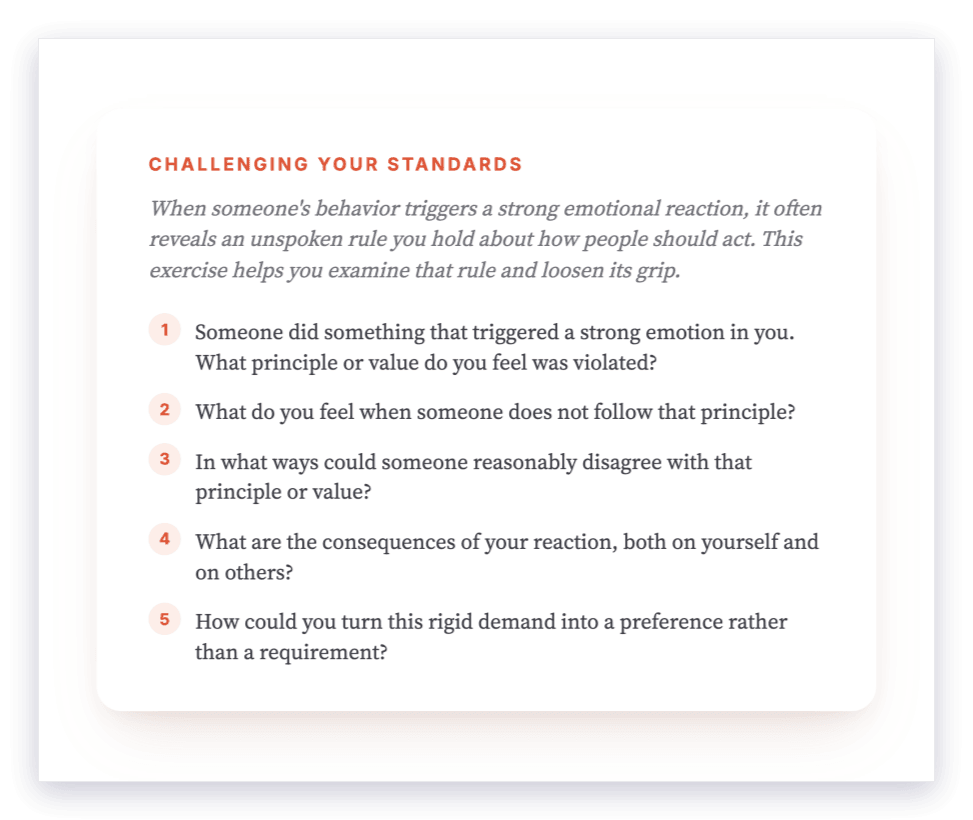
The exercise moves patients through five sequential questions, each designed to advance the work one step further without losing them in abstraction.
The first question asks the patient to identify the specific principle or value they feel was violated by another person's behaviour. This grounds the work in a real situation, not a hypothetical. The second question turns attention inward: what emotion arises when someone fails to follow this principle? This step connects the felt emotional reaction to its cognitive driver.
The third question is the pivot of the whole exercise: the patient is asked to consider how someone else could genuinely disagree with this principle. This is the perspective-taking move that creates the first crack in perceived universality, much like the structured challenge offered by the Perspective-Taking worksheet or the ABC Model in REBT. The fourth question examines the consequences of the patient's reaction, both on themselves and on others, making the personal cost of rigidity visible without any moralising from the clinician. The fifth and final question invites the patient to consider how this demand might become a preference: not abandoned, but held more lightly, which is the central move also explored in Evaluating Demanding Standards and Modifying Rules and Assumptions.
The image above lists these five questions in order with a brief intro. Note that this image is a static preview of the question list only. The full guided exercise, with patient-facing instructions and space to write responses, is what patients actually experience on their own in the app; the image here does not replicate that interactive format.
This exercise is available to patients through the mobile application that is the dedicated patient-side interface of SessionFuel: you assign it directly from your SessionFuel account, and your patient then completes it on their phone, on their own, between your consultations.
750+ clinical tools
A library built with and for clinicians, ready to use in session and extend between appointments.
Access all the toolsUse it with your patients
Share this tool in the mobile app and follow the work between sessions.
Integrating It as Between-Session Homework
This exercise works best assigned after a session in which a specific interpersonal frustration has come up, one where you noticed the intensity of the patient's emotional reaction or the moral language they used ("they have no right," "that's just wrong," "anyone would be shocked"). You do not work through the questions with the patient during the consultation. You assign the exercise as autonomous homework to carry out between two sessions, then use what the patient brings back as the raw material for your next work together.
In terms of patient profile, it suits adults dealing with anger and injustice themes (the Guided Anger Self-Reflection and Perceived Injustice exercises make natural companions), as well as patients caught in need-to-be-right patterns or global judgments of others. It is also relevant where a punitiveness schema is operating beneath the surface.
To introduce it, a simple framing works well: "You've mentioned several times that you find it hard to accept when people act this way. I'd like you to answer five short questions about it before we meet again, in your own time." No lengthy preamble is needed.
When the patient returns, question three (how others might disagree) and question four (the cost of the reaction) typically generate the richest material. Question five, the demand-to-preference reframe, often needs follow-up in the session, especially when patients confuse softening a rule with abandoning a value. The Control, Influence, Accept framework pairs well here for patients who struggle with that distinction.
Key insight: The clinical power of this exercise is that the patient, not the clinician, names the rule, acknowledges its limitations, and considers an alternative. When the reframe comes from the patient's own written words, it is far harder to dismiss.
Your session continues in your patients' pocket
Use with a patientYour resources, available everywhere
The handouts, exercises, programs and audios above: you choose which ones to make available to your patients, in the mobile app dedicated to them.
And far more than a library
The app goes well beyond resources, to support your patients every day:
Related categories
Explore other clinical resources by category.

Anxiety
Clinical hub for anxiety disorders: CBT and ACT worksheets, psychoeducation sheets, and exercises for assessment and treatment across the anxiety spectrum.

Mood
Evidence-based worksheets and clinical tools for mood disorders: CBT, ACT, and positive psychology resources for psychologists and therapists.

Identity
Clinical resources for self-identity work in therapy: CBT, ACT, schema tools for clinicians addressing self-concept, core beliefs, and identity disruption.

Emotions
Clinical resources on emotion regulation: worksheets, coping tools, CBT, REBT, and ACT exercises for therapists working across diagnoses and age groups.

Behaviours
Clinical hub for behaviors in therapy: worksheets and tools for coping, eating disorders, CBT formulation, and maladaptive behavioral patterns.

Cognition
Printable cognitive therapy worksheets and clinical tools for therapists: CBT, ACT, schema work, defusion, distortions, and belief restructuring.