
Clinical picture. A is a 34-year-old with recurrent depressive episodes who presents after making a calculation error that delayed a project at work, leading him to state flatly, "I am incompetent, full stop." The clinician introduces the structured exercise, beginning with question one: A identifies the global judgment ("I am incompetent") and the triggering situation precisely. Moving to question two, A acknowledges the error could have been far more consequential had it gone undetected, which slightly loosens the absoluteness of his appraisal. By question four, A is able to reframe his position from a verdict about his whole person to a specific statement about a single oversight under deadline pressure, which he rates as significantly less distressing. No dramatic shift in mood is claimed, but A notes the exercise gave him a repeatable structure for catching similar over-generalizations between sessions.
Global Judgments in CBT: A Cognitive Restructuring Exercise
Help patients move from harsh global evaluations of persons to specific, nuanced appraisals of behaviors and situations in CBT practice.
Clinical vignettes
Redirecting Self-Condemnation After a Workplace Error
Nuancing a Global Judgment of a Family Member
Clinical picture. M is a 47-year-old presenting with chronic interpersonal conflict and irritability, who describes her adult son as "selfish and bad" following a disagreement about shared household responsibilities. The clinician guides her through the exercise questions in session, starting with question one to pin down the exact situation rather than a character verdict. Question three proves particularly productive: M generates several counterexamples of considerate behavior by her son, which she had been discounting. She is then invited, via question four, to redirect her judgment toward the specific behavior of not contributing to chores rather than toward her son as a person. M leaves the session with a written version of the four questions to apply independently when she notices a strong evaluative reaction arising.
The Clinical Problem: When Judgments Become Verdicts
Global person-rating is one of the stickiest cognitive habits to shift. A patient who thinks "I am worthless" or "she is selfish" is not simply holding an opinion: they have collapsed an entire human being into a single label, and that collapse generates a disproportionate emotional charge. This is the territory covered by the Labeling Cognitive Distortion fiche and by REBT's core distinction between rating a person and rating a behavior, a distinction at the heart of the ABC Model.
Clinicians working in CBT or REBT know this distinction well. The difficulty is that patients rarely grasp it from an oral explanation alone. Telling someone "judge the act, not the person" in session lands intellectually and evaporates by Tuesday. What is needed is a structured self-inquiry that the patient runs on their own, at the moment the judgment is live. This exercise is built for exactly that.
Use this resource with your patients
Handout, exercises and materials ready to use, right inside SessionFuel.
What the Tool Contains
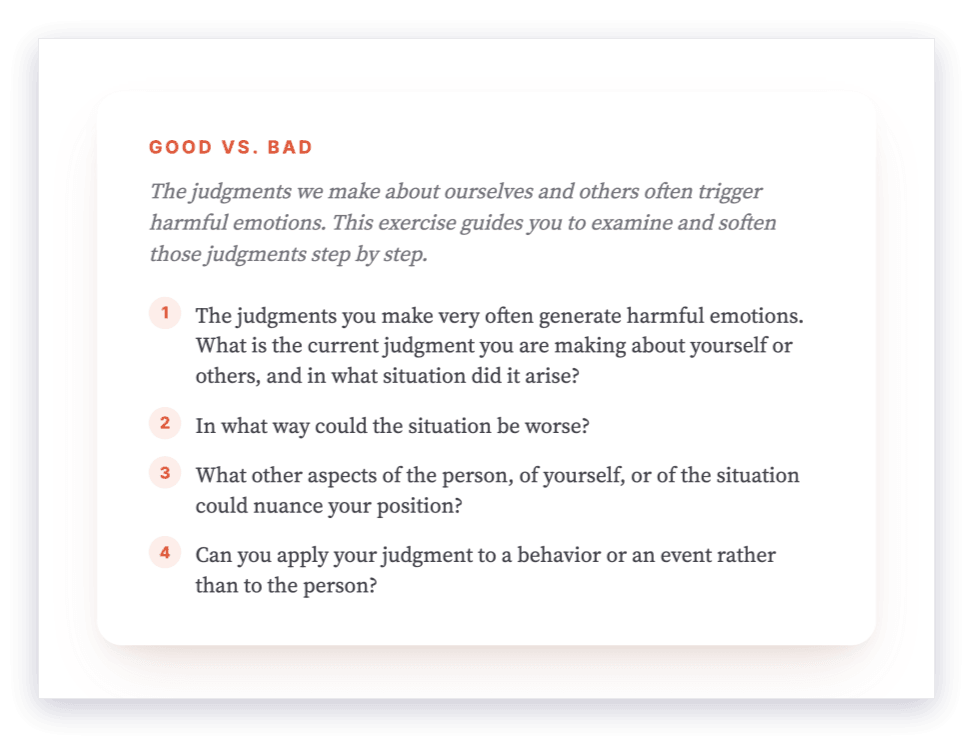
The exercise moves through four questions that form a deliberate progression.
The first question asks the patient to name the current judgment and the situation in which it appeared. This anchors the work in something specific and real rather than abstract. It also brings the emotional charge up to the surface so the remaining questions can do actual work.
The second question invites the patient to consider in what way the situation could be worse. This is a perspective-shifting move: it de-absolutizes the appraisal, introduces gradation, and quietly challenges the catastrophizing that often travels alongside harsh judgments. It connects naturally to decatastrophizing work and is structurally close to exercises like the Catastrophizing in CBT exercise.
The third question opens the patient toward nuance: what other aspects of the person, of themselves, or of the situation could complicate or soften their current position? This is a perspective-taking move, and it builds cognitive flexibility without asking the patient to abandon their assessment entirely. It echoes the kind of questioning taught in Socratic Questioning and the evidence-auditing that underpins challenging negative thoughts.
The fourth question delivers the core reframe: can the judgment be directed at a behavior or an event rather than at the person as a whole? This is the REBT person-versus-behavior distinction made self-applicable. It aligns closely with Personalization exercises, self-blame work, and the Evaluating Demanding Standards fiche when the judgment targets the patient themselves.
The image above lists the four questions with a brief framing. It is a static preview only: the full guided exercise, with the patient-facing instructions and space to answer, is experienced by the patient on their own in the app, not in this image.
Key insight: The value of this exercise is not the answers it produces, but the slowing down it forces: patients who habitually judge quickly learn to pause between the trigger and the verdict.
This exercise is available to your patients through the patient app of SessionFuel. You assign it directly from your clinician account, and your patient completes it on their phone, on their own, between two consultations.
750+ clinical tools
A library built with and for clinicians, ready to use in session and extend between appointments.
Access all the toolsUse it with your patients
Share this tool in the mobile app and follow the work between sessions.
Integrating It as Between-Session Homework
This exercise fits a wide range of patients: those dealing with interpersonal friction (anger, contempt, resentment toward others), those struggling with harsh self-judgment (shame, low self-worth, self-deprecation patterns), and those working through the rigid inner rules covered by the "Should" Statements fiche or the Demandingness in REBT exercise.
Introduce it after you have already established the concept of cognitive distortions and identified labeling as a pattern present in this patient's thinking. The Cognitive Distortions overview or the Judgment Awareness program can serve as useful preparation.
When assigning the exercise between sessions, frame it simply: "The next time you notice a strong verdict about yourself or someone else, I want you to sit with these four questions before the feeling solidifies." Patients who keep a thought record or use the Automatic Thoughts exercise can complete this as a natural extension of that practice.
When the patient returns, the written responses give you a concrete clinical object to work with. Look for what the nuancing question (Q3) produced: patients who struggle to find any nuance often carry a deeper core belief worth naming. Look also at Q4: whether the patient could redirect the judgment toward a behavior tells you how far the person-rating habit is entrenched, and opens the conversation toward the Fact or Opinion distinction or further inner dialogue work.
Your session continues in your patients' pocket
Use with a patientYour resources, available everywhere
The handouts, exercises, programs and audios above: you choose which ones to make available to your patients, in the mobile app dedicated to them.
And far more than a library
The app goes well beyond resources, to support your patients every day:
Related categories
Explore other clinical resources by category.

Anxiety
Clinical hub for anxiety disorders: CBT and ACT worksheets, psychoeducation sheets, and exercises for assessment and treatment across the anxiety spectrum.

Mood
Evidence-based worksheets and clinical tools for mood disorders: CBT, ACT, and positive psychology resources for psychologists and therapists.

Identity
Clinical resources for self-identity work in therapy: CBT, ACT, schema tools for clinicians addressing self-concept, core beliefs, and identity disruption.

Emotions
Clinical resources on emotion regulation: worksheets, coping tools, CBT, REBT, and ACT exercises for therapists working across diagnoses and age groups.

Behaviours
Clinical hub for behaviors in therapy: worksheets and tools for coping, eating disorders, CBT formulation, and maladaptive behavioral patterns.

Cognition
Printable cognitive therapy worksheets and clinical tools for therapists: CBT, ACT, schema work, defusion, distortions, and belief restructuring.