
Clinical picture. M., a woman in her early fifties, presented with persistent low mood and guilt following her adult son's return to alcohol use after a period of sobriety. She held a firm conviction that her failure to call him more often had caused the relapse. The clinician introduced the exercise between sessions, asking her to work through the four questions in writing before the next appointment. When she returned, her written responses named her son's precarious housing situation, a job loss, and the abrupt end of his outpatient support as factors she could not have controlled. She did not fully relinquish her sense of responsibility, yet she arrived at a more distributed account of the event, which allowed the session to shift toward grief about her limited influence rather than guilt about a supposed failure.
Personalization and Self-Blame: A Guided Clinical Exercise
Help patients examine self-attributed responsibility, surface external factors, and calibrate their genuine share of accountability between sessions.
Clinical vignettes
Self-Blame Following a Son's Relapse
Personalizing a Team Conflict at Work
Clinical picture. R., a man in his late thirties being seen for generalised anxiety, described a heated disagreement among colleagues that had escalated to formal mediation; he was convinced his tendency to speak directly had been the sole cause. The clinician asked him to complete the exercise at home, using the four questions as a written reflection rather than an in-session dialogue. His answers identified long-standing communication problems within the team, ambiguous role boundaries set by management, and a prior conflict that predated his arrival. Reviewing the worksheet together, the clinician helped him distinguish between a genuine contribution he could own and the portion of the outcome that lay outside his control. The exercise did not resolve his anxiety, but it gave him a more workable frame from which to examine his actual behaviour without total self-attribution.
When patients collapse all causes onto themselves
Personalization is one of the most tenacious cognitive distortions clinicians encounter. The patient who concludes that a colleague's bad mood is their fault, that their child's difficulties reflect their failure as a parent, or that a relationship ended because of something fundamentally broken in them, these presentations share a common structural error: the automatic attribution of external events to the self, with little or no weight given to situational, relational, or contextual factors.
What makes this distortion clinically tricky is not the patient's lack of insight. It is the emotional logic sustaining it. Guilt and self-blame often feel, to the patient, like a form of control: "if it was my fault, I could have prevented it, and I can prevent it next time." Dismantling that logic verbally rarely suffices. The patient nods, then goes home and blames themselves again. What changes things is structured, autonomous reflection, working through the attribution process in writing, on their own, between appointments. This exercise targets precisely that gap. It connects naturally with the Responsibility Pie Chart worksheet, the Personalization fiche, and the broader framework of challenging negative thinking.
Use this resource with your patients
Handout, exercises and materials ready to use, right inside SessionFuel.
What the exercise contains
The exercise is built around four questions that mirror the clinical logic of cognitive restructuring applied specifically to self-blame and false attribution.
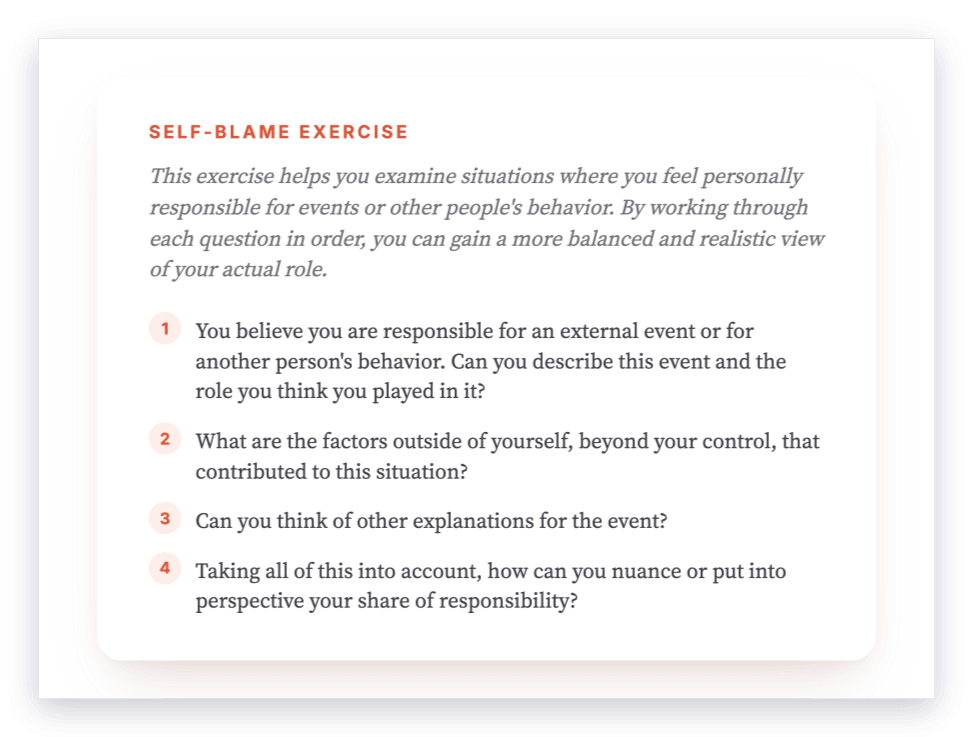
This image is a static preview that simply lists the four exercise questions. The full guided experience, with patient-facing instructions, context for each question, and space to write, is completed by the patient directly in the app, on their phone, on their own. What you see here is for clinician reference only.
The first question asks the patient to describe the event and the role they believe they played, anchoring the work in one specific situation rather than a diffuse sense of fault. The second shifts attention outward: what factors, beyond your control, also contributed? This is the structural move that opens the attribution space, the one that the Perspective-Taking worksheet and the Fact or Interpretation worksheet also target, each from a different angle. Question three invites the patient to generate alternative explanations for the event. The final question asks them to nuance their actual share of responsibility in light of everything surfaced, a calibration step, not a dismissal of genuine accountability.
Taken together, the four questions replicate the reasoning a clinician would guide in session, but the patient does it alone, in their own time, in writing. That written trace is itself clinically valuable.
This exercise is available to patients through the patient app of SessionFuel, the mobile application reserved for patients of clinicians who use SessionFuel. The clinician assigns the exercise as between-session homework, and the patient completes it directly on their phone, at their own pace, before the next appointment.
Key takeaway: The exercise does not ask patients to deny their responsibility. It asks them to examine it, and that distinction is what makes genuine cognitive change possible rather than defensive.
750+ clinical tools
A library built with and for clinicians, ready to use in session and extend between appointments.
Access all the toolsUse it with your patients
Share this tool in the mobile app and follow the work between sessions.
How to assign it and use what patients bring back
This exercise suits a broad patient profile: anyone presenting with guilt-laden cognitions, recurring self-blame after interpersonal events, difficulty tolerating others' negative emotions without internalizing their cause, or perfectionistic standards that generate chronic failure attributions. It pairs well early in cognitive restructuring work, alongside the Self-Blame worksheet and the Guilt and Responsibility exercise.
A natural introduction: "Between now and our next session, I'd like you to work through four questions on your own, in writing. Don't try to reach a conclusion, just write what comes." The instruction to suspend premature resolution matters: patients who over-function tend to rush toward answers before the questions have had time to work.
When the patient returns, focus less on the final answer to question four and more on the movement between question one and question four, whether the attribution shifted at all, even slightly, and what made that shift possible or difficult. Resistance at question two, where patients struggle to name any external factor, is itself clinical material: it may point to hindsight bias, an early maladaptive schema, or a punitiveness pattern worth exploring directly.
The Accepting Mistakes exercise, the Automatic Thoughts restructuring exercise, and the Socratic Questioning worksheet can extend the work once the initial responsibility calibration is underway.
Your session continues in your patients' pocket
Use with a patientYour resources, available everywhere
The handouts, exercises, programs and audios above: you choose which ones to make available to your patients, in the mobile app dedicated to them.
And far more than a library
The app goes well beyond resources, to support your patients every day:
Related categories
Explore other clinical resources by category.
Anxiety
Clinical hub for anxiety disorders: CBT and ACT worksheets, psychoeducation sheets, and exercises for assessment and treatment across the anxiety spectrum.

Mood
Evidence-based worksheets and clinical tools for mood disorders: CBT, ACT, and positive psychology resources for psychologists and therapists.

Identity
Clinical resources for self-identity work in therapy: CBT, ACT, schema tools for clinicians addressing self-concept, core beliefs, and identity disruption.

Emotions
Clinical resources on emotion regulation: worksheets, coping tools, CBT, REBT, and ACT exercises for therapists working across diagnoses and age groups.

Behaviours
Clinical hub for behaviors in therapy: worksheets and tools for coping, eating disorders, CBT formulation, and maladaptive behavioral patterns.

Cognition
Printable cognitive therapy worksheets and clinical tools for therapists: CBT, ACT, schema work, defusion, distortions, and belief restructuring.