
Clinical picture. A, a 34-year-old project manager, presents with generalized anxiety and describes a recent presentation at work as "a complete disaster that will end my career." The clinician introduces the five-question decatastrophizing worksheet as a between-session task, asking A to write down the specific facts supporting that appraisal before the next appointment. At the following session, A had listed three perceived errors but had also, prompted by question three, noted that colleagues had asked follow-up questions and that her manager had not raised any concerns. Working through question four together, A revised her initial reading: the presentation had been imperfect, not career-ending. She identified two concrete steps, requesting brief feedback from her manager and preparing more thoroughly for the next meeting, that gave her a sense of agency rather than dread.
Decatastrophizing: A Guided Cognitive Restructuring Exercise
A structured five-question homework tool helping patients examine catastrophic appraisals, weigh the evidence, and build a more balanced view of distressing situations.
Clinical vignettes
Reappraising a Feared Professional Failure
Challenging Catastrophic Health Appraisal
Clinical picture. M, a 51-year-old man with health anxiety, arrived convinced that a persistent headache confirmed a serious neurological illness, despite a recent unremarkable clinical examination. The therapist assigned the written exercise for homework, encouraging M to answer each question in sequence and to distinguish tangible evidence from interpretations when completing question two. M returned having noted that the only "fact" he could identify was the sensation itself; question three led him to record that the headache had appeared during a period of poor sleep and high work pressure. His written response to question four read: "I still feel worried, but I can see it is not proof of illness." The exercise did not eliminate his anxiety, yet it introduced enough distance from the catastrophic appraisal to allow him to consider behavioral responses, specifically improving sleep hygiene, rather than seeking further reassurance consultations.
Why catastrophizing is so hard to shift with words alone
Catastrophizing is one of the most clinically stubborn patterns you will encounter. Patients who catastrophize are not simply being dramatic; they are caught in an appraisal loop where worst-case readings feel self-evident and irrefutable. Explaining the distortion verbally often hits a wall: the patient nods, then returns the following week with the same catastrophic framing intact. What resists is the absence of a structured moment where they slow down, separate observable facts from interpretations, and actively search for counter-evidence on their own.
This is exactly where the Catastrophizing: PDF Worksheet, Tools and Exercises for Clinical Practice and the Decatastrophizing: PDF Worksheet, Tools and Exercises for Clinical Practice can ground the psychoeducation in session, but they remain clinician-held tools. What is often missing is an autonomous, patient-driven exercise that forces the patient to do the cognitive work themselves, without your scaffolding present in real time. This exercise fills that gap.
Use this resource with your patients
Handout, exercises and materials ready to use, right inside SessionFuel.
What the exercise contains
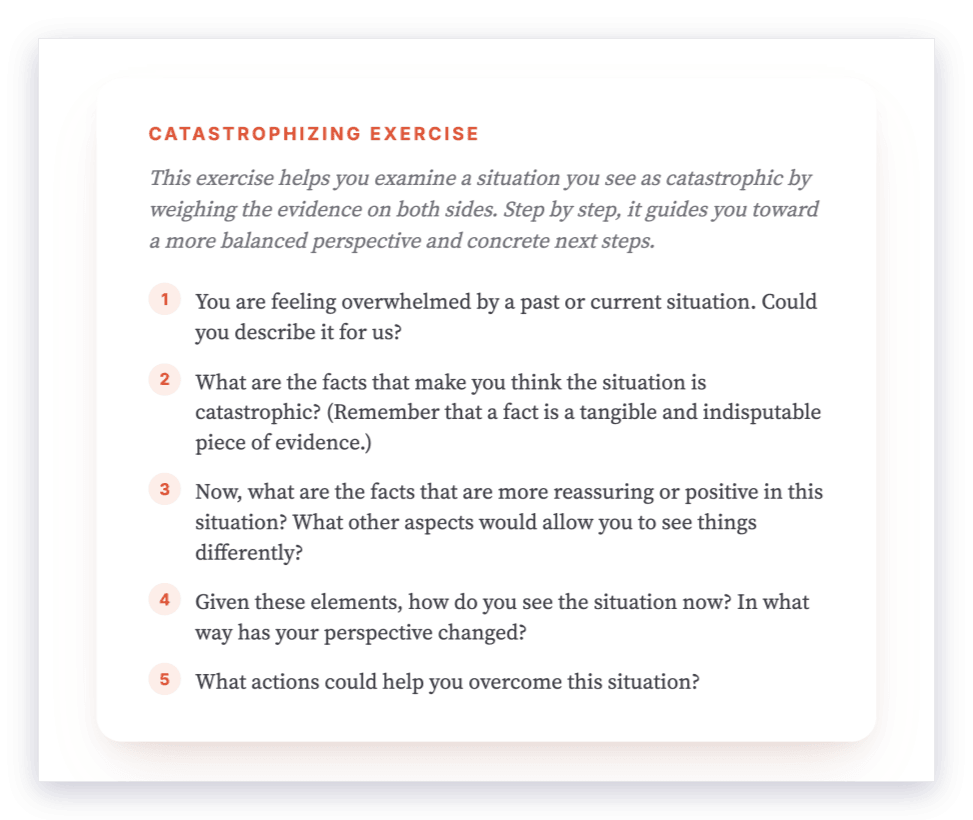
The exercise is built around five sequenced questions that mirror the core logic of cognitive restructuring: description, evidence-gathering, counter-evidence, reappraisal, and action.
The patient begins by describing the situation they are catastrophizing about (past or current), grounding the work in something concrete. The second question asks them to list only the facts, defined explicitly as tangible and indisputable proof, that support the catastrophic reading. This distinction between fact and interpretation is central; it echoes the work done with tools like Fact or Opinion: PDF Worksheet, Tools and Exercises for Clinical Practice and Fact or Interpretation: CBT PDF Worksheet, Tools and Exercises, and it is the hinge on which the restructuring pivots.
Question three actively solicits reassuring or positive facts, as well as other perspectives that could reframe the situation. This is where Challenging Anxious Thoughts: PDF Worksheet, Tools and Exercises and the Perspective-Taking: PDF Worksheet, Tools and Exercises for Clinical Practice provide useful session-side companions. The fourth question asks the patient to articulate how their view has shifted after examining both sides, making belief change explicit and traceable. The fifth question moves toward concrete coping actions, connecting cognitive reappraisal to behavioral planning in a way that complements tools like Focusing on Solutions: PDF Worksheet, Tools and Exercises for Clinical Practice and Coping Skills for Anxiety: PDF Worksheet, Tools and Exercises.
The image above lists all five questions in order. This is a static preview of the question structure only; the full guided exercise, complete with patient-facing instructions, prompts, and space to write, is experienced by the patient autonomously in the app, not in this image.
This exercise is available to patients through the mobile application that is the dedicated patient-side interface of SessionFuel: once you assign it in your SessionFuel workspace, your patient receives it directly on their phone and completes it on their own, between appointments.
Key clinical insight: The power of this exercise lies in question two's insistence on facts only. Patients who struggle to find tangible evidence for their catastrophic reading often reach question four having already done most of the restructuring themselves.
750+ clinical tools
A library built with and for clinicians, ready to use in session and extend between appointments.
Access all the toolsUse it with your patients
Share this tool in the mobile app and follow the work between sessions.
How to integrate it as between-session homework
This exercise suits a wide range of patients: those presenting with generalized anxiety, health anxiety, anticipatory fear, or any pattern where worst-case appraisals recurrently override realistic ones. It is also productive with patients who have begun to name cognitive distortions in therapy, such as magnification or arbitrary inference, but have not yet transferred that awareness into their daily thinking.
Assign it between two sessions once the patient has a basic grasp of the fact-versus-interpretation distinction. You can introduce it simply: "Before our next appointment, I'd like you to take a situation that feels catastrophic to you right now and work through these questions on your own." No lengthy briefing is needed.
When the patient returns, the written responses become your clinical material. Examine which facts they listed in question two and whether they slipped into interpretations. Look at what they found in question three: patients who struggle here often have a co-occurring mental filter or disqualifying-the-positive pattern worth naming explicitly. The shift they report in question four tells you whether genuine reappraisal occurred or whether the restructuring stayed intellectual. And question five opens a direct conversation about problem-solving and behavioral next steps. Over repeated use, the five-step sequence becomes internalized, which is the long-term clinical goal.
For patients working on deeper patterns, this exercise pairs naturally with the Automatic Thoughts: A Guided Cognitive Restructuring Exercise and, when catastrophizing is linked to a core belief, with Cognitive Restructuring When Patients Feel Bad.
Your session continues in your patients' pocket
Use with a patientYour resources, available everywhere
The handouts, exercises, programs and audios above: you choose which ones to make available to your patients, in the mobile app dedicated to them.
And far more than a library
The app goes well beyond resources, to support your patients every day:
Related categories
Explore other clinical resources by category.

Anxiety
Clinical hub for anxiety disorders: CBT and ACT worksheets, psychoeducation sheets, and exercises for assessment and treatment across the anxiety spectrum.

Mood
Evidence-based worksheets and clinical tools for mood disorders: CBT, ACT, and positive psychology resources for psychologists and therapists.

Identity
Clinical resources for self-identity work in therapy: CBT, ACT, schema tools for clinicians addressing self-concept, core beliefs, and identity disruption.

Emotions
Clinical resources on emotion regulation: worksheets, coping tools, CBT, REBT, and ACT exercises for therapists working across diagnoses and age groups.

Behaviours
Clinical hub for behaviors in therapy: worksheets and tools for coping, eating disorders, CBT formulation, and maladaptive behavioral patterns.

Cognition
Printable cognitive therapy worksheets and clinical tools for therapists: CBT, ACT, schema work, defusion, distortions, and belief restructuring.