
Clinical picture. T., a 16-year-old referred for persistent low mood and school avoidance, arrived at session repeating that she was "stupid" after receiving a poor mark on a mathematics test. The clinician introduced the fact-or-opinion distinction using the worksheet, asking T. to apply the camera test: the score of 6 out of 20 could be filmed; the word "stupid" could not. T. identified the evaluative label herself and wrote "opinion" in the margin of her thought record. She did not dismiss the distress, but noted at the end of the session that the thought felt "slightly less like a wall." No change in mood was expected or claimed after a single exercise.
Fact or Opinion: PDF Worksheet, Tools and Exercises for Clinical Practice
A visual PDF worksheet clinicians can use in session to help patients distinguish painful opinions from verifiable facts, with concrete tools and exercises grounded in CBT.
Clinical vignettes
Labelling Thoughts in Adolescent Low Self-Esteem
Cognitive Defusion in Recurrent Depressive Episodes
Clinical picture. M., a man in his early forties with a history of recurrent depressive episodes, described the conviction that "nothing ever goes right" as an obvious truth he saw no reason to examine. The clinician used the worksheet's section on absolute terms, asking M. to locate the word "never" and consider whether two reasonable people could disagree about the claim. M. generated two counterexamples within a few minutes, then paused and said, "So it is an opinion, even though it feels completely solid." The exercise did not resolve the depressive cognition, but it introduced a small degree of distance that M. agreed to practise between sessions by tagging similar thoughts in a brief daily log.
Patients rarely argue with their own cognitions. "I'm a bad person," "this will be a disaster," "no-one will ever love me" arrive with a certainty that feels indistinguishable from fact. Oral reframing helps, but it often stays abstract. This fact or opinion PDF worksheet gives you a visual scaffold to make the distinction concrete, repeatable, and genuinely memorable within a single session.
Use this resource with your patients
Handout, exercises and materials ready to use, right inside SessionFuel.
Why This Distinction Resists Verbal Explanation
The core difficulty is phenomenological: emotional intensity is processed as epistemic weight. Beck named it decades ago, and every clinician knows the pattern. The more a thought hurts, the truer it feels. When you point out that "I'm a failure" is an opinion rather than a fact, the patient's immediate response is often "yes, but it really is true," because the distress itself functions as evidence.
What also trips patients up is the grammar of judgement. "She is selfish" sounds no more subjective than "she shouted at me," yet the first adds an evaluative layer the second does not. Standard cognitive distortions lists help clinicians orient, but patients frequently cannot locate themselves in a taxonomy. They need a simpler binary, applied to their own words, in the room.
The same difficulty arises with all-or-nothing thinking and overgeneralization: "always," "never," and global labels ("I am...") collapse the distinction between a concrete event and a sweeping verdict. A visual support that makes this distinction palpable, with the patient's own sentences on the table, cuts through more quickly than explanation alone.
What the Worksheet Contains
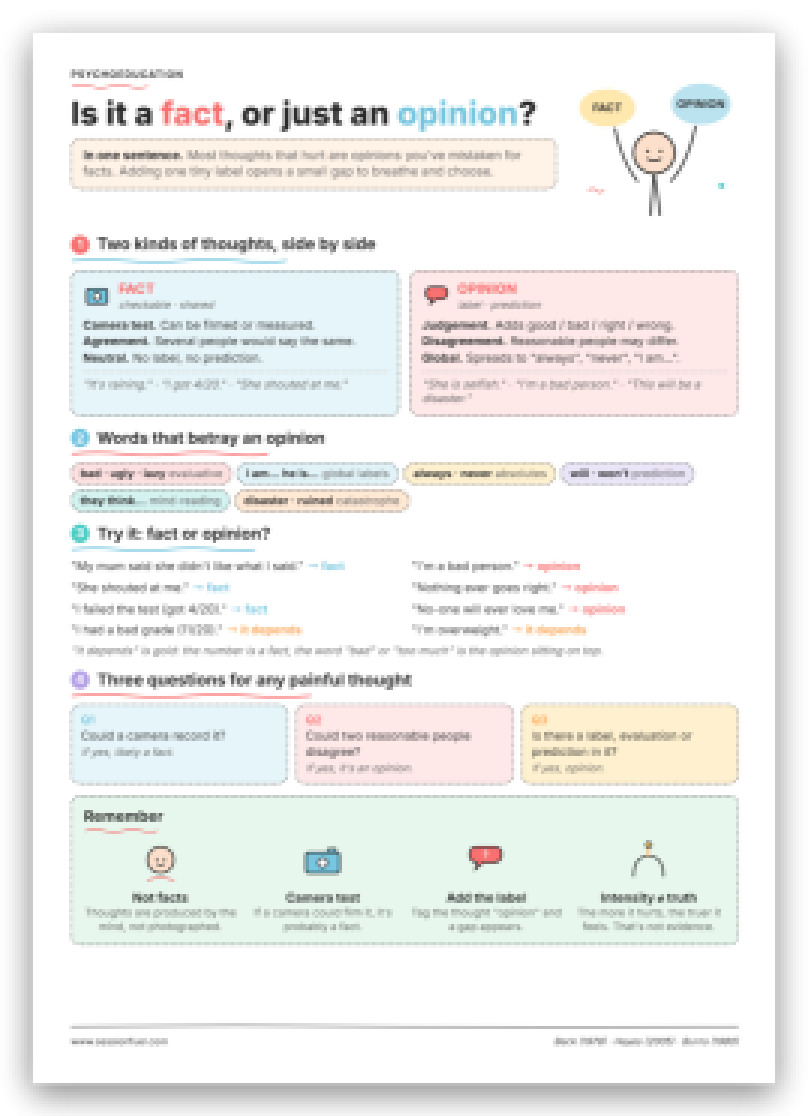
The fiche is structured across four clearly delimited panels, designed to be worked through sequentially with the patient during the session.
Panel 1 places Fact and Opinion side by side in two columns. Each column lists its defining criteria: facts are checkable and shared ("several people would say the same"), opinions carry judgements, global labels, and predictions. Examples run directly beneath each column: "She shouted at me" versus "She is selfish." The side-by-side layout makes visible in seconds what an oral explanation takes minutes to convey.
Panel 2 lists the lexical markers of opinion: evaluative adjectives (bad, ugly, lazy), global labels (I am..., he is...), absolute quantifiers (always, never), predictions (will, won't), mind-reading (they think...), and catastrophising language (disaster, ruined). This panel works as a quick reference alongside the mind reading cognitive distortion work or catastrophizing protocols you may already be running.
Panel 3 applies the framework to six realistic sentences, including two flagged "it depends": "I had a bad grade (11/20)" where the number is a fact but the word "bad" is the opinion sitting on top. This is clinically important: it shows patients that facts and opinions are often layered, not simply alternating.
Panel 4 offers three structured questions the patient can apply to any painful thought: Could a camera record it? Could two reasonable people disagree? Is there a label, evaluation, or prediction in it? These questions do the same work as the ABC model activating event/belief distinction, but in plain language accessible at any literacy level.
The fiche closes with four "Remember" anchors, including the clinically decisive phrase: "Intensity ≠ truth. The more it hurts, the truer it feels. That's not evidence." Having this printed and in the patient's hands removes the burden of your repeating it.
> Key takeaway: this is a visual support that facilitates the explanation of the fact/opinion distinction in session, not a self-administered questionnaire. The patient does not fill it out alone; you use it together to make a complex cognitive move legible, build shared vocabulary, and leave a concrete reference they can take home.
Clinical library
750+ clinical tools
A library built with and for clinicians, ready to use in session and extend between appointments.
Access all the toolsSeveral resource types
Psychoeducation handouts
Understand at a glance
Interactive exercises
To do and fill in
Interactive programs
A structured path
Audios
Meditation and relaxation
Psychometric tests
Automatic scoring
When and How to Introduce It in Session
The worksheet fits naturally from session two onward, once the initial formulation is in place and you are beginning to map the patient's automatic thoughts. It is particularly well-matched to patients who intellectually accept that thoughts are not facts but keep treating their cognitions as reportage, a pattern you will recognise from emotional reasoning presentations and from patients working through automatic thought identification.
A low-threshold introduction: "I'd like to show you something we'll use a lot. It's a simple grid about the difference between a fact and an opinion. Can we put one of your recent thoughts into it?" That framing positions the fiche as a shared working tool, not a didactic lesson.
The three-question panel (Panel 4) can then be assigned as between-session practice, paired with a cognitive restructuring exercise or a thought-catching log if the patient is ready to work autonomously. Debrief by asking which of their week's painful thoughts turned out to be opinions: the "it depends" category often generates the richest clinical material.
One limit to keep in mind: patients with active psychosis or severe dissociation may find the fact/opinion binary destabilising. In those contexts, the distancing and decentering approach or an evaluating thought utility exercise may be a better entry point before returning to this worksheet.
The fiche does not replace the cognitive work; it makes the first move of that work concrete enough that the patient can actually do it.
Use it with your patients
Share this tool in the mobile app and follow the work between sessions.
Sources
- Beck, A. T., Rush, A. J., Shaw, B. F., & Emery, G. (1979). Cognitive Therapy of Depression. Guilford Press.
- Burns, D. D. (1980). Feeling Good: The New Mood Therapy. William Morrow.
- Hayes, S. C., & Smith, S. (2005). Get Out of Your Mind and Into Your Life: The New Acceptance and Commitment Therapy. New Harbinger.
- Hayes, S. C., Strosahl, K. D., & Wilson, K. G. (1999). Acceptance and Commitment Therapy: An Experiential Approach to Behavior Change. Guilford Press.
Patient mobile app
Your session continues in your patients' pocket
Use with a patientYour resources, available everywhere
The handouts, exercises, programs and audios above: you choose which ones to make available to your patients, in the mobile app dedicated to them.
Psychoeducation handoutsInteractive exercisesInteractive programsAudiosPsychometric tests
And far more than a library
The app goes well beyond resources, to support your patients every day:
Standardized tests
Therapy journal
Gamification
Wellbeing challenges
Introspection prompts
Therapist homework
Related categories
Explore other clinical resources by category.
Anxiety
Clinical hub for anxiety disorders: CBT and ACT worksheets, psychoeducation sheets, and exercises for assessment and treatment across the anxiety spectrum.

Mood
Evidence-based worksheets and clinical tools for mood disorders: CBT, ACT, and positive psychology resources for psychologists and therapists.

Identity
Clinical resources for self-identity work in therapy: CBT, ACT, schema tools for clinicians addressing self-concept, core beliefs, and identity disruption.

Cognition
Printable cognitive therapy worksheets and clinical tools for therapists: CBT, ACT, schema work, defusion, distortions, and belief restructuring.

Build awareness
Clinical worksheets and tools to build awareness in therapy: cognitive distortions, schemas, emotions, ACT and CBT resources for practitioners.

Restructure
Clinical hub for cognitive restructuring worksheets: distortion identification, belief disputation, ABC model, and schema work for evidence-based practice.