
Clinical picture. M., a woman in her late thirties, presented with recurrent low mood and a long history of abandoned health goals. She described a consistent pattern: she would adhere strictly to a dietary plan for several days, eat one unplanned item, and then conclude that she had "completely blown it" and abandon the plan entirely for weeks. In session, the clinician introduced the switch-versus-dimmer framework from the psychoeducational sheet, inviting M. to place the episode on a 0-to-100 scale rather than in a pass-or-fail category. M. rated the slip at roughly 15 out of 100 in terms of actual impact on her overall goal. Over the following fortnight she reported two similar slips, neither of which triggered full abandonment, and described the shift as "less dramatic, which I suppose is the point."
All-or-Nothing Thinking: PDF Worksheet, Tools and Exercises
A visual PDF worksheet with tools and exercises to explain all-or-nothing thinking in session and give patients a concrete cognitive anchor they can keep.
Clinical vignettes
One Slip, Abandoned Goal
Performance Review, Binary Self-Appraisal
Clinical picture. T., a man in his mid-forties, sought treatment following a performance review at work that he rated as "a total failure" despite receiving mixed feedback, mostly positive with two areas flagged for development. The clinician noticed the tell-tale words appearing throughout his account: "useless," "never good enough," "completely wrong role for me." Using the informational sheet as a shared reference, they identified the binary sorting happening in real time and worked through the actual review content item by item, assigning rough percentage ratings to each domain. T. acknowledged that his average across domains sat well above the midpoint. His mood rating at the end of the session had shifted modestly; he remained sceptical but agreed to trial the sliding-scale language before the next appointment.
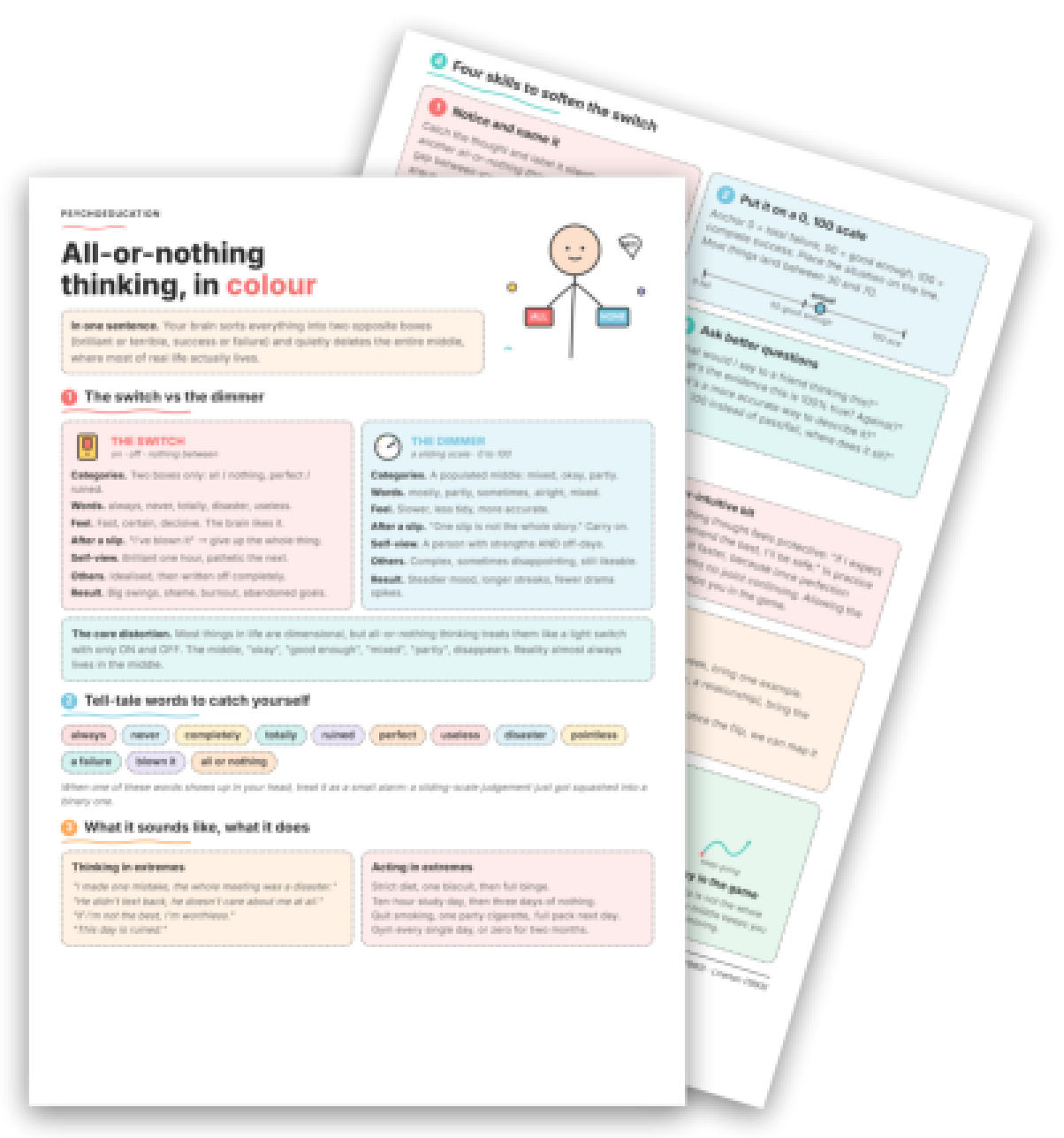
Explaining all-or-nothing thinking verbally is one of those moments where patients nod, say they understand, and then walk out still using "always," "never," and "ruined" with full conviction. The problem isn't their intelligence; it's that the mechanism is structural and spatial, and words alone don't show the structure. This fiche PDF is a visual support designed to do precisely that, in session, alongside you.
Use this resource with your patients
Handout, exercises and materials ready to use, right inside SessionFuel.
Why All-or-Nothing Thinking Resists Oral Explanation
Binary cognition feels correct from the inside. When Beck described dichotomous thinking as a core feature of depressive and anxious processing, he was pointing at something the patient genuinely cannot perceive as distorted without an external reference. They aren't choosing to catastrophise; the mental shortcut operates below deliberate reflection.
What makes this particularly tricky to address verbally is the speed of the pattern. The patient experiences a decisive clarity, a snap judgment that "the day is ruined" or "I'm a failure." Oral psychoeducation can name it, but it rarely slows the process enough for the patient to observe their own mechanism. You end up in a session loop: you explain, they acknowledge, the pattern fires again unchanged.
The fiche sidesteps this by externalising the cognitive structure. The patient can see two modes laid out side by side, compare them, and locate themselves. That visual act of comparison is something no amount of explanation produces alone.
What the Fiche Contains: A Visual Framework Built Around One Contrast
The structural spine of the fiche is "The Switch vs The Dimmer," a two-column comparison that maps every dimension of dichotomous thinking against its dimensional alternative: categories, typical vocabulary, felt sense, what happens after a slip, self-view, view of others, and downstream consequences. One column captures the snap certainty of always / never / disaster; the other populates the middle ground with mostly / partly / mixed / alright. Seeing both columns simultaneously is what makes the contrast land.
Section 2 gives patients a lexical alarm system: twelve tell-tale words, from "totally" and "pointless" to "blown it," printed as a scannable list. The framing the fiche uses, "treat it as a small alarm: a sliding-scale judgement just got squashed into a binary one," is worth quoting directly in session.
Section 3 distinguishes thinking in extremes from acting in extremes, with concrete behavioural examples (strict diet followed by a full binge; daily gym followed by two months of nothing). This section is particularly useful with patients whose all-or-nothing pattern operates primarily at the behavioural level, a presentation that often escapes purely cognitive reframing. Pair it with the Overgeneralization in CBT worksheet or the Decatastrophizing worksheet when the cognitive layer needs more explicit work.
Section 4 outlines four graduated skills: naming the thought (defusion-adjacent, consistent with the work in ACT Cognitive Defusion), placing the situation on a 0-100 scale with an explicit midpoint at 50 ("good enough"), building a vocabulary of shades, and applying four structured reappraisal questions. The scale skill maps neatly onto the ABC Model (REBT) if you are working within a rational-emotive frame.
A final "To discuss in session" block gives patients three concrete observation prompts to bring back, making the fiche a natural bridge to the following session.
> Key point: The fiche is a visual support that facilitates the explanation of all-or-nothing thinking in session; it is not a questionnaire patients complete alone, but a shared reference that gives you and your patient a common language and a concrete takeaway.
750+ clinical tools
A library built with and for clinicians, ready to use in session and extend between appointments.
Access all the toolsWhen and How to Introduce It
The fiche fits naturally from the second or third session onward, once you have a preliminary formulation and can locate the binary pattern in the patient's own examples. It works across presentations: perfectionism and procrastination (where the Perfectionism clinical exercise extends the work), global self-judgments, relapse cycles in addictive or disordered eating behaviour, and interpersonal idealisation-devaluation sequences.
To introduce it without labelling, you might say: "I want to show you something about how the brain tends to categorise; see if any of this rings a bell for you." Then work through the switch-vs-dimmer columns together, asking the patient to place their own language in one column or the other.
Debrief it at the next session using the "To discuss in session" prompts. Where the fiche opens a question about the beliefs fuelling the binary pattern, bridge to Clarifying Core Beliefs or Tracking the Origin of a Negative Thought. Where a Mind Reading pattern drives the all-or-nothing interpretation of others' behaviour, pair the fiches directly. Adolescents and young adults often respond especially well to the Growth Mindset worksheet as a follow-on frame.
One genuine limit: patients with active mania or a pronounced need for cognitive control may resist the "dimmer" frame as threatening, not liberating. In those cases, introduce the scale gradually rather than contrasting it against the switch at full intensity in a first pass.
The fiche does not replace clinical formulation or the relational work of the session. It makes one important piece of that work visible, portable, and reusable between appointments.
Use it with your patients
Share this tool in the mobile app and follow the work between sessions.
Sources
- Beck, A. T., Rush, A. J., Shaw, B. F., & Emery, G. (1979). Cognitive Therapy of Depression. Guilford Press.
- Burns, D. D. (1980). Feeling Good: The New Mood Therapy. Avon Books.
Your session continues in your patients' pocket
Use with a patientYour resources, available everywhere
The handouts, exercises, programs and audios above: you choose which ones to make available to your patients, in the mobile app dedicated to them.
And far more than a library
The app goes well beyond resources, to support your patients every day:
Related categories
Explore other clinical resources by category.

Mood
Evidence-based worksheets and clinical tools for mood disorders: CBT, ACT, and positive psychology resources for psychologists and therapists.

Behaviours
Clinical hub for behaviors in therapy: worksheets and tools for coping, eating disorders, CBT formulation, and maladaptive behavioral patterns.

Cognition
Printable cognitive therapy worksheets and clinical tools for therapists: CBT, ACT, schema work, defusion, distortions, and belief restructuring.

Understand
Clinical hub for the therapeutic aim 'Understand': worksheets and tools to build patient insight across CBT, ACT, schema therapy and more.

Build awareness
Clinical worksheets and tools to build awareness in therapy: cognitive distortions, schemas, emotions, ACT and CBT resources for practitioners.

Restructure
Clinical hub for cognitive restructuring worksheets: distortion identification, belief disputation, ABC model, and schema work for evidence-based practice.