
Clinical picture. M., a woman in her late thirties, presented with recurrent depressive episodes and a pattern of systematically withdrawing from professional opportunities. In a previous session she had tentatively named the belief "I am fundamentally inadequate," and the clinician assigned the structured exercise as between-session homework. Completing the five questions, M. traced the belief to repeated critical comparisons made by a parent during her primary school years, and she identified avoidance of evaluation situations as its main behavioral expression. She returned with written responses noting that the belief also generated a rigid demand that she perform flawlessly before she could consider herself acceptable. This gave the therapist a concrete, patient-generated map from which to begin cognitive restructuring work.
Clarifying a Core Belief: A Structured Clinical Exercise
A guided homework tool helping patients identify, trace, and examine a core belief they have already spotted in therapy, in their own words.
Clinical vignettes
Tracing a Worthlessness Belief in CBT
Examining a Trust Belief After Relational Trauma
Clinical picture. T., a man in his early fifties referred for generalized anxiety with marked interpersonal withdrawal, had identified in session the belief "Others will inevitably let me down." The clinician introduced the clarification exercise as a structured way to slow down and examine what had until then felt like an obvious truth. T. linked the belief to a period in adolescence marked by repeated betrayals within a close peer group, and through question four he articulated how the belief drove him to pre-emptively end relationships before disappointment could arrive. He noted, unprompted, a secondary demand that people prove their reliability through continuous demonstration, a pattern he had not previously made explicit. The completed exercise provided material for a collaborative formulation review at the following appointment.
Why this is clinically harder than it looks
Most patients arrive at the idea of a core belief through the work you do together: a downward arrow sequence, a pattern that keeps surfacing, a formulation moment where something clicks. But naming a belief in the room and genuinely understanding it are two different things. The insight is fragile. Left unprocessed between sessions, it often dissolves or hardens into a cliché the patient repeats without ownership.
What resists purely verbal work is the concrete architecture of the belief: where it came from, which specific behaviors it drives, how it structures avoidance, and whether it generates rigid demands on the self, others, or the world. These are the dimensions that make a core belief clinically workable, not just intellectually acknowledged. Patients need time, privacy, and a structured prompt to really sit with those questions. A conversation in the session rarely gives them enough of either.
This exercise is designed for exactly that gap.
Use this resource with your patients
Handout, exercises and materials ready to use, right inside SessionFuel.
What the exercise contains
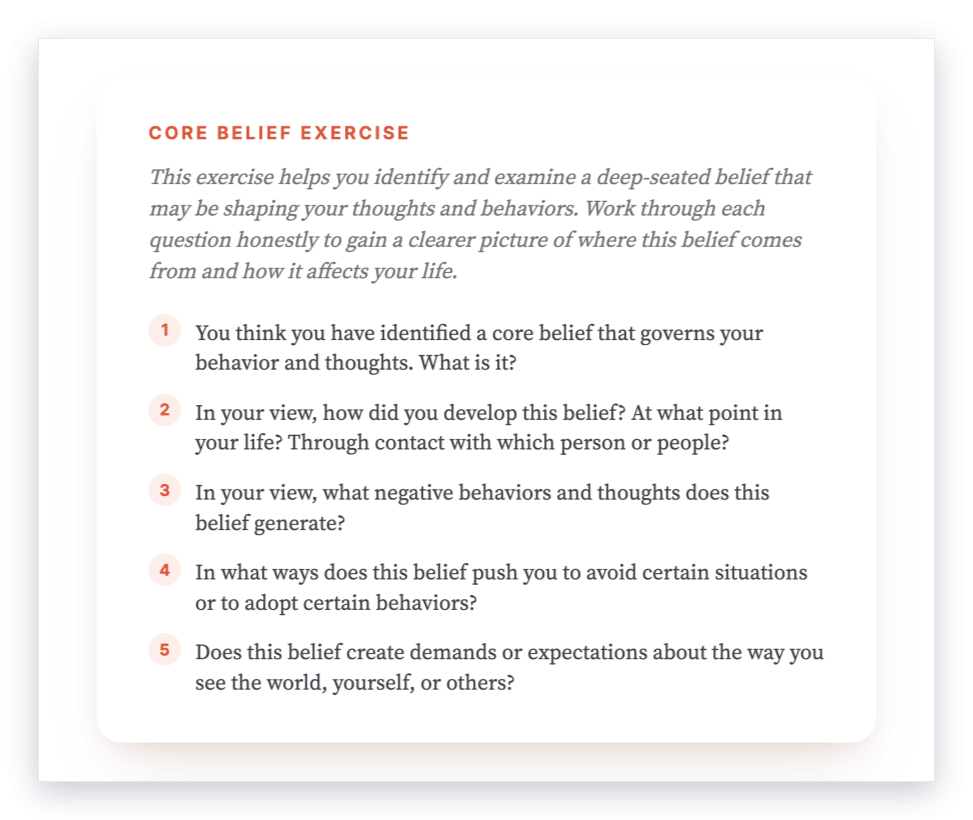
The tool opens by asking the patient to state the belief they have already identified: putting it into their own words, without paraphrase. From there, the questions move deliberately across four dimensions that matter for formulation and change.
The second question targets developmental origin: the period of life, the relational context, the figures involved. This connects the present conviction to the formative experiences that shaped it, grounding schema work in something datable and personal rather than abstract.
The third question maps behavioral and cognitive consequences: the negative thoughts and behaviors the belief generates. This is the maintaining layer that tools like the CBT Maintaining Processes worksheet and Cognitive Case Formulation help clinicians visualize. Here, the patient produces that mapping themselves, in their own language.
The fourth question focuses specifically on avoidance and behavioral constriction: how the belief pushes the patient away from certain situations or locks them into certain patterns. This is where the exercise touches the cycle of avoidance and where schema maintenance loops become personally legible.
The fifth question asks whether the belief generates demands: rigid expectations about the self, others, or the world. This connects directly to the clinical territory of "should" statements and demanding standards, and often surfaces the moralistic or absolutist dimension of a belief that ordinary reflection misses.
The image above lists all five questions with a brief introductory prompt. Note that this image is a static preview of the questions only: the full guided exercise, with patient-facing instructions and space to answer, is experienced by the patient independently in the app, not through this image.
This exercise is available to patients through the mobile application that is the dedicated patient-side interface of SessionFuel: once you assign it in your SessionFuel account, your patient receives it directly on their phone and completes it on their own, at their own pace, between two appointments.
Key insight: A core belief named in session is not yet owned by the patient. This exercise gives them a structured framework to carry that belief into their own life, examine it from multiple angles, and return to you with something genuinely worked through.
750+ clinical tools
A library built with and for clinicians, ready to use in session and extend between appointments.
Access all the toolsUse it with your patients
Share this tool in the mobile app and follow the work between sessions.
How to integrate this as between-session homework
This exercise suits patients who have already done some belief identification work with you: those who can name a belief that feels real to them, even if they cannot yet explain its full reach. It is not a first-step psychoeducation tool; it assumes the patient is past the "what is a core belief" stage, which you might introduce using the Core Beliefs About Self, Others, and World or Early Maladaptive Schemas fiches.
To introduce it, you might say simply: "You have put words to this belief in our sessions. Before we meet again, I want you to explore it on your own, following a few structured questions. There are no right answers: I am interested in what comes up for you." Assigning it between two sessions gives the patient genuine processing time.
When the patient returns, the material they produce becomes a clinical resource. The developmental origin they describe (question 2) can feed directly into your longitudinal case formulation. The avoidance patterns they map (question 4) tell you where behavioral work is most needed. The demands they surface (question 5) tell you whether restructuring will need to address the schema bias that keeps the belief resistant to disconfirming evidence.
From there, the natural continuation is Restructuring a Negative Core Belief, Replacing a Negative Core Belief, or Reinforcing a New Core Belief, depending on where the patient is in the change process. This exercise functions as the diagnostic step that makes those next moves genuinely targeted rather than generic.
Your session continues in your patients' pocket
Use with a patientYour resources, available everywhere
The handouts, exercises, programs and audios above: you choose which ones to make available to your patients, in the mobile app dedicated to them.
And far more than a library
The app goes well beyond resources, to support your patients every day:
Related categories
Explore other clinical resources by category.

Anxiety
Clinical hub for anxiety disorders: CBT and ACT worksheets, psychoeducation sheets, and exercises for assessment and treatment across the anxiety spectrum.

Mood
Evidence-based worksheets and clinical tools for mood disorders: CBT, ACT, and positive psychology resources for psychologists and therapists.

Identity
Clinical resources for self-identity work in therapy: CBT, ACT, schema tools for clinicians addressing self-concept, core beliefs, and identity disruption.

Behaviours
Clinical hub for behaviors in therapy: worksheets and tools for coping, eating disorders, CBT formulation, and maladaptive behavioral patterns.

Cognition
Printable cognitive therapy worksheets and clinical tools for therapists: CBT, ACT, schema work, defusion, distortions, and belief restructuring.

Build awareness
Clinical worksheets and tools to build awareness in therapy: cognitive distortions, schemas, emotions, ACT and CBT resources for practitioners.