
Clinical picture. T., a 34-year-old lawyer, presented with chronic work-related exhaustion and recurrent shame episodes after minor professional errors. He described himself as having "high standards," and initially resisted framing this as a clinical concern. The clinician introduced the worksheet in session, walking T. through the preference/value/demanding standard distinction. When T. reached the sign "relief instead of pride," he paused and noted that completing a brief flawlessly never felt good, only safe. That single recognition opened a productive discussion about the implicit rule "I must never make a mistake or I am incompetent," which had been operating outside his awareness for years.
HandoutAnxietyBehaviours & addictionsThoughts & cognitionSelf & identityBuild awarenessRestructureCBTREBT
Demanding Standards: PDF Worksheet, Tools and Exercises for Clinical Practice
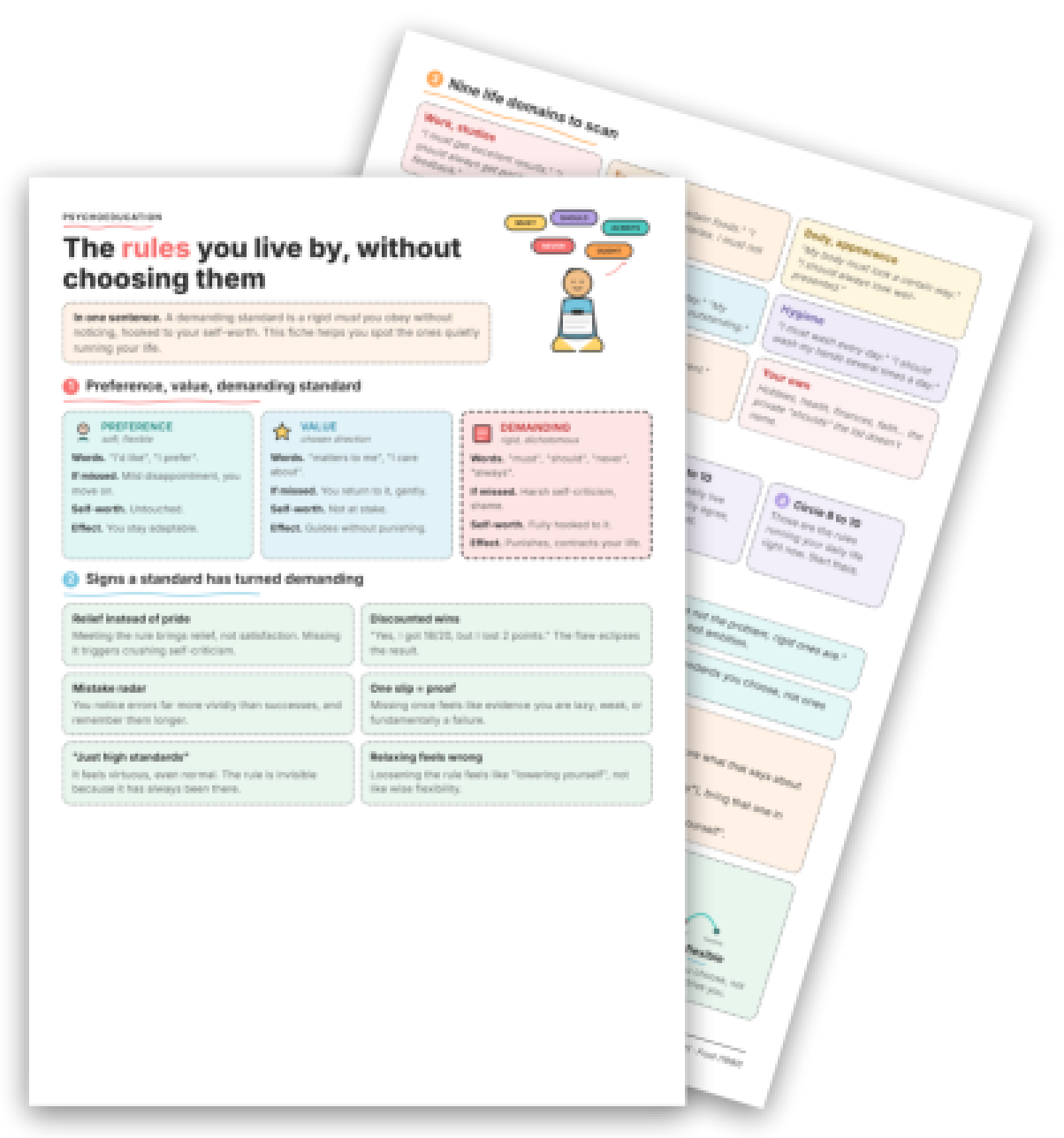
A visual PDF worksheet to help clinicians identify rigid personal rules, distinguish them from values, and open the conversation about self-worth during the session.
Clinical vignettes
Naming the Rule Behind the Relief
Scanning Domains Reveals a Hidden Standard
Clinical picture. M., a 27-year-old graduate student, sought help for persistent low mood and social withdrawal. Her presenting complaint centered on academic performance, but affect flattening appeared across multiple life areas. During a structured review of the nine life domains on the worksheet, M. identified a rule in the social domain she had never articulated: "I must never cause anyone discomfort or I am a burden." She had experienced this as a personal value rather than a rigid standard, and had not linked it to her avoidance of spontaneous social contact. Naming it as a demanding standard, rather than a character trait, allowed the clinician to introduce the idea that the rule could be examined rather than simply obeyed.
Patients with demanding standards almost never present them as rules. They present them as facts about the world, or as basic decency, or simply as "having high standards." Explaining the distinction verbally tends to produce polite agreement and little else. This fiche PDF makes the distinction visible, giving you a shared reference point to work from rather than an abstraction to argue over.
Use this resource with your patients
Handout, exercises and materials ready to use, right inside SessionFuel.
Why Demanding Standards Are Hard to Surface in Session
The clinical obstacle is ego-syntonic embedding. A standard that has governed behaviour since adolescence feels like identity, not like a rule that could be questioned. When you introduce the concept orally, the patient often agrees in principle while immediately exempting their own rules from scrutiny. Their standard around work performance is simply "being professional." Their food rule is "just being careful." The rigidity is invisible because it has always been there.
Two features compound the difficulty. First, intermittent reinforcement: the standard occasionally pays off (a flawless result, an organised environment), which entrenches the belief that the rule works. What the patient registers is the relief of meeting it, not the cost of being governed by it. Second, the all-or-nothing thinking that typically accompanies these standards means that any single slip becomes evidence of fundamental failure, which is almost impossible to convey in the abstract.
Within early maladaptive schemas, this maps onto the Unrelenting Standards schema (Young et al.). In REBT, it is classic demandingness. In the clinical perfectionism model of Shafran and Egan, it is the engine of self-evaluative rigidity. Whatever the framework, the gap between naming the mechanism and helping a patient recognise it in their own life remains wide. That is precisely the gap this fiche addresses.
Clinical library
750+ clinical tools
A library built with and for clinicians, ready to use in session and extend between appointments.
Access all the toolsSeveral resource types
Psychoeducation handouts
Understand at a glance
Interactive exercises
To do and fill in
Interactive programs
A structured path
Audios
Meditation and relaxation
Psychometric tests
Automatic scoring
What the Fiche Contains: A Visual Support for In-Session Explanation
The resource is structured across five panels, each one doing clinical work that oral explanation alone cannot.
Panel 1 presents a three-column comparison: preference, value, and demanding standard. For each category, the fiche shows the characteristic language ("I'd like" vs. "must/should/never"), what happens to self-worth when it is missed, and the overall effect on daily functioning. Placed next to each other visually, the contrast between a standard that leaves self-worth untouched and one that hooks it entirely becomes concrete rather than theoretical. This column layout is what makes the concept stick.
Panel 2 lists six behavioural and cognitive signs that a standard has turned demanding: relief rather than pride when the rule is met, discounted wins, a sharp mistake radar, treating one slip as global proof of failure, the sense that the standard is simply "virtuous," and the feeling that relaxing it means lowering yourself. Patients often recognise two or three of these on first read, which opens the clinical conversation without requiring you to label them.
Panel 3 offers a nine-domain scan: work, food, body and appearance, social relationships, exercise, hygiene, organisation, parenting, and an open "your own" field for domains the list misses. Patients are asked to tick each rule that genuinely lives in their head, add personal ones, and then rate each on a 0-to-10 scale. The instruction "Circle 8 to 10: those are the rules running your daily life right now" focuses attention efficiently.
Panel 4 frames the scan as pure observation, with reframes such as "A standard you can never reach is not a standard, it's a trap", and closes with explicit session discussion prompts for when a patient defends a rule scored 9 or 10, or when relaxing any rule on paper brings up shame.
> Key point: this fiche is a visual support that facilitates in-session explanation. It is not a self-administered questionnaire. You work through it together, and the patient leaves with a concrete reference rather than a concept that fades between sessions.
Use it with your patients
Share this tool in the mobile app and follow the work between sessions.
When and How to Introduce It in Practice
The fiche fits naturally from the second or third session onward, once an initial formulation is taking shape. It is particularly useful when the clinical picture involves signs of perfectionism, low self-esteem, chronic self-criticism, or difficulty tolerating mistakes. You can introduce it with a simple framing: "I'd like us to look at something together. There's a difference between having values and having rules you can't break without feeling like you've failed. This sheet maps that difference."
During the scan, watch for domains where a patient has scored many rules at 8 or above, and for any rule they immediately defend. That defence is the entry point. The fiche's own discussion prompts ("if you find yourself defending a rule you scored 9 or 10, bring that one in first") do part of this clinical framing for you.
For patients who have already begun examining their standards, pair this resource with Evaluating Demanding Standards, which takes the next step of weighing costs and benefits. For those whose standards are driven by a demandingness schema in an REBT framework, the fiche provides the identification phase before moving toward preference conversion. The downward arrow technique works well as a follow-up when a high-rated rule points to a deeper core belief, and the perfectionism ratchet effect fiche complements it for patients who keep raising the bar regardless of performance. For the self-compassion work that often follows identification, Accepting Mistakes offers a structured between-session exercise.
One limit worth noting: patients with very high shame or active self-critical rumination may find the scan activating even when framed as observation. In those cases, slow the process, work through one domain per session, and use the reframes in Panel 4 explicitly before each domain rather than at the end.
The fiche does not replace the therapeutic relationship or the case formulation. What it does is make an otherwise slippery construct visible enough to work with, and leave the patient with a map they can return to on their own.
Patient mobile app
Your session continues in your patients' pocket
Use with a patientYour resources, available everywhere
The handouts, exercises, programs and audios above: you choose which ones to make available to your patients, in the mobile app dedicated to them.
Psychoeducation handoutsInteractive exercisesInteractive programsAudiosPsychometric tests
And far more than a library
The app goes well beyond resources, to support your patients every day:
Standardized tests
Therapy journal
Gamification
Wellbeing challenges
Introspection prompts
Therapist homework
Related categories
Explore other clinical resources by category.

Anxiety
Clinical hub for anxiety disorders: CBT and ACT worksheets, psychoeducation sheets, and exercises for assessment and treatment across the anxiety spectrum.

Identity
Clinical resources for self-identity work in therapy: CBT, ACT, schema tools for clinicians addressing self-concept, core beliefs, and identity disruption.

Behaviours
Clinical hub for behaviors in therapy: worksheets and tools for coping, eating disorders, CBT formulation, and maladaptive behavioral patterns.

Cognition
Printable cognitive therapy worksheets and clinical tools for therapists: CBT, ACT, schema work, defusion, distortions, and belief restructuring.

Build awareness
Clinical worksheets and tools to build awareness in therapy: cognitive distortions, schemas, emotions, ACT and CBT resources for practitioners.

Restructure
Clinical hub for cognitive restructuring worksheets: distortion identification, belief disputation, ABC model, and schema work for evidence-based practice.