
Clinical picture. A, a woman in her late thirties, presented with generalised anxiety and a long-standing pattern of rumination centred on professional competence. During a session following a difficult appraisal meeting, she reported the thought: "I always underperform, everyone can see it." The clinician introduced the Socratic Questioning Worksheet and walked through the eight questions with her, pausing on Question 4 to examine the absolute terms "always" and "everyone." A identified two concrete pieces of counterevidence she had initially dismissed and noted, unprompted, that the thought carried a familiar voice from an earlier supervisor. By the session's end she had drafted a revised thought that retained her genuine concern about one specific skill gap while dropping the global self-indictment; she rated the revised version as noticeably more believable than the original.
Socratic Questioning: PDF Worksheet, Tools and Exercises for CBT Practice
A printable PDF worksheet with structured tools and exercises to help clinicians teach patients to examine automatic thoughts with precision rather than reassurance.
Clinical vignettes
Worksheet Slows a Ruminative Spiral
Adolescent Practises Written Thought-Testing
Clinical picture. T, a sixteen-year-old referred for low mood following social withdrawal, described a recurring thought that arose before school each morning: "If I say the wrong thing, everyone will think I'm an idiot." The clinician offered the worksheet as a between-session task, explaining it as a way to treat the thought as a claim that needed checking rather than a conclusion. T returned the following week having completed the evidence columns and the "likely or just possible" question, noting he had found no concrete memory of peers mocking him in the past term. He remained cautious about social interactions but reported that writing the process down had reduced the intensity of the morning thought enough that he had attended school on four of five days, an improvement from the previous fortnight.
Most patients grasp the idea of Socratic questioning quickly enough when you explain it verbally, then promptly collapse back into confirmation bias the moment a hot thought appears between sessions. This Socratic Questioning PDF worksheet gives you a visual anchor to introduce the method in session and hand the patient something concrete to return to when their reasoning narrows.
Use this resource with your patients
Handout, exercises and materials ready to use, right inside SessionFuel.
Why Socratic Questioning Is Hard to Teach at the Oral Level
The standard explanation runs like this: a thought is a hypothesis, not a fact, let's test it. Patients nod. But without a scaffold, they either over-reassure themselves ("it'll probably be fine") or interrogate the wrong thing entirely: an accurate appraisal of a real problem, rather than a distorted one. A second, subtler issue is the accuracy versus positivity confusion. Patients trained on affirmations expect the technique to produce a brighter thought. When the restructured cognition still carries some discomfort, they conclude they've done it wrong.
These are the two points where oral psychoeducation reliably loses traction. A five-column thought record can capture the output of Socratic questioning, but it doesn't walk the patient through the questioning process itself. That is exactly the gap this fiche PDF fills.
What the Worksheet Contains: A Visual Support for the Questioning Process
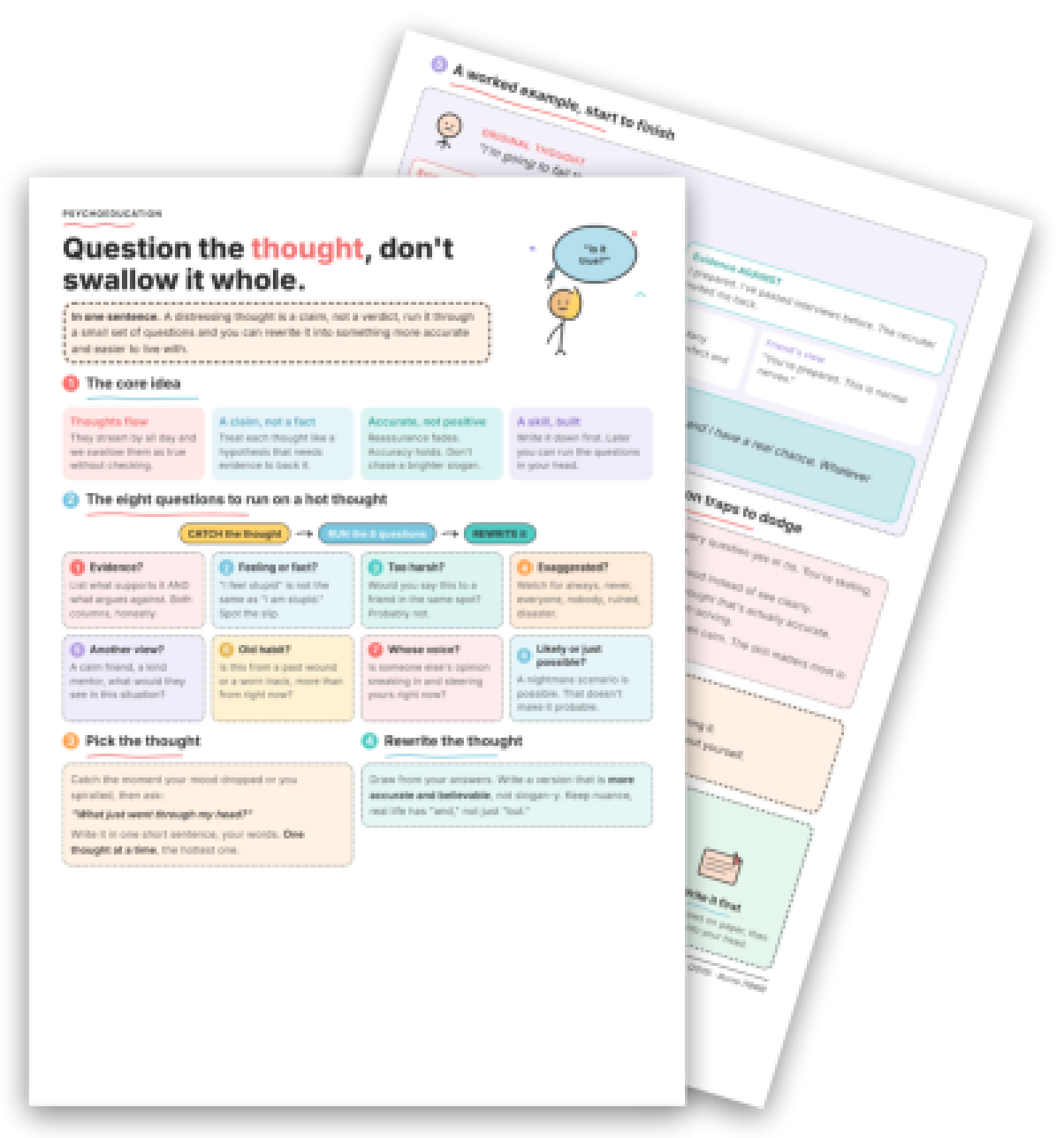
The fiche is structured around eight questions to run on a single "hot thought," preceded by brief framing panels and followed by a fully worked example. The layout is a clinician's teaching tool, not a self-completion questionnaire.
The four framing principles in the opening panel establish the clinical logic immediately: thoughts flow past all day without scrutiny; a thought is a claim, not a fact; the goal is accuracy, not a brighter slogan; and the skill is built on paper before it migrates into real-time thinking. This vocabulary maps directly onto what you'd want to say to a patient before introducing cognitive distortions or a thought-catching exercise.
The eight questions cover the ground that challenging automatic thoughts requires in practice:
- Evidence? Both columns, for and against, honestly.
- Feeling or fact? The slip from "I feel stupid" to "I am stupid", which is the heart of emotional reasoning.
- Too harsh? The friend test, quick and memorable.
- Exaggerated? Flags all-or-nothing thinking and absolutist language.
- Another view? A calm friend, a kind mentor.
- Old habit? Invites schema-level reflection without requiring full schema work.
- Whose voice? Surfaces introjected criticism.
- Likely or just possible? Decouples probability from possibility, the critical move in catastrophic thinking.
The fiche then shows the full CATCH / RUN / REWRITE sequence with a worked example (the pre-interview fear of failure), including separate evidence columns, a feeling-versus-fact check, and a rewritten thought that reads: "I'm nervous because this matters. I've prepared and I have a real chance." Showing a patient this completed example in session is faster than constructing one from scratch. A "signs you're doing it well" checklist and a "common traps" panel round out the resource, including the trap of "questioning a thought that's actually accurate" with the redirect toward problem-solving.
> To retain: this worksheet is a visual support that facilitates the explanation of Socratic questioning in session; it is not a homework form the patient fills out alone, but an in-session psychoeducation tool that leaves them with a precise, portable reference.
750+ clinical tools
A library built with and for clinicians, ready to use in session and extend between appointments.
Access all the toolsWhen and How to Propose the Worksheet
This fiche PDF fits naturally in an early-to-mid phase of CBT-informed work, once automatic thoughts have been identified and the patient understands the ABC model or the cognitive triangle. You can introduce it with a phrase such as: "You've noticed the thought. Now I want to show you the exact questions we can run on it." Lay the fiche on the desk or share it on screen, walk through the eight questions using a current hot thought from the session, then let the patient keep it.
For patients with perfectionism or core belief-level material, flag the "old habit" and "whose voice" questions explicitly: they create a natural bridge toward schema work without requiring you to frame it that way prematurely.
One limit worth naming: patients in acute crisis or with severe dépression mélancolique may find evidence-weighing exercises activating rather than regulating. Pair the worksheet with grounding tools in those cases, and prioritize the "to discuss in session" prompts the fiche itself flags when the questions aren't loosening a thought.
The worksheet doesn't replace the dialogue; it makes the first pass through it faster, more reproducible, and something the patient can re-run independently.
Use it with your patients
Share this tool in the mobile app and follow the work between sessions.
Sources
- Padesky, C. A. (1993). Socratic Questioning: Changing Minds or Guiding Discovery?.
- Beck, A. T., Rush, A. J., Shaw, B. F., Emery, G. (1979). Cognitive Therapy of Depression. Guilford Press.
- Beck, J. S. (2021). Cognitive Behavior Therapy: Basics and Beyond (3rd ed.). Guilford Press.
- Overholser, J. C. (1993). Elements of the Socratic Method: I. Systematic Questioning. Psychotherapy: Theory, Research, Practice, Training.
- Kazantzis, N., Fairburn, C. G., Padesky, C. A., Reinecke, M. A., Teesson, M. (2014). Unresolved Issues Regarding the Research and Practice of Cognitive Behavior Therapy: The Case of Guided Discovery Using Socratic Questioning. Behaviour Change.
Your session continues in your patients' pocket
Use with a patientYour resources, available everywhere
The handouts, exercises, programs and audios above: you choose which ones to make available to your patients, in the mobile app dedicated to them.
And far more than a library
The app goes well beyond resources, to support your patients every day:
Related categories
Explore other clinical resources by category.

Anxiety
Clinical hub for anxiety disorders: CBT and ACT worksheets, psychoeducation sheets, and exercises for assessment and treatment across the anxiety spectrum.

Mood
Evidence-based worksheets and clinical tools for mood disorders: CBT, ACT, and positive psychology resources for psychologists and therapists.

Identity
Clinical resources for self-identity work in therapy: CBT, ACT, schema tools for clinicians addressing self-concept, core beliefs, and identity disruption.

Cognition
Printable cognitive therapy worksheets and clinical tools for therapists: CBT, ACT, schema work, defusion, distortions, and belief restructuring.

Build awareness
Clinical worksheets and tools to build awareness in therapy: cognitive distortions, schemas, emotions, ACT and CBT resources for practitioners.

Restructure
Clinical hub for cognitive restructuring worksheets: distortion identification, belief disputation, ABC model, and schema work for evidence-based practice.