
Clinical picture. M., a 38-year-old project manager, presented with burnout and persistent low mood after a period of high workload. During assessment she described a long-standing private rule: "I must never hand in work that is less than perfect, or I am not doing my job." The clinician introduced the informational sheet on demanding standards and invited M. to locate her rule on the rule-versus-guideline continuum; she recognised, with some resistance, that any output below her self-set threshold triggered shame rather than problem-solving. Over two sessions she drafted a working guideline: "I aim to produce careful, thorough work and accept that constraints sometimes limit the outcome." She reported that framing it this way preserved her professional identity while reducing the all-or-nothing self-appraisal that had been sustaining her low mood.
Evaluating Demanding Standards: PDF Worksheet, Tools and Exercises
A visual PDF worksheet and structured tools to help clinicians explain rigid rules, challenge demanding standards, and guide patients toward flexible guidelines in session.
Clinical vignettes
Rigid Work Rule in Burnout Recovery
Parenting Standard and Chronic Guilt
Clinical picture. T., a 44-year-old parent of two, sought help for chronic guilt and irritability that had intensified after returning to full-time work. He identified a core rule he had never before articulated: "I should always be available to my children, or I am failing them." The clinician used the worksheet to walk T. through the six-step self-interview, focusing first on naming the rule precisely and then examining what tolerance for imperfection the rule actually allowed, which he acknowledged was none. T. noticed that missing bedtime on a busy evening triggered the same shame response as a serious parenting lapse. Reformulating the rule as a guideline, "I want to be reliably present for my children and accept that some evenings this is not possible," did not reduce his commitment to fathering but allowed him to re-engage after an absence rather than withdraw further in self-reproach.
Patients rarely present demanding standards as a problem. They present them as proof of character. That gap between clinical reality and the patient's experience is precisely where verbal explanation reaches its limit, and where this PDF worksheet earns its place at the centre of a session.
Use this resource with your patients
Handout, exercises and materials ready to use, right inside SessionFuel.
Why demanding standards slip past the patient's radar
The core clinical difficulty is not that patients deny having rules. It is that they experience rigid standards as identity, not cognition. When you name the pattern verbally, what the patient hears is a challenge to their integrity. The rule "I must never make a mistake at work" does not land as a belief open to examination; it lands as "who I am."
Patients who have already engaged well with identifying automatic thoughts or with the basics of all-or-nothing thinking will still struggle here, because the must/should/always/never language feels virtuous rather than distorted. The asymmetry between hitting the rule (brief, upward-shifting relief) and missing it (acute shame, sometimes avoidance or burnout) is routinely underreported. The shame feels deserved. That is exactly what makes this concept so resistant to a spoken formulation alone.
What the fiche contains: a visual scaffold for the rule-to-guideline shift
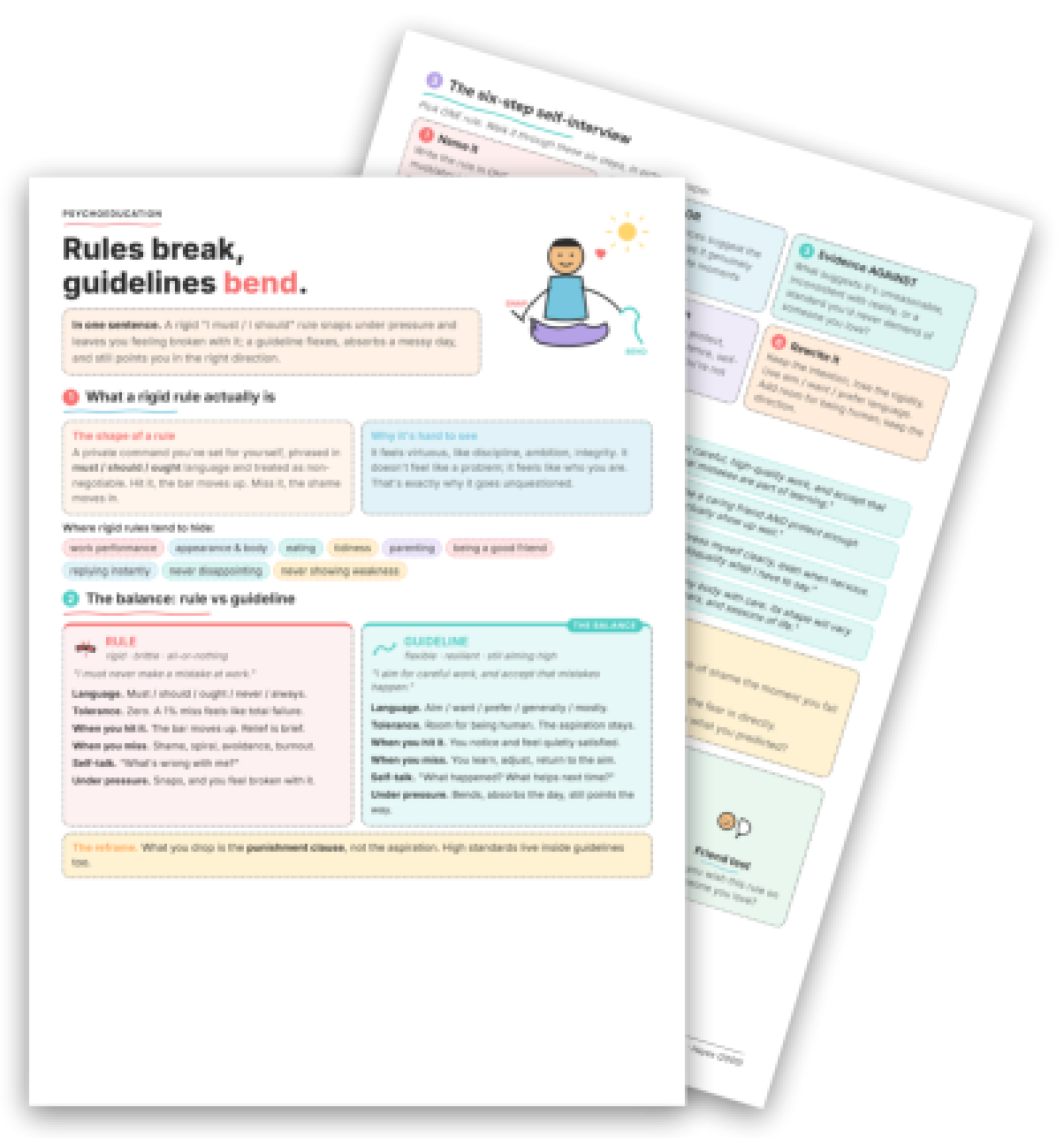
This four-panel PDF worksheet is built to carry the distinction from abstract concept to personal recognition, without the clinician having to hold every element in the air simultaneously.
The first panel defines the cognitive structure precisely: "a private command you've set for yourself, phrased in must / should / ought language and treated as non-negotiable." It also lists the domains where these rules most commonly hide, from work performance and appearance to parenting, friendship, and never showing weakness. Patients locate themselves before any introspective work is asked of them.
The second panel is a two-column comparison table contrasting RULE and GUIDELINE across seven dimensions: language, tolerance, what happens when the standard is met, what happens when it is missed, self-talk, and behaviour under pressure. This layout does something oral explanation cannot: it shows, on the page, that the aspiration survives the reframe. "What you drop is the punishment clause, not the aspiration." Patients who fear that loosening a rule means becoming mediocre can see the guideline column and register that the standard remains, just without the punishment mechanism. This visual moment is often where resistance shifts.
The third panel is a six-step self-interview, walked through on paper with one chosen rule: naming it precisely, weighing evidence for and against, reviewing past misses to check whether the predicted catastrophe actually occurred, naming the underlying intention, then rewriting in preference language. This sequence integrates naturally with cognitive restructuring work, downward arrow techniques, and schema-informed exploration of early maladaptive schemas around failure or defectiveness.
The fourth panel offers four complete, worked rule-to-guideline rewrites across work, friendship, social anxiety, and body image. The worked model substantially reduces abstraction for patients who struggle to generate their own reframe from scratch.
> Key point: This fiche is a visual support that facilitates the explanation of demanding standards in session, not a self-help handout the patient completes alone. The clinician navigates the panels; the patient engages with the content in real time and leaves with a concrete reference.
750+ clinical tools
A library built with and for clinicians, ready to use in session and extend between appointments.
Access all the toolsWhen and how to bring it into session
The fiche fits most naturally in the mid-phase of a CBT or schema therapy contract, once the therapeutic alliance is established and the patient has some working familiarity with the cognitive model. It pairs well with prior work on perfectionism, core beliefs, or the perfectionism ratchet effect.
A low-threshold introduction: "I want to show you something that maps out what I think we've been circling. It's one page. Can we look at it together?" Then open directly to the RULE versus GUIDELINE comparison table, which is typically the panel that catches attention first.
The "To discuss in session" prompts at the foot of the fiche name the two most common resistance points (fear that loosening the rule means becoming lazy or unloved; the flash of shame at a 1% miss) and give you an immediate clinical opening. For patients already engaged with REBT-informed demandingness work, the six-step self-interview maps directly onto converting absolute demands into preferences. For patients with significant perfectionism patterns or harsh self-criticism, the fiche can be debriefed alongside the self-compassion exercise on mistakes the following week.
The fiche does not replace the formulation; it makes one key piece of it legible, and leaves the patient a reference point when the rule next fires between appointments.
Use it with your patients
Share this tool in the mobile app and follow the work between sessions.
Sources
- Ellis, A., & Harper, R. A. (1975). A Guide to Rational Living. Wilshire Book Company.
- Ellis, A. (1956). Rational Psychotherapy. Albert Ellis Institute.
- Ellis, A.. Emotional Disturbance and Its Treatment in a Nutshell. Albert Ellis Institute.
- Dryden, W. (2023). Fundamentals of Rational Emotive Behaviour Therapy: A Training Handbook (3rd ed.). Wiley.
- Young, P., & Turner, M. J. (2023). To (i)B or not to i(B), that is the question: on the differences between Ellis REBT and Beck's CT. Behavioural and Cognitive Psychotherapy.
Your session continues in your patients' pocket
Use with a patientYour resources, available everywhere
The handouts, exercises, programs and audios above: you choose which ones to make available to your patients, in the mobile app dedicated to them.
And far more than a library
The app goes well beyond resources, to support your patients every day:
Related categories
Explore other clinical resources by category.
Anxiety
Clinical hub for anxiety disorders: CBT and ACT worksheets, psychoeducation sheets, and exercises for assessment and treatment across the anxiety spectrum.

Mood
Evidence-based worksheets and clinical tools for mood disorders: CBT, ACT, and positive psychology resources for psychologists and therapists.

Identity
Clinical resources for self-identity work in therapy: CBT, ACT, schema tools for clinicians addressing self-concept, core beliefs, and identity disruption.

Behaviours
Clinical hub for behaviors in therapy: worksheets and tools for coping, eating disorders, CBT formulation, and maladaptive behavioral patterns.

Cognition
Printable cognitive therapy worksheets and clinical tools for therapists: CBT, ACT, schema work, defusion, distortions, and belief restructuring.

Build awareness
Clinical worksheets and tools to build awareness in therapy: cognitive distortions, schemas, emotions, ACT and CBT resources for practitioners.