
Clinical picture. P., a woman in her mid-forties, presented with a six-month history of recurrent abdominal discomfort and escalating concern that she had undetected cancer, despite two unremarkable investigations. She checked her abdomen several times daily and sought GP reassurance at least weekly. The clinician introduced the Theory A / Theory B worksheet, inviting her to write out both accounts side by side: Theory A held that a real illness was being missed, while Theory B framed the problem as an intense fear maintained by body-scanning and repeated reassurance-seeking. When P. rated her belief in each theory and worked through the six structured questions, she noticed that her checking had never produced lasting relief and that calm only lasted until the next physical sensation. She agreed, tentatively, to delay one checking episode per day as a first behavioural test of Theory B, and reported at the following session that the urge had peaked and then subsided without escalating.
Theory A / Theory B: PDF Worksheet, Tools and Exercises for Clinical Practice
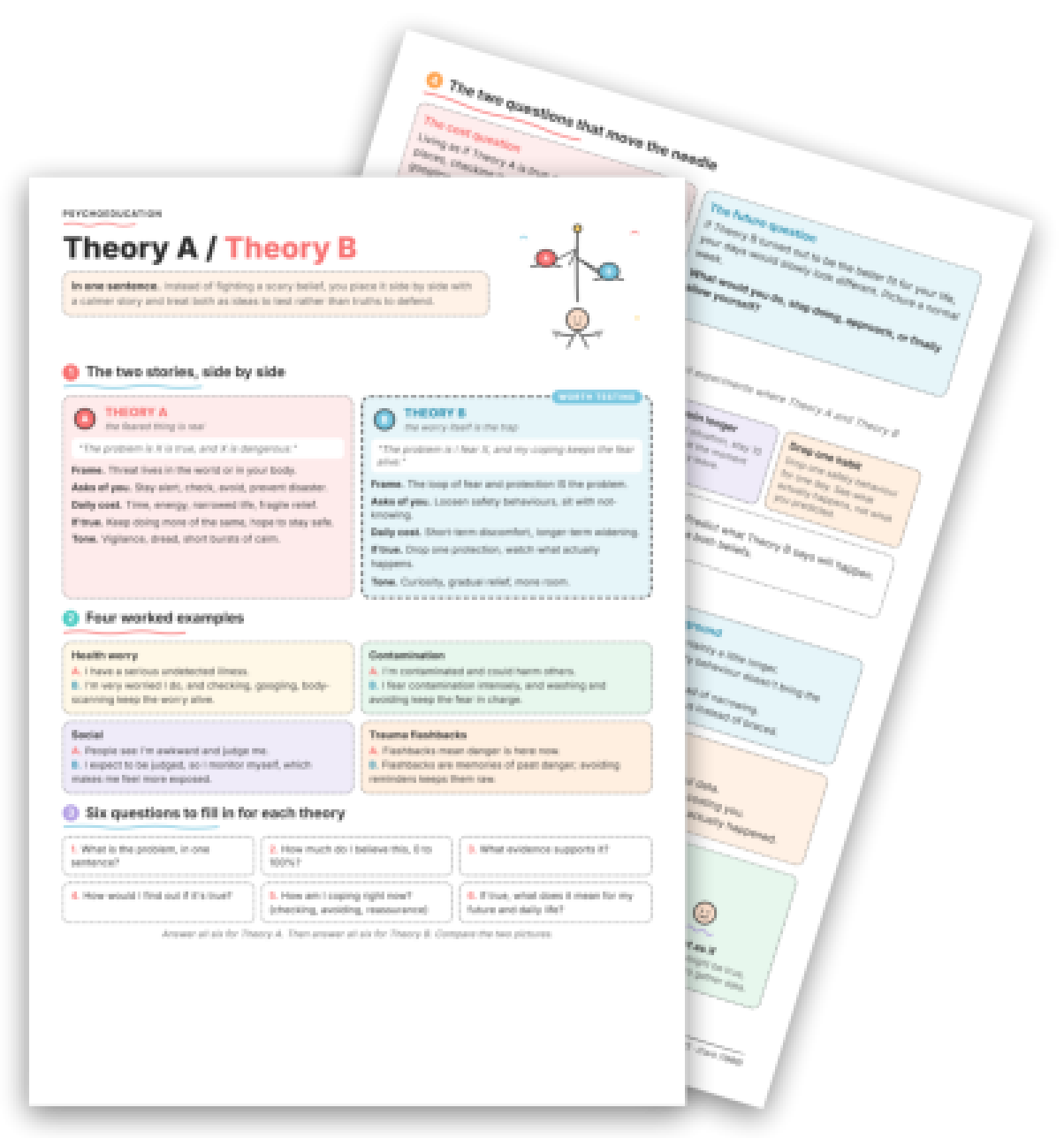
A visual PDF worksheet placing two competing hypotheses side by side so patients can test rather than debate them, tools and exercises for CBT-informed work on anxiety, OCD, and safety behaviours.
Clinical vignettes
Health Anxiety and the Checking Trap
Social Monitoring Sustaining Anxiety
Clinical picture. M., a man in his late twenties, described marked discomfort in workplace meetings, a conviction that colleagues noticed his blushing and judged him as incompetent, and a habit of rehearsing contributions extensively before speaking. The clinician used the Theory A / Theory B framework to place the two accounts alongside each other without immediately challenging either: Theory A stated that others were indeed observing and evaluating his social performance negatively, while Theory B proposed that self-focused monitoring and over-preparation were sustaining the sense of exposure. Filling in the six questions revealed that M. had no reliable evidence colleagues had noticed anything, yet his coping efforts consumed roughly two hours each workday. He identified dropping post-meeting mental replays as a small, testable reduction in safety behaviour. After two weeks he reported that meetings felt slightly less loaded, which he cautiously attributed to directing attention outward rather than inward.
Patients who carry a threat belief rarely release it when you offer a verbal alternative. The pull of Theory A is not logical; it is somatic, habitual, and reinforced by every safety behaviour that has never yet failed. This Theory A / Theory B PDF worksheet gives you a concrete visual frame to introduce the distinction in session, placing both explanations side by side as hypotheses to test rather than positions to defend.
Use this resource with your patients
Handout, exercises and materials ready to use, right inside SessionFuel.
Why the Theory A / Theory B distinction resists verbal explanation
The core clinical obstacle is that patients hear "maybe the problem is your worry, not the danger" as dismissal. Without a visible structure, the alternative explanation feels like a trick, not a genuine scientific possibility. The therapist ends up arguing for Theory B, which paradoxically strengthens the patient's investment in Theory A.
A second layer of difficulty: safety behaviours feel like evidence. Checking worked, washing prevented harm, avoidance kept disaster at bay. Patients reasoning from within Theory A experience their protective strategies as proof, not as maintenance. Reassurance-seeking follows exactly the same logic. Dismantling that from the oral channel alone asks patients to simultaneously understand the model, apply it to themselves, and tolerate the uncertainty of not knowing which theory is correct. That is too much at once.
The fiche solves this by externalising both theories onto a printed page. The patient is not being asked to abandon anything; they are invited to look at two stories and agree to run small experiments that could distinguish between them.
What the fiche contains: a visual support built for session use
The six-panel structure maps onto a full psychoeducation arc without requiring lengthy explanation.
Panel 1 presents the two-column comparison directly: Theory A ("The problem is X is true, and X is dangerous") against Theory B ("The problem is I fear X, and my coping keeps the fear alive"). Each column specifies the underlying frame, what the theory asks of the patient, its daily cost, and its emotional tone. Seeing vigilance, dread on one side and curiosity, gradual relief on the other lands differently on paper than it does as speech.
Panel 2 offers four worked examples across health worry, contamination fear, social anxiety, and trauma flashbacks, so the patient immediately finds a recognisable version of their own presentation. Panel 3 provides six structured questions to complete for each theory, covering belief ratings, evidence, current coping strategies, and projected futures.
Panels 4 and 5 carry the clinical weight. Panel 4 asks two questions that shift the conversation from which theory is true to what is each theory costing you, a move that sidesteps the debate and opens the values dimension. Panel 5 frames four concrete behavioural experiments: skipping a reassurance text, suspending body scanning, staying ten minutes past the usual exit point, dropping one safety behaviour for a day. The scientist stance section prompts patients to write predictions for both theories before acting and record what actually happened.
Panel 6 gives a quick self-monitoring tool: Signs A is in charge versus Signs B is gaining ground, with three discussion prompts explicitly flagged as material to bring back to session.
> Key takeaway: the fiche is a visual support that facilitates the explanation of Theory A / Theory B in session; it is not a standalone self-help document. The clinician uses it to build a shared language, then leaves the patient with a concrete reference between appointments.
750+ clinical tools
A library built with and for clinicians, ready to use in session and extend between appointments.
Access all the toolsWhen and how to propose the fiche
The optimal moment is once formulation is sufficiently developed for the patient to recognise their own pattern in the examples, typically from session two or three onward. The fiche is particularly well-suited to presentations where checking, certainty-seeking, and doubt are prominent, including OCD, health anxiety, and intolerance of uncertainty in GAD.
A low-threshold introduction: "I want to show you something that might capture what we have been discussing. There are two possible ways of describing what is happening for you, and I would like us to look at them together." Framing it as a shared looking exercise, not an assignment, preserves the alliance.
Use Panels 1 and 2 in session to establish the frame. Assign Panels 3 and 6 as structured between-session observation (not homework in the directive sense). Debrief Panel 5 the following session: ask for the prediction, the action taken, and what actually happened, without steering toward Theory B. The data the patient brings will do that work.
One caution: for patients with psychological safety crutches so entrenched that entertaining Theory B provokes acute distress, introduce the framework alongside graded exposure rather than as a precursor to it. The fiche sets the conceptual stage; the experiments give it traction.
Use it with your patients
Share this tool in the mobile app and follow the work between sessions.
Sources
- Salkovskis, P. M. (1996). The cognitive approach to anxiety: Threat beliefs, safety-seeking behavior, and the special case of health anxiety and obsessions. Guilford Press.
- Bream, V., Challacombe, F., Palmer, A., & Salkovskis, P. M. (2017). Cognitive Behaviour Therapy for Obsessive-Compulsive Disorder. Oxford University Press.
- Gústavsson, S. M., Salkovskis, P. M., & Sigurðsson, J. F. (2021). Cognitive analysis of specific threat beliefs and safety-seeking behaviours in generalised anxiety disorder: Revisiting the cognitive theory of anxiety disorders. Cambridge University Press.
Your session continues in your patients' pocket
Use with a patientYour resources, available everywhere
The handouts, exercises, programs and audios above: you choose which ones to make available to your patients, in the mobile app dedicated to them.
And far more than a library
The app goes well beyond resources, to support your patients every day:
Related categories
Explore other clinical resources by category.
Anxiety
Clinical hub for anxiety disorders: CBT and ACT worksheets, psychoeducation sheets, and exercises for assessment and treatment across the anxiety spectrum.

Trauma
Clinical hub on trauma and PTSD: assessment, differential diagnosis, treatment phases, and printable resources for practitioners. 155 chars.

Mood
Evidence-based worksheets and clinical tools for mood disorders: CBT, ACT, and positive psychology resources for psychologists and therapists.

Cognition
Printable cognitive therapy worksheets and clinical tools for therapists: CBT, ACT, schema work, defusion, distortions, and belief restructuring.

Build awareness
Clinical worksheets and tools to build awareness in therapy: cognitive distortions, schemas, emotions, ACT and CBT resources for practitioners.

Restructure
Clinical hub for cognitive restructuring worksheets: distortion identification, belief disputation, ABC model, and schema work for evidence-based practice.