
Clinical picture. T., a 34-year-old accountant, presented with generalised anxiety and a longstanding pattern of over-compliance at work, reporting he never declined requests from colleagues for fear of being labelled difficult. His conviction that any refusal would result in social exclusion was rated at 80% during session. The clinician introduced the assertiveness behavioral experiment framework: T. identified one concrete prediction, specified the observable outcomes he expected, and designed a single, low-stakes trial in which he would decline a peer's request to cover a Friday task using one sentence and no apologetic filler. The following week he reported that the colleague had replied briefly and moved on without any sign of coldness, and T. re-rated his conviction at 35%. He noted that dropping his habitual over-explanation had felt uncomfortable but had not produced the anticipated rupture.
Assertiveness Behavioral Experiment: PDF Worksheet, Tools and Exercises
A visual PDF worksheet clinicians can use in session to help patients design, run, and debrief assertiveness experiments, building real behavioral evidence against fear-driven predictions.
Clinical vignettes
Testing a Workplace Refusal Prediction
Naming a Need in a Close Relationship
Clinical picture. M., a woman in her late twenties seen for social anxiety with depressive features, described consistent difficulty expressing preferences to her partner, predicting at 90% that any stated need would be received as selfish and trigger conflict. Within a CBT session the clinician used the behavioral experiment structure to help M. specify the prediction in concrete, observable terms rather than the global sense that "it'll be bad," and they collaboratively planned a brief, direct statement at a low-pressure moment at home. M. identified two safety behaviours she typically relied on, self-deprecating humour and pre-emptive concession, and agreed to omit both. She returned reporting mild awkwardness but no conflict; her partner had simply agreed. Re-rating stood at 55%, and M. reflected that the residual conviction pointed to a further experiment rather than confirming the original fear.
In TCC practice, cognitive restructuring alone rarely shifts the fear that keeps assertive behaviour blocked. The patient understands the reasoning, accepts the logic, and still says nothing. This fiche PDF on the assertiveness behavioral experiment is a visual support you can open in session to move that stuck point: it operationalises the shift from intellectual agreement to tested evidence, step by step, in language patients can hold onto.
Use this resource with your patients
Handout, exercises and materials ready to use, right inside SessionFuel.
Why Assertiveness Predictions Resist Cognitive Work Alone
The clinical block here is not a skill deficit, at least not primarily. It is a catastrophic prediction that has never been disconfirmed. The patient who cannot say no to a colleague or hold eye contact while making a request has never had the chance to observe what actually happens when they do. Avoidance, as the fiche puts it plainly: "Silence keeps the prediction alive. Every time you stay quiet, the fear stays intact."
This is the crux of why oral psychoeducation on assertive communication hits a wall. You can explain the cognitive model, map the distortion driving the prediction, even rehearse the I-messages in session. But without a structured framework for designing, running, and reviewing a real-world test, the belief gets no new data. The prediction stays a fact by default.
What the Fiche Contains: A Visual Tool for Designing the Experiment
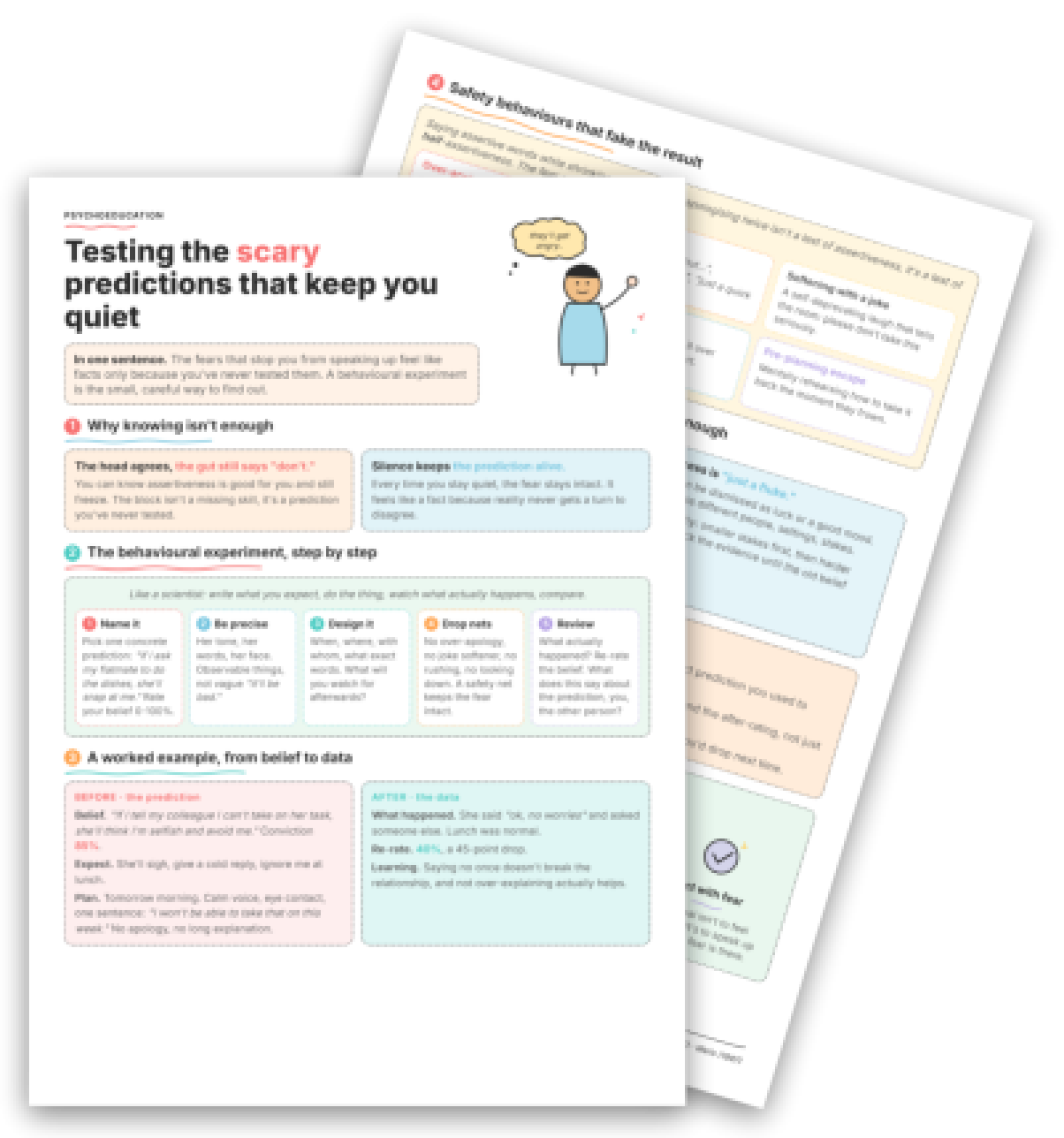
The fiche is organised across five panels, each covering a discrete stage of the experimental process. The visual layout is what makes this usable mid-session: patients see the full arc of the exercise at once rather than tracking a verbal sequence.
Panel 1 situates the clinical rationale: the gap between knowing and doing, and why untested predictions survive intact. Panel 2 lays out a five-step experiment protocol: naming the specific prediction and rating belief conviction from 0 to 100%, defining observable (not vague) expected outcomes, designing the exact moment and wording, dropping safety behaviours, and reviewing what actually happened. Panel 3 provides a fully worked example: a patient enters with "If I tell my colleague I can't take on her task, she'll think I'm selfish and avoid me" at 85% conviction, runs the experiment, and re-rates at 40% after she says "ok, no worries." The before-and-after structure shown on the page makes the logic of belief change concrete in a way that oral description rarely achieves.
Panel 4 is clinically high-value: it catalogues six safety behaviours that invalidate the experiment, including over-apologising, hedging with "I might be wrong but...", self-deprecating humour, gaze avoidance, rushing, and mentally pre-planning a retraction. Any clinician familiar with exposure therapy will recognise these as the partial-avoidance patterns that preserve fear even when the patient appears to have attempted the behaviour. Seeing them listed visually helps patients identify their own without feeling accused. Panel 5 addresses negative outcomes: how to interpret them as data rather than confirmation, and why repeated experiments across varied contexts are necessary before a belief genuinely shifts. This maps directly onto graded exposure logic and belongs in the same clinical arc.
A final "To discuss in session" section structures the debrief by asking patients to bring the exact prediction they used to silence themselves, their before-and-after ratings, and the safety behaviour they would drop next time.
> Key point: The fiche is a visual support that facilitates the explanation in session: it is not a questionnaire patients fill in alone. You work through it together, using the panels to pace the psychoeducation and leaving the patient a concrete reference to take away.
750+ clinical tools
A library built with and for clinicians, ready to use in session and extend between appointments.
Access all the toolsWhen and How to Introduce It in Your Practice
This fiche fits naturally once the formulation de cas is established and the patient has identified at least one recurrent avoidance pattern. It works well after an initial sequence on assertive rights or assertiveness laddering, when the patient's motivation is present but behavioural engagement has stalled.
For patients presenting with social anxiety, the panel on safety behaviours is particularly worth slowing on: they often believe they have already "tried" assertiveness, when in fact they ran a heavily modified version that left the fear untouched. You can introduce the fiche with something like: "Before we think about what to say, let's look at how to set up the test so we actually learn something from it."
Debrief the following session using the fiche's own structure: before-rating, what happened, after-rating. The numerical shift in conviction is worth naming explicitly. It grounds automatic thought restructuring in observed behaviour rather than in reasoning alone, which is where durable change tends to take hold.
The fiche does not replace the therapeutic relationship or the graduated hierarchy you build with the patient. It makes the experimental logic visible, saves explanation time, and gives the patient a structure they can apply autonomously between appointments.
Use it with your patients
Share this tool in the mobile app and follow the work between sessions.
Sources
- Bennett-Levy, J., Butler, G., Fennell, M., Hackmann, A., Mueller, M., Westbrook, D. (2004). Oxford Guide to Behavioural Experiments in Cognitive Therapy. Oxford University Press.
- Rouf, K., Fennell, M., Westbrook, D., Cooper, M., Bennett-Levy, J. (2004). Devising effective behavioural experiments. Oxford University Press.
Your session continues in your patients' pocket
Use with a patientYour resources, available everywhere
The handouts, exercises, programs and audios above: you choose which ones to make available to your patients, in the mobile app dedicated to them.
And far more than a library
The app goes well beyond resources, to support your patients every day:
Related categories
Explore other clinical resources by category.

Anxiety
Clinical hub for anxiety disorders: CBT and ACT worksheets, psychoeducation sheets, and exercises for assessment and treatment across the anxiety spectrum.

Mood
Evidence-based worksheets and clinical tools for mood disorders: CBT, ACT, and positive psychology resources for psychologists and therapists.

Identity
Clinical resources for self-identity work in therapy: CBT, ACT, schema tools for clinicians addressing self-concept, core beliefs, and identity disruption.

Relationships
Clinical worksheets and tools on relational functioning: attachment, schemas, assertiveness, and communication skills for therapists. Printable PDF resources.

Cognition
Printable cognitive therapy worksheets and clinical tools for therapists: CBT, ACT, schema work, defusion, distortions, and belief restructuring.

Build awareness
Clinical worksheets and tools to build awareness in therapy: cognitive distortions, schemas, emotions, ACT and CBT resources for practitioners.