
Clinical picture. M., a woman in her late thirties, presents with longstanding difficulty refusing requests from her mother, whom she describes as intrusive. In session she rehearses a limit-setting statement and the clinician notes that her voice rises at the end of each sentence, converting the statement into an audible question. The clinician draws her attention to this single channel, using the worksheet's passive-assertive-aggressive table to name what is happening, and invites her to replant her feet, exhale, and repeat the phrase with a level ending. After three repetitions she reports that the sentence felt different in her chest, and she agrees to monitor this pattern in the coming week and bring a specific moment back to the next session.
Assertive Body Language: PDF Worksheet, Tools and Exercises for Clinical Practice
A structured PDF worksheet with visual tools and concrete exercises to help patients align their nonverbal signals with assertive communication in and between sessions.
Clinical vignettes
Voice Rising at the Limit
Feedback Mistaken for Humour
Clinical picture. T., a man in his mid-forties referred for workplace conflict, describes a recurring pattern in which colleagues dismiss his critical feedback as though he were joking. The clinician uses the worksheet to map the interaction: T. delivers corrective comments with a sustained nervous smile and a quiet, rising tone, two channels pulling against his words. Together they rehearse one specific sentence from a recent meeting, first in its habitual form, then with a relaxed neutral face and a steady voice that ends firmly. T. does not resolve the conflict in session, yet he names which channel he will focus on that week, choosing voice over the other five to keep the task manageable.
When a patient reports "I said it assertively, but nothing changed," the explanation usually lives in the body, not the words. This PDF worksheet on assertive body language gives you a concrete visual anchor to make that distinction explicit in session, before the patient tries again outside.
Use this resource with your patients
Handout, exercises and materials ready to use, right inside SessionFuel.
Why Assertive Body Language Resists Oral Explanation
Assertiveness training frequently stalls at the nonverbal layer. Patients can rehearse an "I" statement with guidance from assertiveness tools and exercises, articulate their assertive rights, and still leave a limit-setting conversation feeling unheard. The gap is rarely syntactic. It's postural, vocal, spatial.
Explaining this orally runs into a specific problem: the clinician describes multiple nonverbal channels in sequence, the patient nods, and the integrated picture dissolves by the time they walk out. Mehrabian's work on verbal-nonverbal congruence has long been absorbed into clinical common sense, and Linehan's DBT interpersonal effectiveness module addresses it directly, yet translating that principle into actionable self-monitoring is exactly where most oral psychoeducation falls short. A patient who says "no" in a rising, questioning tone while staring at their shoes has communicated the opposite of their words, and may have no conscious awareness of it.
Approval-seeking patterns, submissive schema modes (see the ACT schemas and modes framework), and social anxiety each compound the problem through different mechanisms. The somatic channel, however, tends to carry the same underlying message across profiles: "I'm not certain I deserve this."
What the Fiche Contains: A Three-Mode, Six-Channel Visual Map
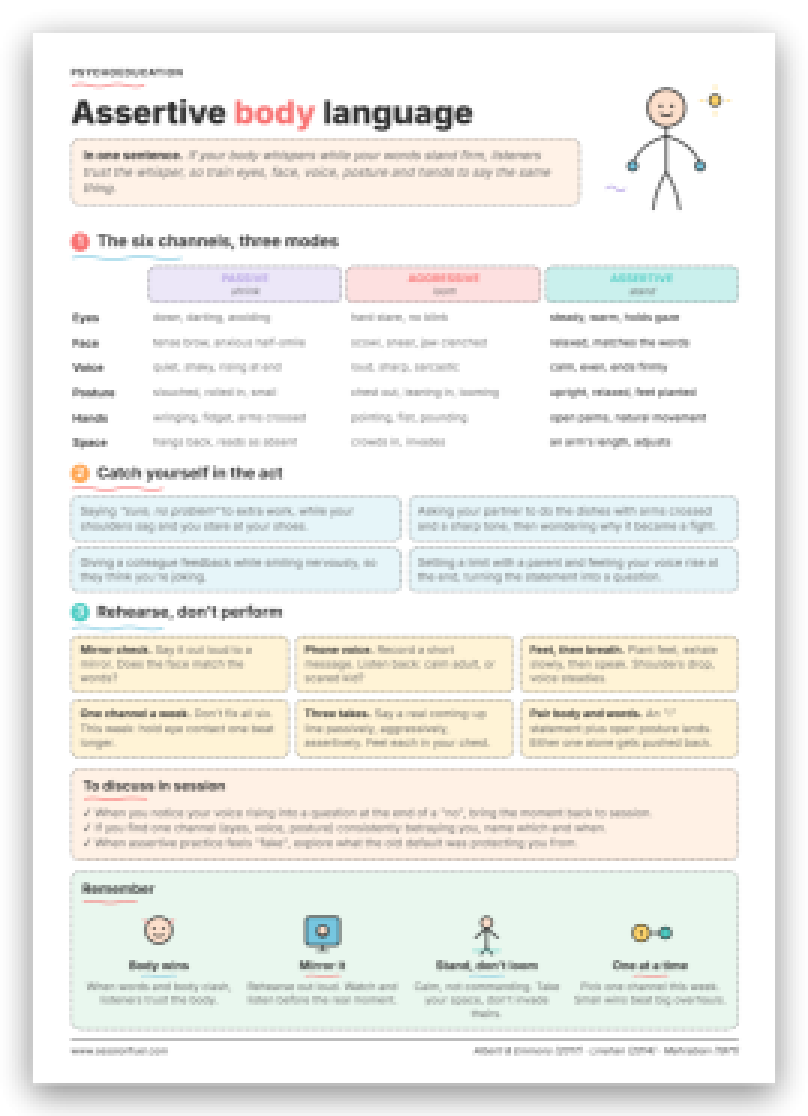
The structural centerpiece is a six-channel, three-mode comparison table. Rows map six nonverbal channels (eyes, face, voice, posture, hands, space) across three behavioral modes: passive, aggressive, and assertive. Each cell is short and precise. Under Eyes / Passive, the fiche reads "down, darting, avoiding"; under Eyes / Assertive, "steady, warm, holds gaze." Laid out as a table, the full contrast is visible at a glance. That simultaneous comparison is exactly what sequential oral description cannot replicate, and it is where the visual format earns its place in session.
A second panel, "Catch yourself in the act," presents four brief recognizable scenarios: saying "sure, no problem" with shoulders sagging; asking a partner to do the dishes with arms crossed and a sharp tone; delivering colleague feedback with a nervous smile so they think it's a joke; and setting a limit with a voice that rises at the end, turning a statement into a question. Patients typically locate themselves in at least one of these within seconds, which active listening skills work alone would not produce so efficiently.
The third panel, "Rehearse, don't perform," provides six micro-techniques: a mirror check, a phone voice recording, a brief somatic primer ("plant feet, exhale slowly, then speak"), a one-channel-per-week focus, a three-takes comparison exercise (passive, aggressive, assertive in sequence), and a reminder that pairing an "I" statement with open posture is more effective than either element alone. A closing "To discuss in session" block names three targeted clinical prompts for debrief.
> Key takeaway: this fiche is a visual support that facilitates the in-session explanation of assertive body language. It is not a self-administered questionnaire. It is a psychoeducation tool the clinician works through with the patient to build shared vocabulary, then leaves as a concrete post-session reference.
750+ clinical tools
A library built with and for clinicians, ready to use in session and extend between appointments.
Access all the toolsWhen and How to Propose It in Session
This fiche fits naturally in a mid-phase assertiveness sequence, after initial work on communication styles, for instance after reviewing aggressive communication patterns or working through the assertiveness ladder, and before launching graded behavioral practice. It is especially useful with patients who report assertiveness failures they cannot account for, with patients whose social anxiety produces somatically driven avoidance, and with couples or individuals where relational stakes heighten embodied inhibition.
A straightforward introduction: "You've articulated what you want to say. Let's look at what your body might be saying at the same time." That framing avoids positioning the patient as incongruent and opens a curiosity stance rather than a corrective one.
In debrief, take the "To discuss in session" prompts literally. Ask which channel consistently betrays them, and, when assertive practice feels "fake," explore what the earlier default was protecting. That last prompt touches core belief work and connects naturally to broader schema restructuring, making the fiche a bridge into deeper formulation rather than a standalone behavioral exercise. If the patient is working on relational communication more broadly, pairing the fiche with communication psychoeducation or reflective listening tools extends its clinical reach.
One caution: with patients in active trauma processing, or where somatic focus carries dissociation risk, introduce the body-channel framework carefully and monitor the therapeutic window throughout.
The fiche does not replace the clinical frame. It makes a genuinely complex, multi-channel concept faster to explain, easier to remember, and something the patient can return to between sessions with a clear reference point.
Use it with your patients
Share this tool in the mobile app and follow the work between sessions.
Sources
- Alberti, R. E., Emmons, M. L. (2017). Your Perfect Right: Assertiveness and Equality in Your Life and Relationships (10th ed.). New Harbinger Publications / Impact Publishers.
- Hall, J. A., Horgan, T. G., Murphy, N. A. (2019). Nonverbal Communication. Annual Review of Psychology, 70, 271-294.
Your session continues in your patients' pocket
Use with a patientYour resources, available everywhere
The handouts, exercises, programs and audios above: you choose which ones to make available to your patients, in the mobile app dedicated to them.
And far more than a library
The app goes well beyond resources, to support your patients every day:
Related categories
Explore other clinical resources by category.
Anxiety
Clinical hub for anxiety disorders: CBT and ACT worksheets, psychoeducation sheets, and exercises for assessment and treatment across the anxiety spectrum.

Mood
Evidence-based worksheets and clinical tools for mood disorders: CBT, ACT, and positive psychology resources for psychologists and therapists.

Identity
Clinical resources for self-identity work in therapy: CBT, ACT, schema tools for clinicians addressing self-concept, core beliefs, and identity disruption.

Relationships
Clinical worksheets and tools on relational functioning: attachment, schemas, assertiveness, and communication skills for therapists. Printable PDF resources.

Understand
Clinical hub for the therapeutic aim 'Understand': worksheets and tools to build patient insight across CBT, ACT, schema therapy and more.

Build skills
Skill-building resources for clinicians: printable worksheets and exercises for coping, assertiveness, and communication skills training in therapy.