
Clinical picture. M., a woman in her late thirties, presents with chronic anxiety and a long history of exhausting arguments with her mother that routinely last two hours without resolution. In session, the clinician introduces the STOP worksheet and walks through each step using a recent phone call as the working example. M. practises the Tell phrase aloud: "I think we're going in circles. I'm going to stop here for tonight." She initially struggles with the Persist step, anticipating guilt if her mother pushes back, so the clinician runs a brief role-play in which M. repeats the closing line twice without elaborating. By the following session M. reports having used the script once; the call ended in under ten minutes and she noted a modest but meaningful reduction in post-call rumination.
STOP: Assertively Ending Conversations, PDF Worksheet, Tools and Exercises
A visual PDF worksheet clinicians can use in session to teach the STOP method: a four-step assertive exit script for conversations that loop, escalate, or cross a line.
Clinical vignettes
STOP in a Family Conflict Pattern
Assertive Exit from a Workplace Loop
Clinical picture. T., a man in his mid-forties referred for adjustment difficulties, describes a colleague who reliably restarts resolved disagreements and dismisses any position T. takes. The clinician presents STOP as a concrete alternative to T.'s current pattern of either going silent or eventually snapping. Together they identify his personal Spot cues: a sensation of tightness in the throat and an awareness that the same sentence has been exchanged three times. T. drafts a Tell statement suited to a professional setting: "I don't think we're reaching agreement today. Let's leave it here." He returns the next week having deployed the script once; the colleague pressed twice more, T. held the line without raising his voice, and he described feeling less depleted than after previous exchanges.
Teaching a patient to leave a conversation that has gone nowhere is deceptively harder than teaching them to start one assertively. The moment tends to collapse under guilt, catastrophising, or a half-remembered worry that walking away signals defeat. This fiche PDF gives you a concrete visual anchor for that exact clinical moment, grounded in the same assertiveness literature you already draw on, Alberti & Emmons, Linehan, Paterson.
Use this resource with your patients
Handout, exercises and materials ready to use, right inside SessionFuel.
Why "just end it" is harder to explain than it sounds
Patients who struggle with assertive communication rarely lack the intellectual understanding that they can exit a circular argument. What they lack is a procedural script, a sequence they can retrieve under activation, when cognitive resources are already stretched. Oral psychoeducation alone rarely bridges that gap. You explain the principle; they agree; they go home and either stay trapped for another hour or slam a door.
The difficulty is compounded by the three non-assertive exits most patients cycle through: going passive (swallowing it silently), going aggressive (voice up, door down), or sliding into passive-aggressive communication (sarcasm, eye-rolls, withdrawal). Each feels like the only available option in the moment. Without a visible map that places these alongside the assertive alternative, the concept of a "middle path" stays abstract.
There is also a layer of cognitive interference worth noting. The fiche explicitly names five inner blocks, "I'm being rude if I end this," "They'll be furious," "If I leave, I lose", that function as permission-withholding beliefs. Patients attending to these thoughts in real time need more than a spoken reframe; they need something they have already seen, held, and internalised before the conversation ever starts.
What the fiche contains: a visual map of assertive disengagement
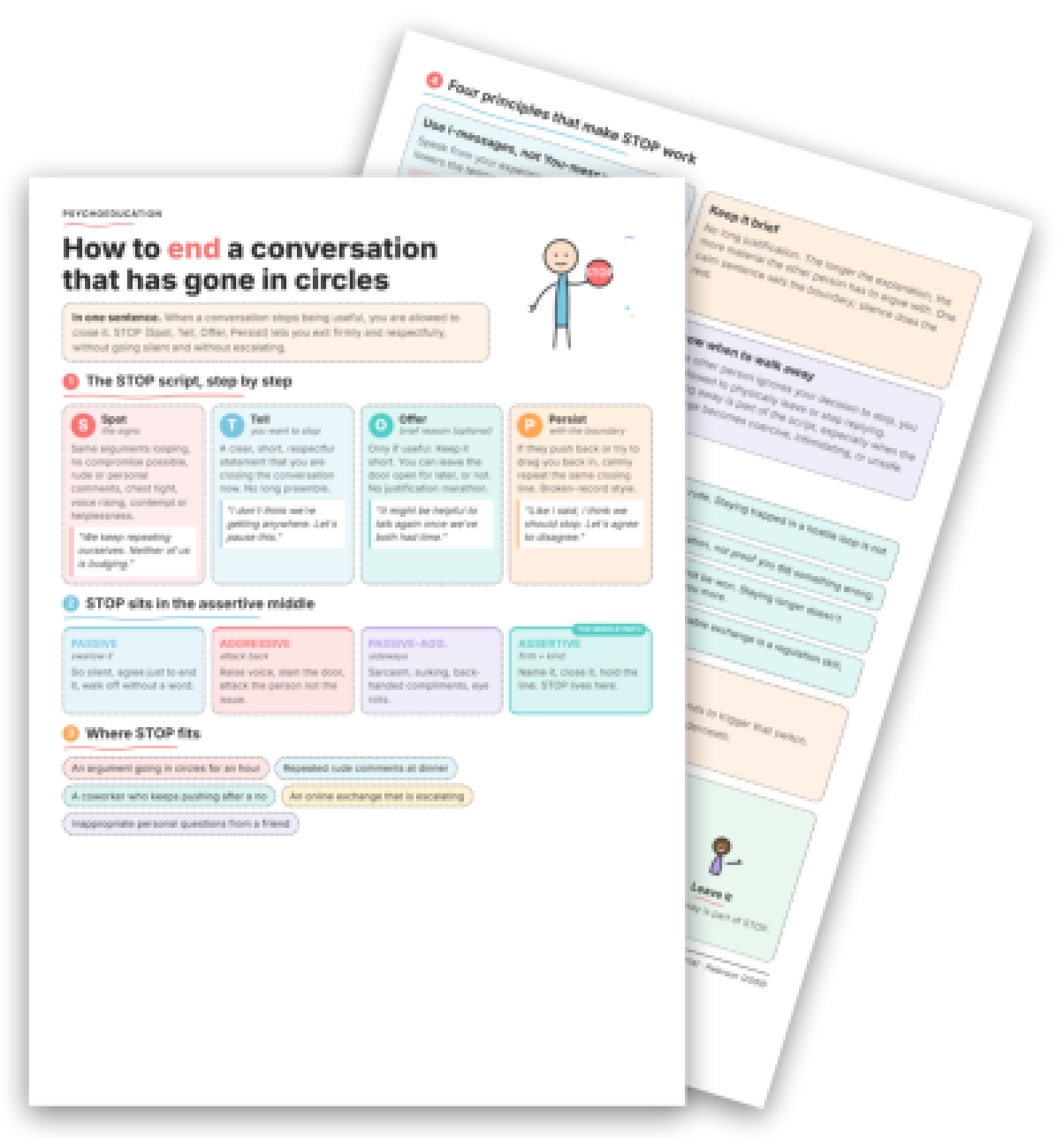
The layout is structured as five numbered panels, each serving a distinct psychoeducational function.
- Panel 1, The STOP script, step by step: four phases (Spot, Tell, Offer, Persist) with verbatim model phrases for each. "I don't think we're getting anywhere. Let's pause this." is the Tell step; "Like I said, I think we should stop. Let's agree to disagree." illustrates the broken-record technique in Persist.
- Panel 2, The assertive middle: a four-quadrant comparison (Passive / Aggressive / Passive-Aggressive / Assertive) that makes the behavioural spectrum visible at a glance, far more efficiently than any oral description.
- Panel 3, Where STOP fits: six concrete scenarios (looping argument, repeated rude comments, coercive coworker, escalating online exchange) so patients can immediately locate their own situation.
- Panel 4, Four principles: I-messages vs You-messages with side-by-side examples, brevity as a boundary tool, ending respectfully, and explicit permission to physically leave when an exchange becomes coercive or unsafe.
- Panel 5, Inner blocks and reframes: paired cognitive reframes for each permission-withholding belief, formatted for self-consultation between sessions.
- "To discuss in session" prompts: three guided questions that open debrief work around triggers, underlying fears, and a safe first exposure context.
> Key point: the fiche is a visual support that facilitates the explanation of STOP in session, not a questionnaire the patient fills out alone, but a shared reference you and the patient read together, which then leaves their hands as a portable reminder between appointments.
750+ clinical tools
A library built with and for clinicians, ready to use in session and extend between appointments.
Access all the toolsWhen and how to propose it
The fiche sits naturally in the mid-phase of work on assertiveness or interpersonal conflict, once the patient understands the passive-aggressive-assertive spectrum (see Communication Styles and Assertive Rights) but has not yet been able to apply it under relational pressure. It is especially well-suited for patients presenting with self-sacrifice schema patterns, approval-seeking behaviour, or a history of conflict avoidance that tips into sudden explosiveness.
You can introduce it with: "This is a four-step method for getting out of a conversation that's stopped being useful. Let's look at it together and see which of these steps feels most difficult for you." That framing positions the fiche as a collaborative exploration rather than a homework assignment.
Debrief usefully focuses on the Persist step: most patients can manage the Tell, but the broken-record repetition under pushback triggers the same permission-withholding beliefs the fiche names in Panel 5. Pairing the fiche with a behavioural experiment around assertiveness or with the CALM Assertive Repetition and DBT DEAR MAN frameworks extends the work naturally.
One contraindication to flag: with patients currently in coercive or unsafe relationships, the fiche's explicit permission to physically leave is clinically relevant, but the session debrief must attend carefully to safety planning. The fiche supports setting personal limits, it does not replace risk assessment. Used well, it closes a gap that oral explanation alone consistently leaves open.
Use it with your patients
Share this tool in the mobile app and follow the work between sessions.
Sources
- Alberti, R. E., & Emmons, M. L. (2017). Your Perfect Right: Assertiveness and Equality in Your Life and Relationships (10th ed.). Impact Publishers.
- Smith, M. J. (1975). When I Say No, I Feel Guilty. Bantam Books.
- Linehan, M. M. (2015). DBT Skills Training Handouts and Worksheets (2nd ed.). Guilford Press.
- Gordon, T. (2000). Parent Effectiveness Training: The Proven Program for Raising Responsible Children. Harmony.
Your session continues in your patients' pocket
Use with a patientYour resources, available everywhere
The handouts, exercises, programs and audios above: you choose which ones to make available to your patients, in the mobile app dedicated to them.
And far more than a library
The app goes well beyond resources, to support your patients every day:
Related categories
Explore other clinical resources by category.

Anxiety
Clinical hub for anxiety disorders: CBT and ACT worksheets, psychoeducation sheets, and exercises for assessment and treatment across the anxiety spectrum.

Identity
Clinical resources for self-identity work in therapy: CBT, ACT, schema tools for clinicians addressing self-concept, core beliefs, and identity disruption.

Emotions
Clinical resources on emotion regulation: worksheets, coping tools, CBT, REBT, and ACT exercises for therapists working across diagnoses and age groups.

Relationships
Clinical worksheets and tools on relational functioning: attachment, schemas, assertiveness, and communication skills for therapists. Printable PDF resources.

Build awareness
Clinical worksheets and tools to build awareness in therapy: cognitive distortions, schemas, emotions, ACT and CBT resources for practitioners.

Build skills
Skill-building resources for clinicians: printable worksheets and exercises for coping, assertiveness, and communication skills training in therapy.