
Clinical picture. T., a woman in her late thirties, presented with low mood and chronic work-related stress. She described a pattern of agreeing to additional tasks she could not manage, then feeling resentful and exhausted, yet unable to identify why her needs were consistently unmet. The clinician introduced the four-style framework using the psychoeducation sheet, inviting T. to locate her habitual response. She recognised herself immediately in the passive column, noting the phrase 'it is safer to say nothing' as something she had never before put into words. Over the following two sessions, this shared language gave T. a concrete reference point for practising brief assertive statements, beginning with lower-stakes interactions at work.
Communication Styles: PDF Worksheet, Tools and Exercises for Clinical Practice
A visual PDF worksheet and practical exercises to help clinicians explain passive, aggressive, passive-aggressive, and assertive communication clearly in session.
Clinical vignettes
Passive Style in a Work Context
Passive-Aggressive Pattern in a Couple
Clinical picture. M., a man in his mid-forties, attended individual therapy after his partner described feeling 'walked on eggshells' around him. M. denied being angry, yet recounted habitual sarcasm, deliberate forgetting of agreed tasks, and prolonged silence after disagreements. When the clinician reviewed the communication styles sheet with him, M. paused at the passive-aggressive description and said it felt 'uncomfortably accurate.' He connected this pattern to a childhood home where direct protest was met with withdrawal of affection, making indirect expression feel like the only viable route. This recognition did not resolve the behaviour, but it shifted the therapeutic work from defensiveness toward a more collaborative examination of the fear underlying the indirection.
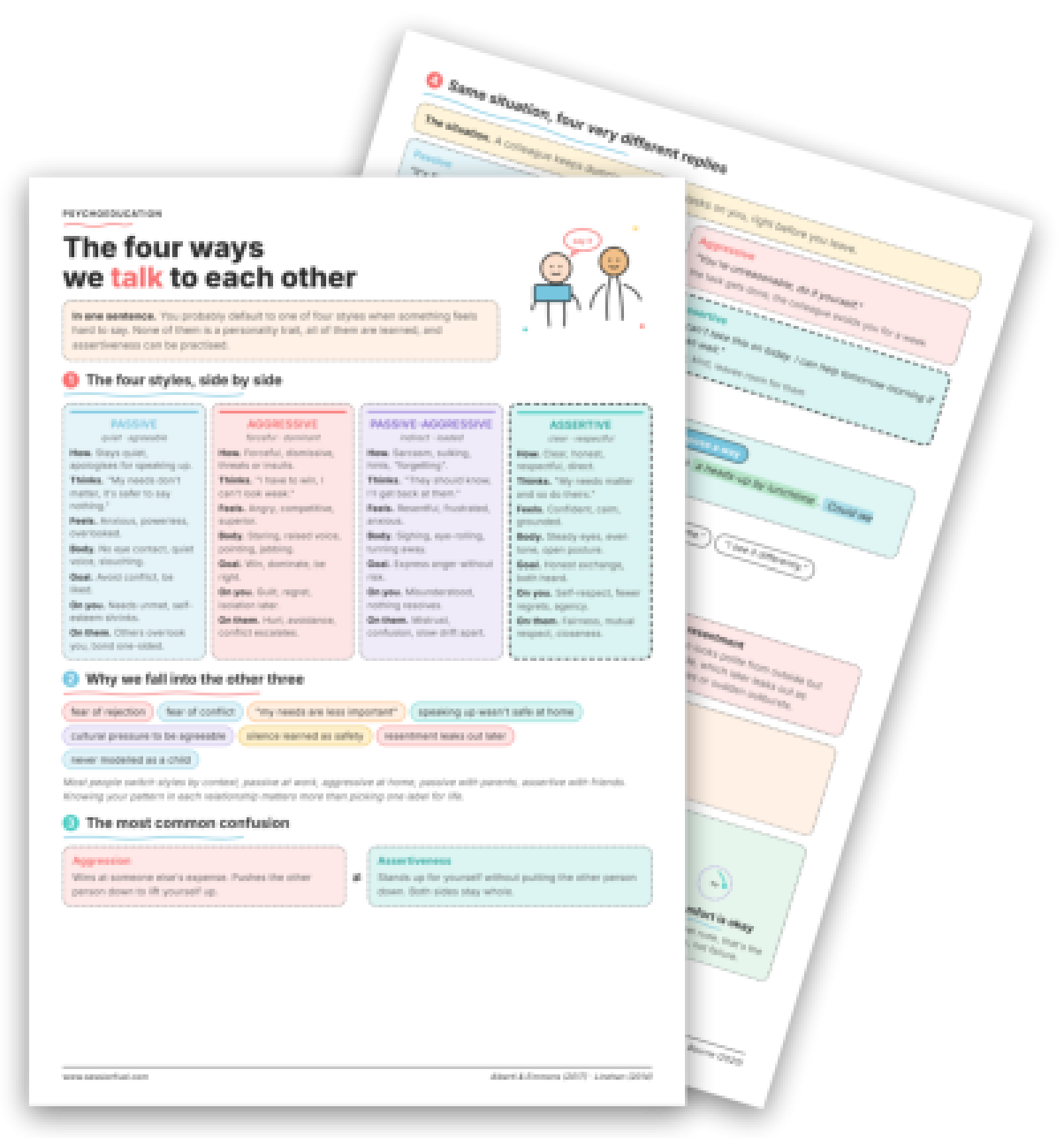
Patients rarely arrive in session without a label for themselves: "I'm a pushover," "I blow up," "I go silent." These self-descriptions collapse a four-way distinction into one or two poles, and that collapse resists correction when you address it verbally alone. This fiche PDF gives you a shared visual frame to map all four communication styles together in session, name the patient's pattern without pathologising it, and build a common vocabulary for the work ahead.
Use this resource with your patients
Handout, exercises and materials ready to use, right inside SessionFuel.
Why communication styles are hard to clarify without a visual support
The main obstacle is not conceptual difficulty but perceptual bias. Patients gravitate toward the style label that least threatens their self-image. Someone with entrenched passive-aggressive communication patterns typically sees themselves as passive and therefore blameless. A patient whose interpersonal style reads as frankly aggressive will frequently reframe it as assertiveness. Spoken explanations of the four-style model tend to confirm whichever label the patient walked in with.
There is also a developmental layer worth surfacing early in the formulation. The fiche notes that "speaking up wasn't safe at home" and that silence was "learned as safety," grounding style selection in early conditioning rather than fixed character. That reframe, from personality trait to acquired coping pattern, is therapeutically significant. Patients absorb it more readily from a diagram than from a verbal explanation, because the visual format bypasses the defensive processing that narrated feedback tends to trigger. Clinicians working within schema therapy or late-wave CBT will recognise this immediately as a lever for reducing therapeutic resistance.
What the fiche contains: a six-panel visual map
The fiche PDF is structured across six numbered panels. The core of the tool is Panel 1: a four-column comparison grid covering passive, aggressive, passive-aggressive, and assertive styles across seven dimensions each: how the person communicates, the underlying thought, the felt emotion, body language, goal, effect on oneself, and effect on the other person. Seeing all four columns side by side is what makes this different from an oral description. A patient can scan the "Feels" row, recognise "anxious, powerless, overlooked," and trace it horizontally to its style and consequences without you having to name their pattern for them.
Panel 3 addresses the most clinically common confusion directly: aggression versus assertiveness. The distinction is stated without hedging: aggression "wins at someone else's expense," while assertiveness means "both sides stay whole." This is precisely the point that patients with approval-seeking schemas or significant self-esteem deficits resist in a spoken explanation, because they fear that standing up for themselves is indistinguishable from being unkind.
Panel 4 applies all four styles to a single concrete scenario (a colleague offloading last-minute work), producing four distinct replies with their relational consequences. Panel 5 provides a four-step sentence-building template: "Name the fact, say the feeling, state the need, propose a way," alongside six ready-to-borrow phrases ("No, I can't do that," "I see it differently") that you can role-play directly from the sheet during the session, in preparation for assertive communication exercises or I-message practice.
Panel 6 closes with two short psychoeducation points and three "To discuss in session" prompts that serve as a natural debrief scaffold, including a reflection on style-switching between work and home contexts.
> Key takeaway: The fiche is a visual support that facilitates the explanation of communication styles in session. It is not a self-assessment patients complete alone; it is a shared reference the clinician uses to name patterns, compare styles, and anchor vocabulary for future work.
750+ clinical tools
A library built with and for clinicians, ready to use in session and extend between appointments.
Access all the toolsWhen and how to introduce the fiche in session
The fiche sits naturally in early-to-mid treatment, once the presenting problem is mapped and a relational or self-assertion theme has surfaced. It works particularly well with patients carrying social anxiety, low self-esteem, or chronic relational conflict, and with couples where communication breakdown is the primary complaint. For the latter, it pairs directly with the Communication in Couples program.
A workable introduction: "I'd like to show you something that maps four ways people communicate when things feel hard to say. Have a look at the grid and tell me which column feels familiar to you." That framing keeps the patient in an exploratory mode rather than a diagnostic one, and avoids the label-resistance described above.
For debrief, the Panel 6 prompts are ready to use. You can ask directly when they last swallowed a "no" they wanted to say, or whether they notice a style shift between contexts. From there, a graded assertiveness ladder, a behavioural experiment, or scenario-based assertiveness training provide a clear next step. The Assertive Body Language worksheet can extend Panel 1's body language dimension with somatic detail, and Active Listening Skills rounds out the relational picture for patients working on the receptive side of assertive exchange.
One limit: patients in acute relational crisis, or those with significant characterological rigidity, may use the four-column grid to label their partner rather than examine their own pattern. Introduce the fiche after stabilising the alliance in those cases, and frame it explicitly around self-observation from the outset.
The fiche does not replace the case formulation or the therapeutic relationship. It makes a nuanced distinction clear in under five minutes and leaves the patient with a concrete reference they can return to between sessions.
Use it with your patients
Share this tool in the mobile app and follow the work between sessions.
Sources
- Alberti, R. E., & Emmons, M. L. (2017). Your Perfect Right: Assertiveness and Equality in Your Life and Relationships (10th ed.). Impact Publishers / New Harbinger Publications.
- Linehan, M. M. (2014). DBT Skills Training Manual (2nd ed.). The Guilford Press.
- Jakubowski, P., & Lange, A. J. (1978). The Assertive Option: Your Rights and Responsibilities. Research Press.
Your session continues in your patients' pocket
Use with a patientYour resources, available everywhere
The handouts, exercises, programs and audios above: you choose which ones to make available to your patients, in the mobile app dedicated to them.
And far more than a library
The app goes well beyond resources, to support your patients every day:
Related categories
Explore other clinical resources by category.
Anxiety
Clinical hub for anxiety disorders: CBT and ACT worksheets, psychoeducation sheets, and exercises for assessment and treatment across the anxiety spectrum.

Mood
Evidence-based worksheets and clinical tools for mood disorders: CBT, ACT, and positive psychology resources for psychologists and therapists.

Identity
Clinical resources for self-identity work in therapy: CBT, ACT, schema tools for clinicians addressing self-concept, core beliefs, and identity disruption.

Emotions
Clinical resources on emotion regulation: worksheets, coping tools, CBT, REBT, and ACT exercises for therapists working across diagnoses and age groups.
Relationships
Clinical worksheets and tools on relational functioning: attachment, schemas, assertiveness, and communication skills for therapists. Printable PDF resources.

Understand
Clinical hub for the therapeutic aim 'Understand': worksheets and tools to build patient insight across CBT, ACT, schema therapy and more.