
Clinical picture. A is a 38-year-old woman presenting with chronic exhaustion and low-grade resentment toward her partner and adult siblings. She describes herself as "a pushover" yet struggles to recognise this pattern as boundary-related rather than a personal failing. The clinician introduces the informational sheet on boundary types, walking through the six domains and the porous-healthy-rigid spectrum together. A quickly identifies that her emotional and material boundaries are markedly porous, while her intellectual boundary has become rigid as a secondary defence. Naming the asymmetry across domains rather than applying a single global label gave her a more workable and less shame-laden frame for what she had been experiencing.
Boundary Types: PDF Worksheet, Tools and Exercises for Clinical Practice
A visual PDF worksheet mapping porous, healthy, and rigid boundaries across six life domains, with scripts and reflection questions to use directly in session.
Clinical vignettes
Mapping Uneven Boundaries Across Domains
Rigid Emotional Boundary After Repeated Relational Harm
Clinical picture. M is a 52-year-old man referred following a relationship breakdown; he reports that his partner had described him as "cold and unreachable." Using the boundary-types sheet as a psychoeducational anchor, the clinician explained how a sealed emotional filter often develops as a learned protection rather than a character flaw, and invited M to locate himself on the porous-to-rigid continuum for each domain. M recognised a rigid emotional boundary alongside a largely healthy physical and intellectual pattern, which he had not previously distinguished. The exercise did not produce immediate change, though M noted at the following session that he had observed himself deflecting his son's attempt at closeness and had paused before doing so, a small but clinically meaningful shift in self-monitoring.
Explaining the boundary spectrum verbally almost always collapses into a lecture on assertiveness, leaving patients with a vague instruction to "just say no" but no map of where they actually sit. This fiche PDF gives you a precise, side-by-side visual scaffold so the distinction between porous, healthy, and rigid becomes immediately legible in session.
Use this resource with your patients
Handout, exercises and materials ready to use, right inside SessionFuel.
Why the Porous-Healthy-Rigid Spectrum Resists Verbal Explanation
The most persistent clinical friction is that patients confuse rigid limits with healthy ones. After years of over-giving, any act of refusal feels like progress, so a patient who has swung from porous to rigid genuinely believes they have found balance. Without a visual showing all three positions simultaneously, that misreading is nearly impossible to correct through words alone.
A second layer complicates the picture: patients rarely hold the same boundary style across every area of their life. Someone with porous material and time limits alongside rigid emotional ones will not recognise themselves in a single-axis description. The concept needs to breathe across multiple domains before it lands. This is exactly what the Boundary Styles worksheet alone cannot always provide, and where the six-domain structure here becomes useful.
The oral explanation also tends to activate the patient's dominant schema before the concept has room to take hold. Patients carrying an abandonment schema or a strong approval-seeking pattern hear "limit" and immediately think loss of connection. A visual that frames healthy calibration as staying open, not shutting down, short-circuits that reaction.
What the Fiche Contains: a Visual Anchor for the Spectrum
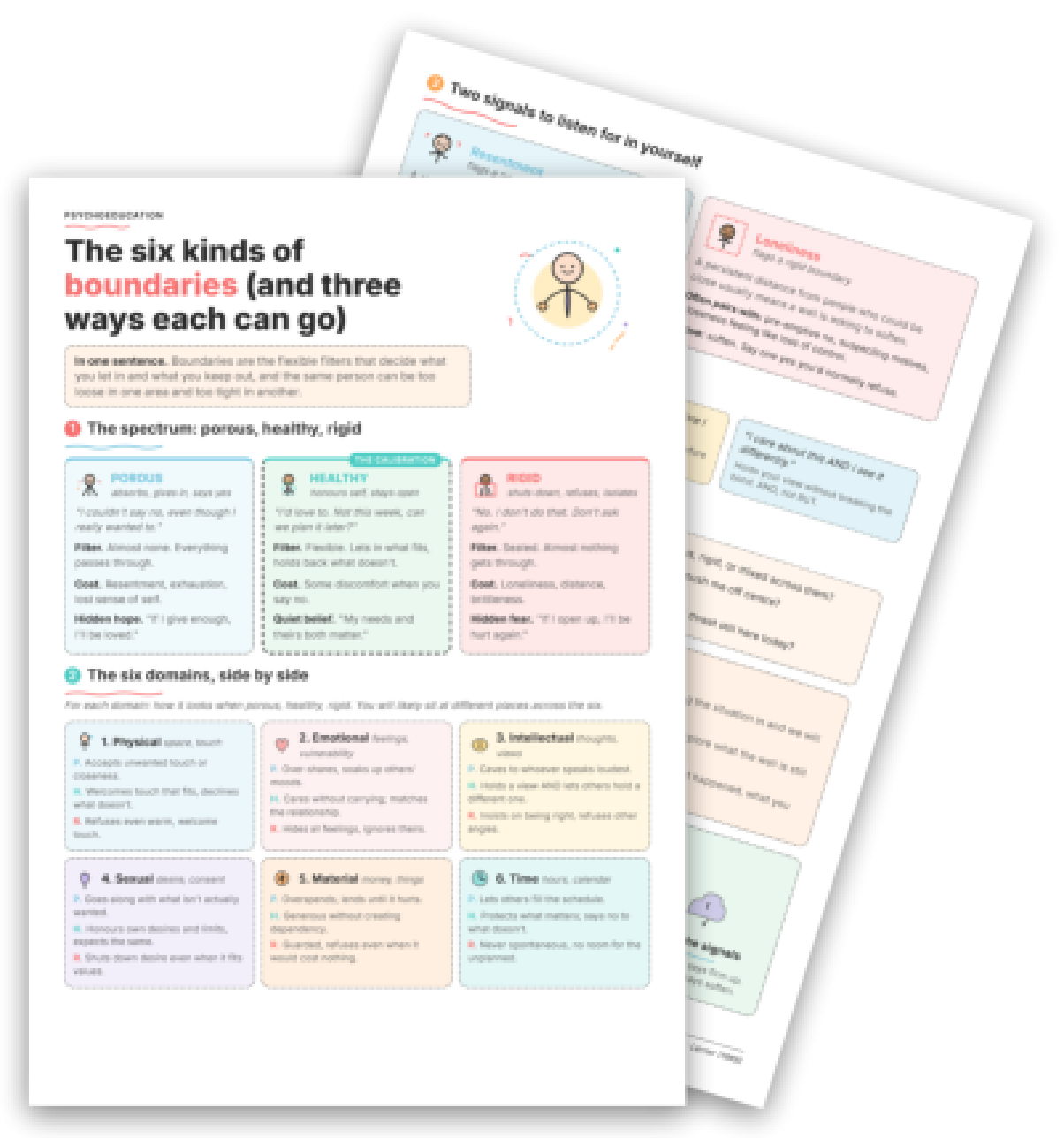
The fiche PDF is structured around four numbered panels that build on each other.
The first panel presents the three-position spectrum, with each position mapped across its filter (what passes through), its immediate cost, and the hidden belief driving it. The porous position carries "If I give enough, I'll be loved"; the rigid position carries "If I open up, I'll be hurt again." Showing those hidden beliefs on paper is often the moment patients stop defending their pattern and start examining it.
The second panel lays out six domains in a side-by-side table: physical space, emotional vulnerability, intellectual views, sexual consent, material resources, and time. For each domain, the fiche shows concisely how porous, healthy, and rigid behaviour differs in practice. A patient can read across a row and locate themselves immediately, something no oral explanation replicates. This format makes it natural to notice domain-by-domain asymmetry, which is the clinical point worth naming.
The third panel identifies two somatic signals the fiche asks patients to track between sessions: resentment as a flag for a porous limit that was needed and not held, and loneliness as a flag for a rigid limit that may be ready to soften. Both signals come with a one-line action prompt ("firm up" / "soften") grounded in behavioural terms, which pairs naturally with the assertiveness-building work many of these patients are also doing.
The fourth panel offers three short scripts for real-world use, including the formulation "I'd like to think about it before I answer", which targets the reflexive compliance that assertive communication training often works on, and the AND/not-BUT reframe for holding a position without rupturing the relationship.
> Key point: the fiche is a visual support that facilitates the explanation of boundary types in session. It is not a self-administered questionnaire. The clinician walks through it with the patient, using the domain table as a shared map rather than a test to complete alone.
A closing reflection block offers five questions and three explicit debriefing prompts addressed directly to the clinician, framing what to bring back in the next appointment.
Clinical library
750+ clinical tools
A library built with and for clinicians, ready to use in session and extend between appointments.
Access all the toolsSeveral resource types
Psychoeducation handouts
Understand at a glance
Interactive exercises
To do and fill in
Interactive programs
A structured path
Audios
Meditation and relaxation
Psychometric tests
Automatic scoring
When and How to Introduce This Fiche
The most effective entry point is after the initial anamnesis, once the therapeutic alliance supports mild confrontation of relational patterns. Proposing it too early, before the patient feels safe enough to examine their interpersonal style, risks activating the very defences the fiche is designed to soften.
For patients presenting with relational beliefs that damage their close bonds, chronic resentment, or reported loneliness that coexists with an apparent refusal of closeness, this becomes a primary psychoeducation tool. It is also well-suited to the mid-phase of treatment with patients following assertive rights work or an assertiveness training programme, where finer calibration across domains is the next clinical step.
A low-activation introduction keeps the focus observational: "I'd like to show you a map that many people find useful. We're not diagnosing your style, we're just going to look at where you tend to sit across a few different areas of your life." From there, the six-domain table does the work. Ask the patient to read across each row silently before commenting. Their spontaneous reactions, surprise at a domain where they hadn't noticed rigidity, or quick identification with the porous filter in the time domain, are more clinically useful than anything you could point to directly.
Debrief by asking which domain produced the strongest recognition, and which hidden belief (from panel one) resonated most. The resentment and loneliness signals in panel three translate naturally into between-session tracking, and the fiche's own closing prompts specify precisely what to bring back next time. Pair it with the Healthy Relationships psychoeducation programme when the work extends into the patient's couple or family context.
The fiche does not replace the clinical formulation; it makes one piece of it visible, shareable, and concrete enough that patients leave with a reference, not just a memory of something they half-understood in session.
Use it with your patients
Share this tool in the mobile app and follow the work between sessions.
Sources
- Tawwab, N. G. (2021). Set Boundaries, Find Peace: A Guide to Reclaiming Yourself. TarcherPerigee.
- Katherine, A. (1991). Boundaries: Where You End and I Begin: How to Recognize and Set Healthy Boundaries. Hazelden Publishing.
- University of Iowa Student Health and Counseling Services (2021). Wellness Tips: Healthy Interpersonal Boundaries.
Patient mobile app
Your session continues in your patients' pocket
Use with a patientYour resources, available everywhere
The handouts, exercises, programs and audios above: you choose which ones to make available to your patients, in the mobile app dedicated to them.
Psychoeducation handoutsInteractive exercisesInteractive programsAudiosPsychometric tests
And far more than a library
The app goes well beyond resources, to support your patients every day:
Standardized tests
Therapy journal
Gamification
Wellbeing challenges
Introspection prompts
Therapist homework
Related categories
Explore other clinical resources by category.

Identity
Clinical resources for self-identity work in therapy: CBT, ACT, schema tools for clinicians addressing self-concept, core beliefs, and identity disruption.

Relationships
Clinical worksheets and tools on relational functioning: attachment, schemas, assertiveness, and communication skills for therapists. Printable PDF resources.

Understand
Clinical hub for the therapeutic aim 'Understand': worksheets and tools to build patient insight across CBT, ACT, schema therapy and more.

Build awareness
Clinical worksheets and tools to build awareness in therapy: cognitive distortions, schemas, emotions, ACT and CBT resources for practitioners.

Build skills
Skill-building resources for clinicians: printable worksheets and exercises for coping, assertiveness, and communication skills training in therapy.

CBT
CBT worksheets, cognitive restructuring exercises & behavioral tools for clinicians. Evidence-based resources for every phase of cognitive behavioral therapy.