
Clinical picture. T., a 15-year-old referred after a conflict with a peer group, disclosed during session that a classmate had shared an intimate photo she sent him, insisting she had "never said no" to it being forwarded. The clinician introduced the informational sheet on consent, walking through the specificity and reversibility criteria with T. using the traffic-light framework. T. was able to identify that her original yes was directed at one recipient and did not extend to others, which the sheet made concrete rather than abstract. She left the session with clearer language to use when speaking with school staff, and reported reduced self-blame at the next appointment.
Understanding Consent: PDF Worksheet, Tools and Exercises for Teen Work
A visual psychoeducation fiche helping clinicians explain consent to adolescents in session, with a traffic light model, real scenarios, and ready-to-use phrases.
Clinical vignettes
Reframing Silence as Consent
Consent Vocabulary in Adolescent Group Work
Clinical picture. A school-based group of 14 to 16-year-olds, run by a psychologist within a prevention programme, included several adolescents who conflated persistent asking with eventual agreement. The clinician distributed the sheet and anchored discussion around the "worn down" and "I guess so" examples, asking participants to sort each scenario into the traffic-light categories. One adolescent spontaneously noted that a past situation he had described as consensual mapped onto amber rather than green once he applied the criteria. The group closed with each participant naming one sign from the sheet they had not previously recognised as indicating absent consent.
Adolescents rarely lack information about consent. They lack a shared vocabulary for it, one that holds up in real situations, not just in health class. This PDF worksheet gives you a concrete visual scaffold to build that vocabulary together in session, rather than talking around a concept that most teenagers will insist they already understand.
Use this resource with your patients
Handout, exercises and materials ready to use, right inside SessionFuel.
Why Consent Is Hard to Explain to Adolescents in Session
The cognitive challenges are predictable. Adolescents tend to conflate verbal compliance with genuine consent, miss coercive dynamics when the social pressure is implicit rather than explicit, and misread physiological freeze responses as acquiescence. They also routinely generalise: a prior yes becomes a standing yes, and context specificity collapses entirely.
What makes this particularly difficult to address orally is the social performance dimension of the consultation. A teenager who understands the concept abstractly may still struggle to locate it in their own relational experience without a structured prompt. Without something concrete to look at together, the conversation easily drifts into the theoretical, or worse, triggers defensiveness when the clinician's framing sounds evaluative.
A psychoeducation approach built around real teen scenarios grounds the work differently: it shifts the register from moral instruction to shared analysis. That is precisely where this fiche is useful.
Clinical library
750+ clinical tools
A library built with and for clinicians, ready to use in session and extend between appointments.
Access all the toolsSeveral resource types
Psychoeducation handouts
Understand at a glance
Interactive exercises
To do and fill in
Interactive programs
A structured path
Audios
Meditation and relaxation
Psychometric tests
Automatic scoring
What the Fiche Contains: A Visual Support for the Consent Conversation
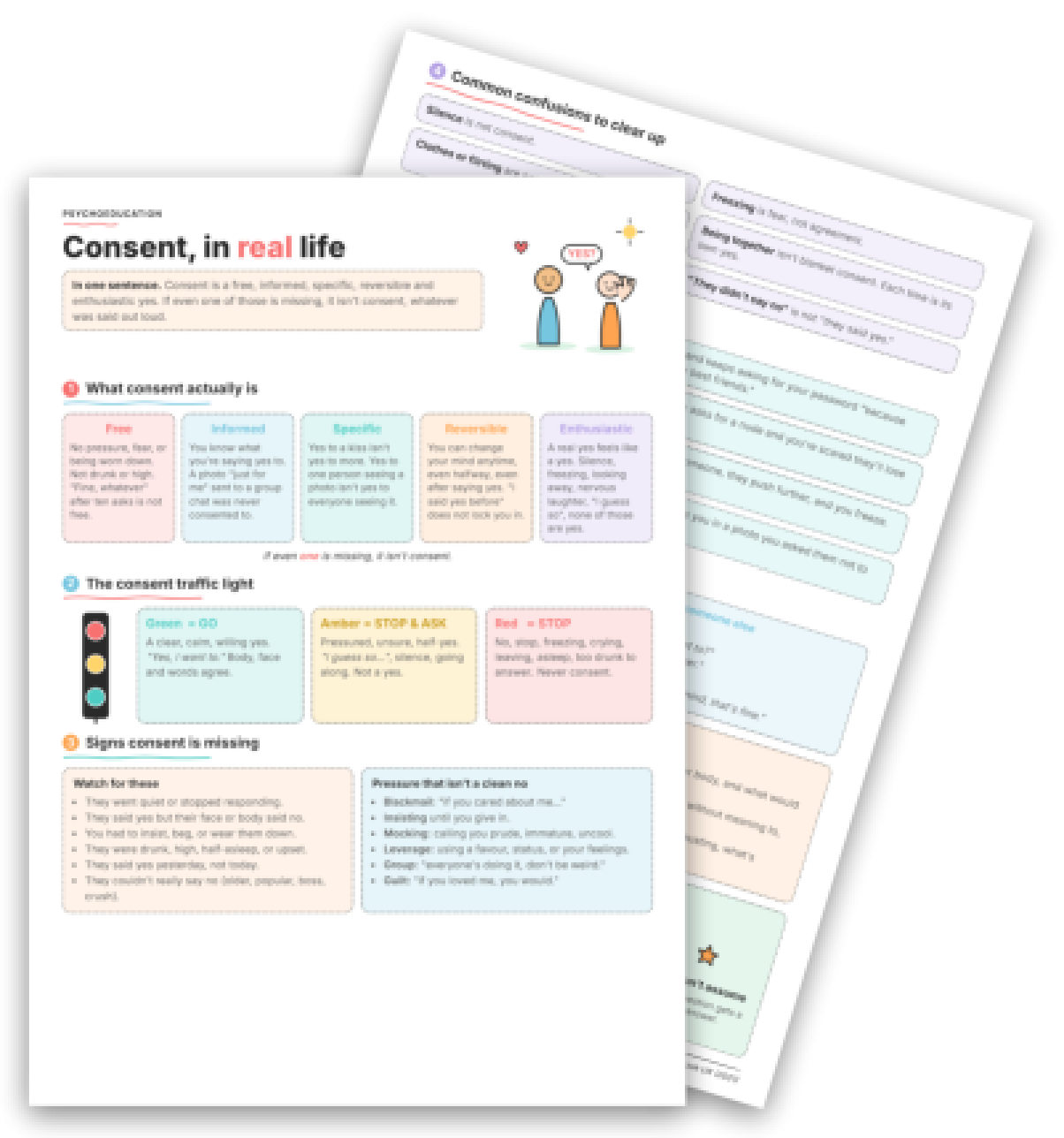
The fiche is organised around six numbered panels, each addressing a discrete aspect of consent. The opening panel states the core definition directly: "Consent is a free, informed, specific, reversible and enthusiastic yes. If even one of those is missing, it isn't consent." This sentence does the work of any ten-minute oral explanation, and you can point to it rather than paraphrase it.
Panel 2 presents a consent traffic light: green for a clear, willing yes; amber for pressure, uncertainty, or a half-hearted "I guess so..."; red for no, freezing, intoxication, or distress. The three-colour visual does something no verbal explanation does easily: it makes the ambiguous middle category legible. Clinicians working with adolescents who rationalise coercive dynamics frequently find that the amber zone is where the real clinical work sits.
Panel 3 lists observable signs of missing consent and names six distinct pressure tactics by type, including guilt induction, insistence until exhaustion, and leverage through status or favours. Panel 4 tackles common confusions directly: silence, freezing, clothing, or prior intimacy are not consent. Panel 5 offers eight real teen scenarios spanning photo sharing without permission, password requests, drink spiking, unsolicited forwarding of private messages, and freeze responses during physical contact. These are the situations your patients are actually navigating, and seeing them listed without judgment lowers defensiveness considerably.
Panel 6 gives ready-to-use phrases in two registers: phrases to set limits or change one's mind, and phrases to check in with another person. There are also three discussion prompts framed explicitly "to discuss in session", including: "When you remember a time your own consent wasn't respected: how did it land in your body, and what would you want to say or do now?"
> Key takeaway: The fiche is a visual support that facilitates the explanation of consent in session. It is not a questionnaire the patient fills in alone. It gives both clinician and patient something concrete to examine together, which is where the therapeutic movement happens.
Use it with your patients
Share this tool in the mobile app and follow the work between sessions.
When and How to Propose It in Session
This fiche fits most naturally from the second or third session onward, once the therapeutic alliance is established enough to raise relational and bodily experience without triggering shutdown. It is particularly indicated when working with adolescents presenting with trauma-related symptoms, boundary difficulties, bullying contexts, or relational coercion, including situations that may not yet be named as such by the patient.
You can introduce it without labelling the patient's situation: "I'd like to go through something with you that comes up for a lot of young people. Tell me what you think as we look at it together." This framing positions the fiche as normative rather than diagnostic. Work through the traffic light first, then move to the scenarios in Panel 5. The assertiveness skills for teens fiche pairs well as a follow-up, and for patients where coercive dynamics point toward something more systemic, the cycle of abuse and gaslighting warning signs resources extend the conversation naturally.
One clinical caution: with patients in active disclosure, move slowly through Panel 3. The precision of the pressure taxonomy can surface recognition that the patient is not yet ready to name. Pace it to the alliance, not the content.
The fiche does not replace a trauma-informed formulation. It gives the explanation more traction, builds shared language, and leaves the patient with a reference they can return to outside the room.
Patient mobile app
Your session continues in your patients' pocket
Use with a patientYour resources, available everywhere
The handouts, exercises, programs and audios above: you choose which ones to make available to your patients, in the mobile app dedicated to them.
Psychoeducation handoutsInteractive exercisesInteractive programsAudiosPsychometric tests
And far more than a library
The app goes well beyond resources, to support your patients every day:
Standardized tests
Therapy journal
Gamification
Wellbeing challenges
Introspection prompts
Therapist homework
Related categories
Explore other clinical resources by category.

Identity
Clinical resources for self-identity work in therapy: CBT, ACT, schema tools for clinicians addressing self-concept, core beliefs, and identity disruption.

Relationships
Clinical worksheets and tools on relational functioning: attachment, schemas, assertiveness, and communication skills for therapists. Printable PDF resources.

Build awareness
Clinical worksheets and tools to build awareness in therapy: cognitive distortions, schemas, emotions, ACT and CBT resources for practitioners.

Build skills
Skill-building resources for clinicians: printable worksheets and exercises for coping, assertiveness, and communication skills training in therapy.

Engage & motivate
Clinical hub: printable worksheets and exercises to build therapeutic engagement and motivation across ACT, CBT, and integrative practice. For clinicians.

Integrative
Integrative therapy clinical resources: worksheets, psychoeducation programs, and exercises for eclectic, multimodal practice across orientations.