
Clinical picture. M., a woman in her late thirties, presents with chronic exhaustion and low-grade resentment toward her family of origin; she describes a pattern of agreeing to requests and then cancelling at the last minute, followed by self-reproach. Her clinician introduces the informational sheet on boundaries and uses the wall-versus-boundary distinction to help her see that her cancellations function as delayed refusals rather than protected limits. Together they identify two ready-to-borrow phrases she can use with her mother, specifically "This doesn't work for me" and "Not at this time," and they anticipate the guilt wave likely to follow. At the next session M. reports having used one phrase by text; she felt guilty for two days, but the resentment that usually lasted a week did not appear. The clinician normalises this as the first data point that guilt and wrongdoing are not the same signal.
Setting Boundaries: How to Say No: PDF Worksheet, Tools and Exercises
A printable PDF worksheet, practical tools, and ready-to-use exercises to help patients understand, set, and hold personal limits in session and beyond.
Clinical vignettes
Guilt After a Clear No
Over-Explaining as a Boundary Failure
Clinical picture. T., a man in his mid-forties with a history of anxious attachment, comes to session describing an interaction with a colleague in which he declined a favour but spent ten minutes justifying the refusal, ultimately agreeing to help anyway. The clinician uses the fiche's section on "no limit" behaviour to name what happened: the over-explanation functioned as a fawn response aimed at conflict avoidance, and it cost T. both time and self-trust. They practise shortening the refusal to a single sentence, such as "I can't do that for you," and discuss why adding reasons invites negotiation. T. trialled this once before the following session, reporting discomfort but no relational rupture. The clinician notes that the absence of catastrophe is itself useful clinical material.
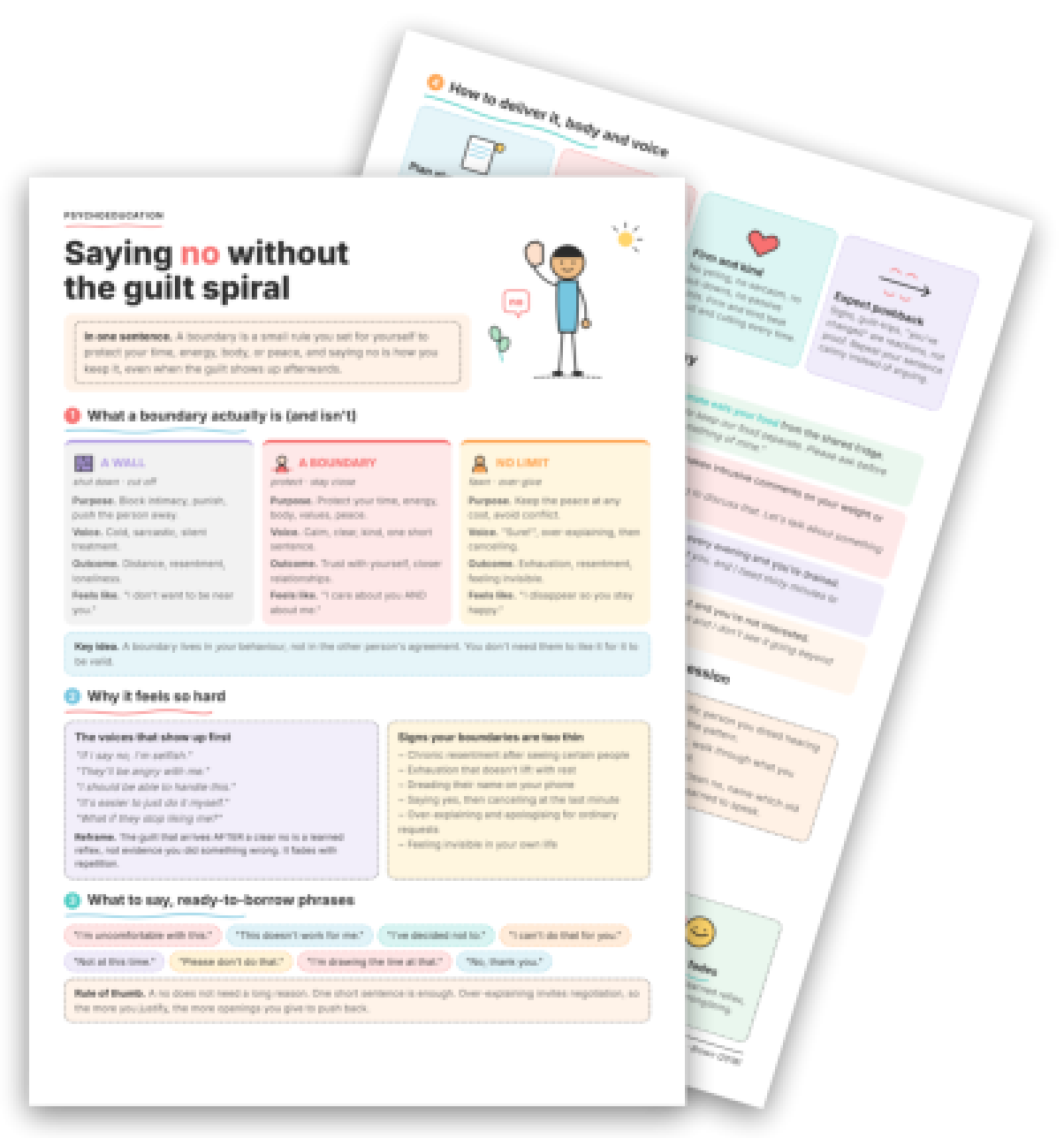
Explaining boundary-setting in session often produces the same result: the patient nods, agrees it makes sense, then leaves and does nothing differently. The concept stays abstract until patients can see, side by side, exactly what a boundary is not. This PDF worksheet on setting boundaries gives you a concrete visual anchor to work from, cutting the explanation time and leaving the patient with something precise to take home.
Use this resource with your patients
Handout, exercises and materials ready to use, right inside SessionFuel.
Why "Just Say No" Falls Flat in Session
The core difficulty is conceptual conflation. Most patients arrive equating a boundary either with a wall (cold shutdown, relational severance) or with aggression. Neither map is accurate, and correcting it verbally tends to generate circular conversation. Patients whose histories include fawn responses or a self-sacrifice schema are particularly prone to reading any firm limit as abandonment or cruelty toward the other person.
A second layer makes this harder: post-compliance guilt. The moment a patient successfully declines a request, the guilt that floods in is read as evidence of wrongdoing. This guilt is a learned reflex, not a moral signal, but that reframe rarely lands through words alone. Patients with strong approval-seeking patterns or a history reinforced by beliefs that damage relationships need more than a verbal explanation to internalize this distinction. A visual that holds the contrast steady while you talk is the difference between understanding and knowing.
What the Fiche Contains: A Visual Comparison That Does the Work for You
The fiche opens with a three-column comparison: A Wall, A Boundary, and No Limit. Each column names the underlying purpose, the voice it uses, the relational outcome, and the felt sense for the patient. "A boundary lives in your behaviour, not in the other person's agreement" appears as a key idea immediately below, which is one of the most clinically precise framings available for patients who stall waiting for the other person's buy-in.
The second panel maps the cognitive voices that show up first: "If I say no, I'm selfish," "What if they stop liking me?" These are presented without commentary, which makes them easy to pause on in session and work with using a cognitive restructuring approach or the ABC model from REBT. A checklist of six behavioral signs of thin limits follows (chronic resentment, over-explaining, saying yes then cancelling), giving you a quick recognition tool you can read through together.
Panels three and four provide ready-to-borrow phrases and a delivery guide covering body language, vocal tone, and a method for handling pushback. This is where the fiche earns its keep as a psychoeducation support for assertiveness work: patients who know what to say but freeze in the moment leave session with eight short sentences they can rehearse. A worked-scenarios panel covers seven common situations, from a colleague asking for shift coverage to a partner who vents each evening. The specificity matters. Vague principles do not generalise; concrete scripts do.
The final section, "To discuss in session," lists three reflection prompts the patient can bring back the following week, making the fiche a natural bridge to your next contact rather than a closed exercise.
> Key point: this fiche is a visual support that facilitates the explanation in session, not a questionnaire the patient fills out alone. Work through the three-column comparison together, pause on the voices panel to identify which messages the patient recognises, and hand the sheet over at the end as a concrete reference.
750+ clinical tools
A library built with and for clinicians, ready to use in session and extend between appointments.
Access all the toolsWhen and How to Introduce It
The fiche fits naturally after an initial anamnèse when avoidance, relational exhaustion, or recurring resentment emerges in the clinical picture. It is well-suited to patients working on boundary styles, on assertive rights, or through a DBT DEAR MAN framework. For adolescents, pair it with the dedicated assertiveness resource for teens.
Introduce it without labelling the patient's current pattern: "I'd like to show you something that distinguishes a few approaches people take when limits come up, and then we'll see where you recognise yourself." After working through the three-column visual together, use the behavioral signs checklist as a natural self-assessment. Debrief by asking which of the borrowed phrases feels most usable this week, and which old voice the patient predicts will show up afterwards.
One contraindication worth naming: in the context of active coercive control or relational threat, the delivery section (firm voice, steady eye contact, expect pushback) needs careful adaptation before the patient applies it at home. The fiche does not replace a safety assessment, and the post-limit pushback panel should be read together rather than assigned as autonomous practice in those cases.
The fiche does not replace the therapeutic framework; it makes the explanation sharper and leaves the patient with a reference they can return to between sessions.
Use it with your patients
Share this tool in the mobile app and follow the work between sessions.
Sources
- Tawwab, N. G. (2021). Set Boundaries, Find Peace: A Guide to Reclaiming Yourself. TarcherPerigee.
- Alberti, R. E., Emmons, M. L. (2017). Your Perfect Right: Assertiveness and Equality in Your Life and Relationships (10th ed.). New Harbinger Publications.
- Cloud, H., Townsend, J. (1992). Boundaries: When to Say Yes, How to Say No to Take Control of Your Life. Zondervan.
- (2025) The four pathways of assertiveness: a multidimensional framework for enhancing individual well-being. Frontiers in Psychology.
Your session continues in your patients' pocket
Use with a patientYour resources, available everywhere
The handouts, exercises, programs and audios above: you choose which ones to make available to your patients, in the mobile app dedicated to them.
And far more than a library
The app goes well beyond resources, to support your patients every day:
Related categories
Explore other clinical resources by category.

Identity
Clinical resources for self-identity work in therapy: CBT, ACT, schema tools for clinicians addressing self-concept, core beliefs, and identity disruption.

Relationships
Clinical worksheets and tools on relational functioning: attachment, schemas, assertiveness, and communication skills for therapists. Printable PDF resources.

Build awareness
Clinical worksheets and tools to build awareness in therapy: cognitive distortions, schemas, emotions, ACT and CBT resources for practitioners.

Build skills
Skill-building resources for clinicians: printable worksheets and exercises for coping, assertiveness, and communication skills training in therapy.
CBT
CBT worksheets, cognitive restructuring exercises & behavioral tools for clinicians. Evidence-based resources for every phase of cognitive behavioral therapy.
Anxiety
Clinical hub for anxiety disorders: CBT and ACT worksheets, psychoeducation sheets, and exercises for assessment and treatment across the anxiety spectrum.