
Clinical picture. J., 15, was referred for low mood and recurrent somatic complaints; his parents described him as "too easy-going," and peers had been borrowing his belongings and notes without reciprocating. In session, the clinician introduced the three-style framework from the psychoeducation sheet, asking J. to read the passive column aloud and rate how often each description fit him. J. identified strongly with "bottled until they leak" and, unprompted, connected it to the stomach aches he reported every Sunday evening before the school week. The clinician did not push for behaviour change in that session; simply naming the pattern as a learned style rather than a fixed trait appeared to reduce J.'s self-criticism and opened space for the following session's work on assertive phrasing.
Assertiveness for Teens: PDF Worksheet, Tools and Exercises for Clinical Practice
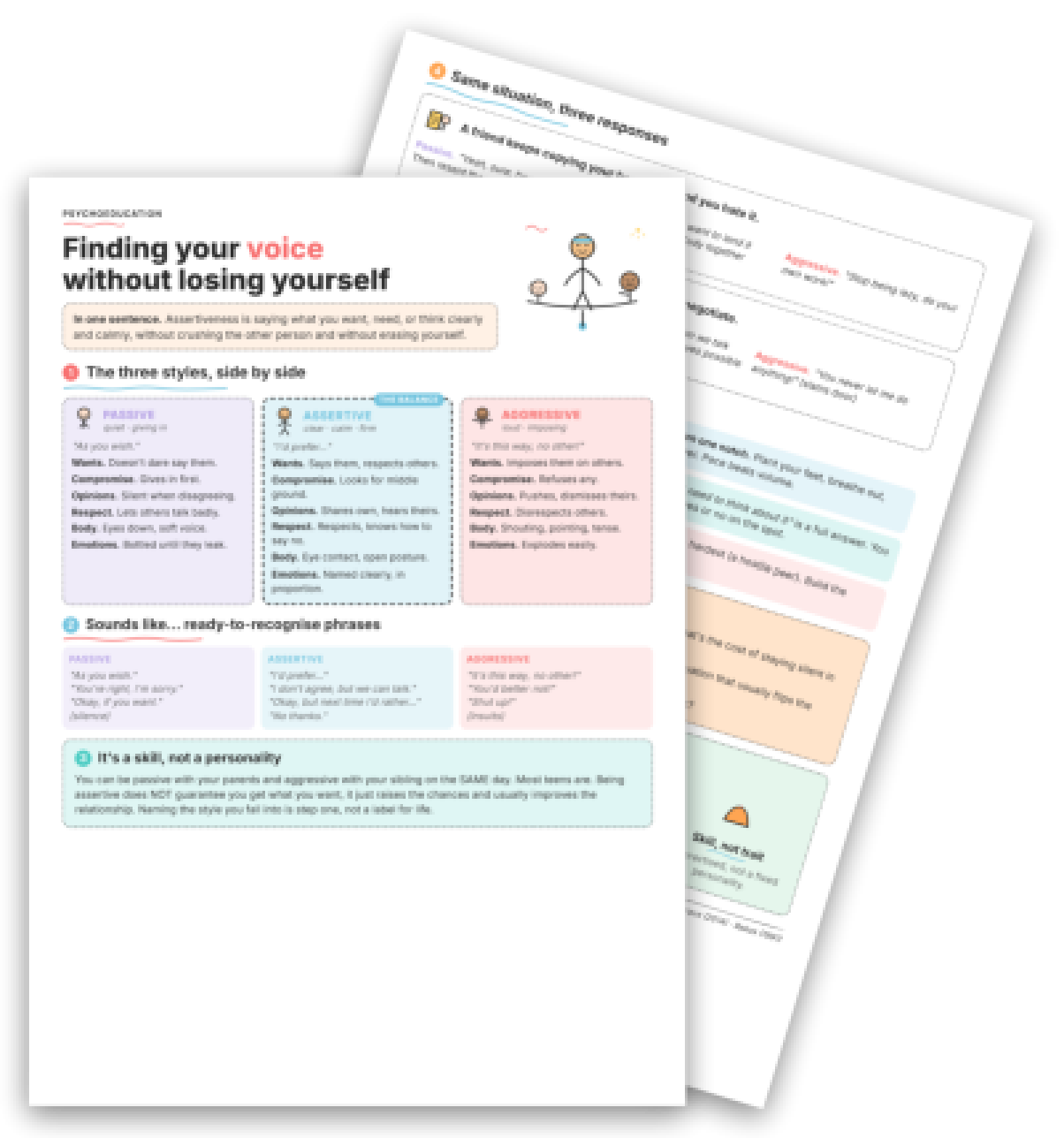
A visual psychoeducation tool to help adolescent patients understand passive, assertive, and aggressive styles, and start practising assertive communication in session.
Clinical vignettes
Naming the Style Before Changing It
Oscillating Styles in an Adolescent with Conflict at Home
Clinical picture. A., 14, presented after a school exclusion following a verbal altercation with a classmate; at home, her mother reported that A. never expressed disagreement and went silent for days after arguments. Using the same-situation exercise from the worksheet, the clinician and A. role-played the homework-lending scenario, and A. spontaneously produced a response that matched the aggressive column almost word for word. When shown the side-by-side table, A. noted, without prompting, that she was passive at home and aggressive at school, and asked why she could not "just be in the middle." That observation became the working hypothesis for the following sessions, framing assertiveness as a context-sensitive skill to practise rather than a character deficit to correct.
Explaining assertiveness to a teenager at the oral level rarely sticks. The concept sits uncomfortably close to a character verdict, and most adolescents hear "be more assertive" as either a criticism or an impossible personality transplant. This fiche PDF cuts through that impasse by making the three communication styles immediately visible and personally recognisable, so the explanation lands during the session, not three weeks later.
Use this resource with your patients
Handout, exercises and materials ready to use, right inside SessionFuel.
Why Assertiveness Is Hard to Explain to Adolescent Patients
The central clinical difficulty is that teenagers tend to collapse assertiveness into either compliance or aggression. When you describe the middle ground verbally, they nod, and then describe their last conflict in entirely passive or aggressive terms, without noticing the gap. The cognitive schema around approval seeking (well documented in the literature on adolescent social cognition) makes even the concept of expressing a need feel threatening.
There is also a developmental timing issue: the prefrontal modulation of assertive behaviour is genuinely immature, which means many teens oscillate between bottling up and blowing up on the same day, sometimes with the same person. Framing this as a skills deficit rather than a personality flaw is the therapeutic leverage point, but that reframe is hard to hold with words alone. A visual support on assertive communication gives the clinician something concrete to point to when the patient insists "that's just who I am."
Finally, the passive-aggressive continuum is invisible to many adolescents because no one has ever laid the two extremes and the middle ground side by side in front of them. That juxtaposition is exactly what this fiche is designed to provide.
What the Fiche Contains: A Visual Map of Three Styles
The fiche opens with a single-sentence working definition: "Assertiveness is saying what you want, need, or think clearly and calmly, without crushing the other person and without erasing yourself." That sentence is worth reading aloud together before you unfold the rest.
The core visual is a three-column comparison table (Passive / Assertive / Aggressive) across six dimensions: Wants, Compromise, Opinions, Respect, Body language, and Emotions. A patient who has been intellectually agreeing with your explanations for sessions often stops short when they see "Emotions: Bottled until they leak" listed under Passive, or "Body: Eyes down, soft voice". The layout makes the behavioural signature of each style scannable in under thirty seconds, which is precisely what an oral explanation cannot do.
Panel 2 gives ready-to-recognise phrases for each style ("As you wish," "I'd prefer...," "Shut up!"), useful for the patient who processes through dialogue rather than abstraction. Panel 3 makes the developmental reframe explicit: "You can be passive with your parents and aggressive with your sibling on the same day. Most teens are." That sentence alone often unlocks the session.
Panel 4 runs the same two situations through all three response styles (the friend copying homework, the parent refusing an outing), which is where the fiche earns its clinical value as a visual support: seeing Passive / Assertive / Aggressive side by side in a recognisable context is far more generative than any abstract definition. Panel 5 offers five starter micro-behaviours (start with "I", slow down one notch, buy time with "I need to think about it") that translate neatly into between-session assignments without overwhelming the patient.
A dedicated To discuss in session block closes the fiche with three guided reflection questions, including "Which person feels safe enough to practise one assertive sentence with this week?", which maps directly onto a graded assertiveness ladder if you are structuring graduated exposure to interpersonal situations.
> Key takeaway: this fiche is a visual psychoeducation support the clinician uses during the session to make the three styles concrete and comparable at a glance; it is not a self-report questionnaire or a homework worksheet the patient fills in alone.
750+ clinical tools
A library built with and for clinicians, ready to use in session and extend between appointments.
Access all the toolsWhen and How to Introduce the Fiche
This support fits naturally from the second or third session, once the alliance is established and the formulation of case has flagged interpersonal difficulties or a pattern of conflict avoidance. It is particularly indicated for adolescents presenting with social anxiety, low self-esteem, or recurrent peer conflict, and for those who report swinging between passivity and anger outbursts without understanding the mechanism.
A low-threshold introduction: "I'd like to show you a diagram that maps out three ways people communicate. Tell me which column feels most familiar to you this week." This immediately positions the patient as the expert on their own experience, not as someone being diagnosed with a communication problem.
Clinicians working within a TCC framework can follow the fiche with I-messages practice or a behavioural experiment on assertiveness. Those working with coping strategies in younger adolescents will find the fiche slots naturally into a broader skills-building sequence. For patients whose passivity is entangled with approval-seeking schemas, the fiche pairs well with schema-focused work on beliefs about the consequences of saying no.
One limit to note: with patients in acute interpersonal crisis (active conflict at home, relational trauma), introduce the conceptual framework gently and resist over-focusing on the behavioural skills column until emotional safety is sufficiently established.
The fiche does not replace the therapeutic frame; it makes the explanation clearer and leaves the patient with a concrete reference point they can return to between sessions.
Use it with your patients
Share this tool in the mobile app and follow the work between sessions.
Sources
- Alberti, R. E., Emmons, M. L. (2017). Your Perfect Right: Assertiveness and Equality in Your Life and Relationships. New Harbinger Publications.
Your session continues in your patients' pocket
Use with a patientYour resources, available everywhere
The handouts, exercises, programs and audios above: you choose which ones to make available to your patients, in the mobile app dedicated to them.
And far more than a library
The app goes well beyond resources, to support your patients every day:
Related categories
Explore other clinical resources by category.

Identity
Clinical resources for self-identity work in therapy: CBT, ACT, schema tools for clinicians addressing self-concept, core beliefs, and identity disruption.
Relationships
Clinical worksheets and tools on relational functioning: attachment, schemas, assertiveness, and communication skills for therapists. Printable PDF resources.

Understand
Clinical hub for the therapeutic aim 'Understand': worksheets and tools to build patient insight across CBT, ACT, schema therapy and more.

Build skills
Skill-building resources for clinicians: printable worksheets and exercises for coping, assertiveness, and communication skills training in therapy.
CBT
CBT worksheets, cognitive restructuring exercises & behavioral tools for clinicians. Evidence-based resources for every phase of cognitive behavioral therapy.
Anxiety
Clinical hub for anxiety disorders: CBT and ACT worksheets, psychoeducation sheets, and exercises for assessment and treatment across the anxiety spectrum.