
Clinical picture. M., a woman in her late thirties, presented with chronic fatigue and low-grade irritability that she attributed to a demanding line manager. She described routinely answering work messages after 10 p.m. and feeling personally responsible when a colleague left a meeting visibly upset. The clinician introduced the Boundaries Exploration Worksheet, asking M. to map her boundary style across the six domains within that single work relationship rather than globally. She quickly identified a porous pattern in the time and emotional domains while recognising that her material and physical limits at work were, by contrast, quite intact. This differentiated picture gave her a precise starting point: one concrete time limit to practise before the next session, rather than a vague goal of "being more assertive."
Boundaries Exploration Worksheet: PDF Worksheet, Tools and Exercises
A visual PDF worksheet and clinical tools to explain boundary styles across six life domains, for psychoeducation use in individual and couples therapy.
Clinical vignettes
Time and Emotional Boundaries at Work
Rigid Pattern in a Long-Term Partnership
Clinical picture. T., a man in his mid-fifties referred following a relationship crisis, reported that his partner had described him as emotionally unavailable for years. He was sceptical of any framework he perceived as "pop psychology." The clinician presented the Boundaries Exploration Worksheet in session, framing the three boundary styles as descriptive rather than evaluative, and asked T. to rate each domain within his partnership using his own words. He self-identified a predominantly rigid pattern in the emotional and intellectual domains, noting that any difference of opinion felt like an intrusion. Naming the pattern himself, without being labelled, reduced his defensiveness enough to sustain a conversation about the cost that rigidity had accrued over time.
Explaining boundary dynamics verbally is rarely enough. Patients who systematically say yes while exhausted, or who manage every difficulty alone rather than ask for support, understand the word "boundary" perfectly and still cannot locate where their own line sits. This PDF worksheet gives you a visual scaffold to use directly in session, so the concept moves from abstract principle to something the patient can map onto a specific relationship before they leave the room.
Use this resource with your patients
Handout, exercises and materials ready to use, right inside SessionFuel.
Why Boundary Styles Are Difficult to Convey Without a Visual Support
The clinical difficulty is not conceptual opacity. It is that patients tend to hear "you need better limits" and immediately assume they need to become less accommodating, collapsing a three-position continuum into a binary. In schema therapy terms, both the porous style and the rigid style are dysfunctional adaptations, and a patient who prides themselves on independence may not recognise that their self-sufficiency is avoidant rigidity rather than healthy autonomy. Naming this verbally risks immediate defensiveness; showing it on a structured visual changes the relational tone of the conversation.
There is also a domain-specificity problem that an oral explanation cannot easily solve. A patient may enforce clear time limits at work while leaking emotionally with a parent, or carry firm sexual limits while absorbing every colleague's distress. Describing this in session requires the patient to hold six life domains and three boundary styles in working memory simultaneously. The fiche externalises that cognitive load, freeing the clinical conversation for the relational content rather than the taxonomy.
What the Fiche Contains
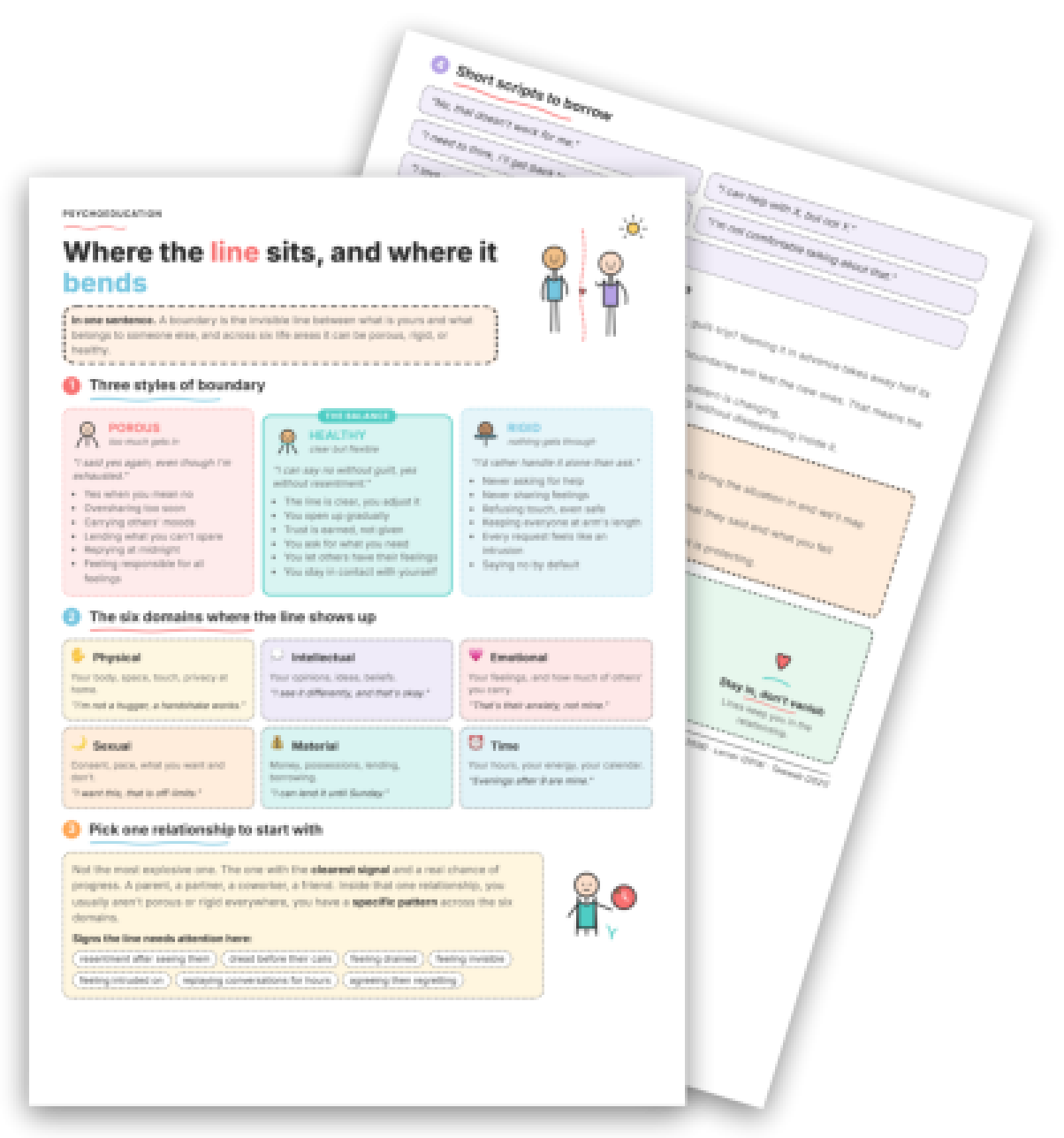
The worksheet opens with a three-column comparison of boundary styles: Porous, Healthy, and Rigid. Each column is populated with behavioural exemplars grounded in daily life, concrete enough that most patients locate themselves within the first read. The porous column lists items like "Replying at midnight" and "Carrying others' moods"; the rigid column counters with "Every request feels like an intrusion" and "Never asking for help". The healthy middle names the clinical target: "The line is clear, you adjust it."
The second structural element is a six-domain grid: Physical, Intellectual, Emotional, Sexual, Material, and Time. Each domain carries a one-line example script (e.g., "Evenings after 9 are mine" for Time; "That's their anxiety, not mine" for Emotional). This layout lets you and the patient scan across domains within a single relationship and identify which areas are porous, which are rigid, and which already hold. No domain-by-domain monologue required.
A "Pick one relationship" prompt follows, with explicit guidance to start with the one that offers the clearest signal and a realistic chance of progress, not the most explosive one. Four ready-to-use verbal scripts appear next ("I can help with X, but not Y", "I love you, and the answer is still no"), alongside a section on what to expect when the line changes: pushback, guilt, and the patient's tendency to read their own discomfort as proof they acted wrongly. This last section is clinically significant for patients whose guilt overrides their own limits chronically.
A closing "To discuss in session" block names three specific situations to bring back: resentment after seeing a particular person, pushback following a new refusal, and guilt that keeps erasing the line. This converts the fiche into a structured between-session bridge.
> To remember: This fiche is a visual support that facilitates the explanation of boundary styles in session. It is not a questionnaire the patient completes alone; it is a psychoeducation tool you work through together, leaving the patient a concrete reference to consult between appointments.
750+ clinical tools
A library built with and for clinicians, ready to use in session and extend between appointments.
Access all the toolsWhen and How to Introduce the Worksheet in Practice
The fiche fits naturally in a second or third session, once the chief complaint is clear and patterns of avoidance or interpersonal friction have surfaced in the formulation. It is particularly well-suited to patients presenting with approval-seeking dynamics, chronic resentment, relational exhaustion, patterns associated with an abandonment schema, or the core beliefs that damage relationships repeatedly across contexts.
You can introduce it simply: "I'd like to show you a map of the different ways people draw their lines in relationships. Tell me where you recognise yourself." This frames it as collaborative observation, not diagnosis.
In individual therapy, the "pick one relationship" structure pairs directly with assertiveness tools and the right to say no, and the four scripts on the fiche give concrete material for assertiveness rehearsal scenarios in the following session. It also connects naturally to work on assertive rights and healthy relational foundations.
In couples work, introduce the fiche to each partner independently before mapping the dyadic pattern together. Pair it with couples communication psychoeducation, conflict resolution exercises, or trust-building work once individual styles are named.
One limit: with patients carrying significant relational trauma or a dissociative profile, the six-domain grid can surface material quickly. Introduce it after a stable therapeutic alliance is established, and follow the patient's pace of self-recognition rather than covering all domains in one pass. The fiche does not replace the clinical formulation; it makes the explanation faster, more precise, and more durable.
Use it with your patients
Share this tool in the mobile app and follow the work between sessions.
Sources
- Tawwab, N. G. (2021). Set Boundaries, Find Peace: A Guide to Reclaiming Yourself. TarcherPerigee.
Your session continues in your patients' pocket
Use with a patientYour resources, available everywhere
The handouts, exercises, programs and audios above: you choose which ones to make available to your patients, in the mobile app dedicated to them.
And far more than a library
The app goes well beyond resources, to support your patients every day:
Related categories
Explore other clinical resources by category.

Identity
Clinical resources for self-identity work in therapy: CBT, ACT, schema tools for clinicians addressing self-concept, core beliefs, and identity disruption.

Relationships
Clinical worksheets and tools on relational functioning: attachment, schemas, assertiveness, and communication skills for therapists. Printable PDF resources.

Build awareness
Clinical worksheets and tools to build awareness in therapy: cognitive distortions, schemas, emotions, ACT and CBT resources for practitioners.

Build skills
Skill-building resources for clinicians: printable worksheets and exercises for coping, assertiveness, and communication skills training in therapy.

Engage & motivate
Clinical hub: printable worksheets and exercises to build therapeutic engagement and motivation across ACT, CBT, and integrative practice. For clinicians.

CBT
CBT worksheets, cognitive restructuring exercises & behavioral tools for clinicians. Evidence-based resources for every phase of cognitive behavioral therapy.