
Clinical picture. J., a woman in her early 30s, presented with chronic anxiety within a three-year relationship she described as objectively calm and reciprocal. She sought daily verbal reassurance from her partner and monitored his tone during ordinary exchanges for signs of cooling interest. The clinician introduced the abandonment schema psychoeducation sheet and walked through the surrender profile together, naming the low-grade bodily alarm and the scanning behaviour as schema-driven rather than reality-based. J. recognised the pattern almost immediately and noted, unprompted, that the same dynamic had appeared in her two previous relationships. This shared framework gave the work a concrete starting point, though she remained cautious about whether change was possible.
The Abandonment Schema: PDF Worksheet, Tools and Exercises
A visual PDF worksheet to explain the abandonment schema in session, map its three survival strategies, and make the self-confirming loop legible for patients.
Clinical vignettes
Reassurance-Seeking in a Stable Relationship
Preemptive Withdrawal Before Intimacy Deepens
Clinical picture. M., a man in his mid-40s, reported a pattern of ending relationships abruptly at the point when a partner began to feel genuinely close. He framed this as personal preference for independence and was initially reluctant to consider a relational explanation. The clinician used the overcompensation section of the abandonment schema sheet to map the sequence: activation, preemptive rupture, and the temporary relief that reinforced the strategy. M. was struck by the self-confirming loop diagram, observing that he had in fact provoked the exact endings he anticipated. He left the session uncertain but willing to track the bodily state the sheet described before his next impulse to withdraw.
The abandonment schema is one of the harder schemas to make clinically workable in early sessions: patients arrive describing jealousy, preemptive breakups, or sudden emotional withdrawal as if these were three unrelated problems. This PDF worksheet gives you a single structured visual to work from, one that names the schema, maps its behavioral expressions, and shows exactly how the fear perpetuates itself.
Use this resource with your patients
Handout, exercises and materials ready to use, right inside SessionFuel.
Why the Abandonment Schema Resists Verbal Explanation
The core difficulty is not naming the schema; it is getting the patient to recognize their own version of it. In Young's framework, the abandonment/instability schema organizes itself differently across patients: one clings and seeks reassurance compulsively, another pulls away the moment intimacy deepens, a third ends relationships before the other person can. These look like distinct clinical pictures, and patients rarely connect them to the same underlying expectation until something lays the alternatives side by side.
The schema also produces strong évitement expérientiel around its origins. Patients often carry fragmented or minimized memory of the early caregiving failures that built it, and they arrive describing relational patterns without linking them to attachment history. A verbal psychoeducation risks staying abstract precisely where concreteness is what produces recognition. For patients who intellectualize, or who are caught in the self-confirming loop described by emotional dependency, seeing the architecture changes the register of the conversation.
What the Fiche Contains: A Visual Map of the Schema and Its Logic
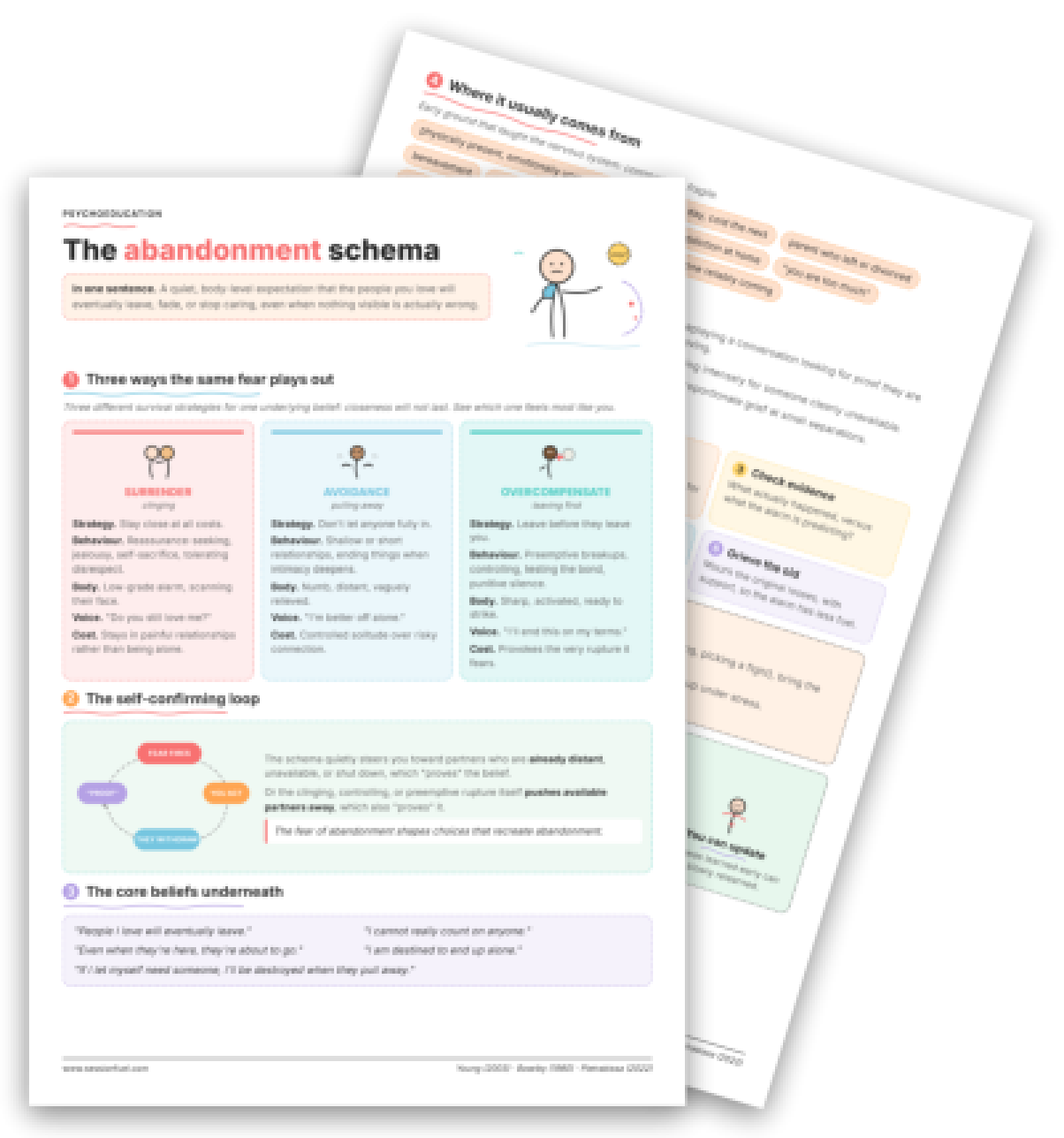
The PDF worksheet is structured across six numbered panels. The first defines the schema in one sentence: "a quiet, body-level expectation that the people you love will eventually leave, fade, or stop caring, even when nothing visible is actually wrong." That formulation alone often produces more recognition than five minutes of explanation.
Panel 2, titled "Three ways the same fear plays out," is the clinical centrepiece. It maps three survival strategies with parallel structure across strategy, behaviour, body sensation, characteristic inner voice, and cost:
- Surrender (clinging, reassurance-seeking, tolerating disrespect; "Do you still love me?")
- Avoidance (shallow or short relationships, emotional numbness, controlled solitude; "I'm better off alone.")
- Overcompensation (leaving first, testing the bond, punitive silence; "I'll end this on my terms.")
Patients working through the fear of being left frequently identify one dominant style and a secondary one that surfaces under stress. The side-by-side visual format makes that dual identification possible in a way that sequential verbal explanation does not.
Panel 3 illustrates the self-confirming loop: the schema steers patients toward unavailable or shut-down partners, or the coping behaviour itself pushes available ones away. The four-node cycle (fear fires, you act, they withdraw, "proof") is the piece that converts intellectual understanding into genuine insight. Panel 4 maps early origins, including emotional unavailability, inconsistent caregiving, bereavement, and the message "manage on your own." Panel 5 is a checklist of recognizable present-day moments: panic when a partner does not reply, disproportionate grief at small separations, falling for someone clearly unavailable. Panel 6 offers six concrete steps, from naming the alarm to grieving the original losses, and closes with three "To discuss in session" prompts that bring behavioural observations from the week directly into the therapeutic frame.
> Key takeaway: The fiche is a visual support that facilitates the explanation of the abandonment schema in session; it gives the patient a concrete map to take home, not a self-test to complete alone.
750+ clinical tools
A library built with and for clinicians, ready to use in session and extend between appointments.
Access all the toolsWhen and How to Introduce the Fiche
This worksheet fits naturally once the schema has been tentatively named, typically from the second or third session after the anamnèse has surfaced significant relational history and at least one current pattern that fits. It works especially well for patients who intellectualize or who minimize early attachment disruption.
A low-pressure opening: "I want to show you something that may describe what we've been circling around." Work through Panel 2 together and ask which of the three strategies feels most familiar. If Surrender is the dominant style, pairing the fiche with the reassurance-seeking exercise extends the work concretely between sessions. For patients ready to examine partner selection, attachment styles in romantic relationships deepens the psychoeducation.
For debrief, the "To discuss in session" prompts are ready-made: bring in a specific moment from the week, identify which style appeared, and map it onto the confirming loop in Panel 3. Deeper origin work can follow with the relational origins of core beliefs exercise, or with clarifying core beliefs once the alliance is solid enough. When the schema is entrenched across multiple relational contexts, articulating it with the 12 ACT schemas and modes of thinking resource adds a useful defusion angle. Longer-term, tracking a negative thought back to its core belief and rebuilding trust in relationships provide natural downstream steps. You can also examine beliefs that damage relationships as a complement when the schema is driving rigid relational rules.
One contraindication: with patients in acute distress around a current abandonment, move through the fiche at a slower pace. Naming the confirming loop before the acute affect is regulated can feel invalidating rather than illuminating.
The fiche does not replace schema work or the relational texture of the therapeutic alliance. It makes the schema legible, and legibility is where change becomes possible.
Use it with your patients
Share this tool in the mobile app and follow the work between sessions.
Sources
- Young, J. E., Klosko, J. S., Weishaar, M. E. (2003). Schema Therapy: A Practitioner's Guide. Guilford Press.
- Bowlby, J. (1969). Attachment and Loss, Vol. 1: Attachment. Basic Books.
- Bowlby, J. (1980). Loss: Sadness and Depression (Attachment and Loss, Vol. 3). Basic Books.
Your session continues in your patients' pocket
Use with a patientYour resources, available everywhere
The handouts, exercises, programs and audios above: you choose which ones to make available to your patients, in the mobile app dedicated to them.
And far more than a library
The app goes well beyond resources, to support your patients every day:
Related categories
Explore other clinical resources by category.

Identity
Clinical resources for self-identity work in therapy: CBT, ACT, schema tools for clinicians addressing self-concept, core beliefs, and identity disruption.

Relationships
Clinical worksheets and tools on relational functioning: attachment, schemas, assertiveness, and communication skills for therapists. Printable PDF resources.

Cognition
Printable cognitive therapy worksheets and clinical tools for therapists: CBT, ACT, schema work, defusion, distortions, and belief restructuring.

Understand
Clinical hub for the therapeutic aim 'Understand': worksheets and tools to build patient insight across CBT, ACT, schema therapy and more.

Build awareness
Clinical worksheets and tools to build awareness in therapy: cognitive distortions, schemas, emotions, ACT and CBT resources for practitioners.

Integrative
Integrative therapy clinical resources: worksheets, psychoeducation programs, and exercises for eclectic, multimodal practice across orientations.