
Clinical picture. M., a woman in her early thirties, presented with longstanding emotional dependency, frequently seeking reassurance from her partner after minor relational tensions. Her therapist introduced the guided self-reflection exercise, asking her to identify a recent triggering situation and the emotions and beliefs underneath it. Working through questions three and four, M. acknowledged that her partner's responses rarely brought lasting relief, and that she had, in fact, managed an analogous situation alone two years prior. For question five, she chose one small autonomous action for the following week: writing her own account of a conflict before reaching out to anyone. At the next session, she reported a modest but meaningful shift in her sense of agency.
Emotional Dependency: A Guided Self-Reflection Exercise
Help patients examine emotional dependency patterns, trace the underlying beliefs, and begin rebuilding autonomous coping and self-esteem.
Clinical vignettes
Tracing Dependency Patterns After Conflict
Rebuilding Self-Esteem Through Guided Reflection
Clinical picture. T., a man in his mid-forties with recurrent depressive episodes, described a persistent need for external validation at work, which he suspected reflected emotional dependency. His clinician used the exercise systematically across two sessions, first helping him articulate the core belief that others were inherently better equipped to evaluate his competence. Exploring question three, T. noted that colleague reassurance felt good for a few hours at most, then dissolved, pointing toward the belief's self-reinforcing quality. He identified a short-term goal he could accomplish without external input: completing one work task and logging his own appraisal of it before seeking feedback. The exercise did not resolve the underlying pattern, yet it gave T. a structured reference point for observing his dependency in real time.
Why Emotional Dependency Is Hard to Work With Clinically
Emotional dependency sits at a peculiar crossroads: patients often suspect it in themselves before they can name it clearly, and yet they resist the label because seeking closeness feels indistinguishable from healthy attachment. The clinical difficulty is not helping them see the pattern; it is helping them feel the difference between relational need that is proportionate and the compulsive pull toward others as the only available source of relief.
A verbal explanation in the room rarely moves that needle far. What tends to land is the patient's own words, written in their own time, tracing a real and recent situation. That is the clinical gap this exercise fills. It complements schema-level psychoeducation tools such as the Dependence / Incompetence Schema worksheet or the Enmeshment / Undeveloped Self Schema fiche, by giving the patient a personal, situated account to bring back to you.
Use this resource with your patients
Handout, exercises and materials ready to use, right inside SessionFuel.
What the Exercise Contains
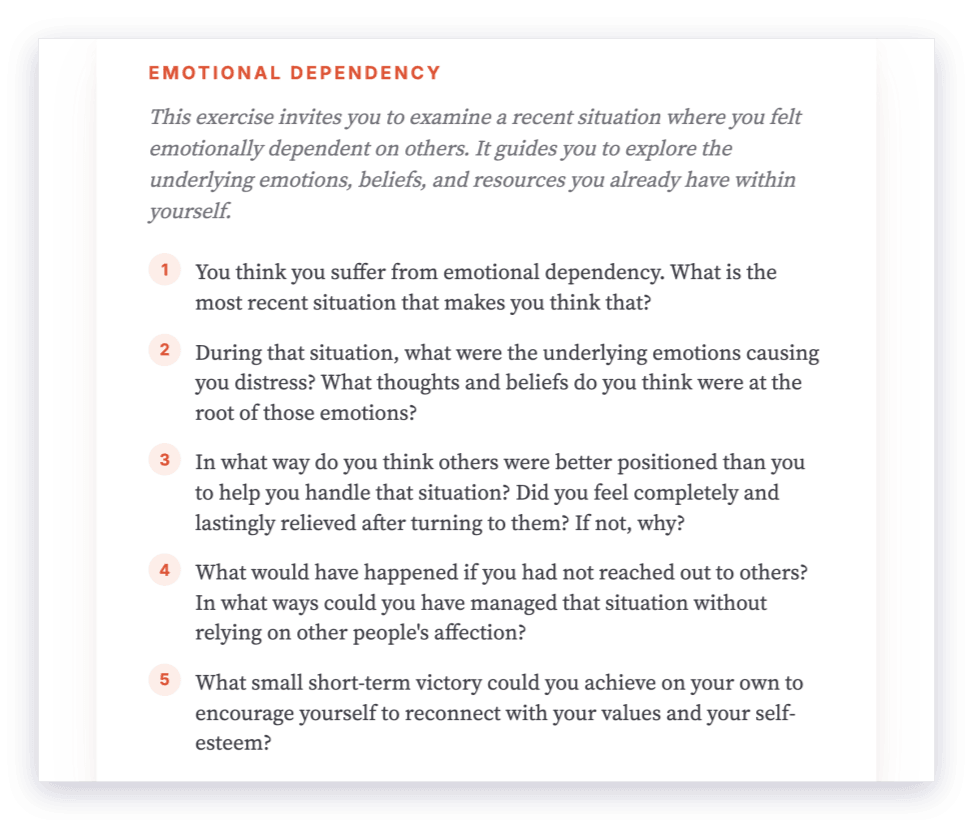
The exercise opens by asking the patient to identify the most recent concrete situation that left them suspecting emotional dependency. This grounds the reflection immediately in lived experience rather than abstraction.
The second question turns inward: what underlying emotions were present, and what thoughts and beliefs were generating them? This mirrors the layered work clinicians do with the Behavior, Emotion, Underlying Need framework and with core belief examination, but in the patient's own language.
The third question is where genuine insight begins to form. It asks directly whether others were truly better placed to manage the situation, and whether the relief they provided was durable. Patients rarely ask themselves this. The contrast between the felt urgency of seeking others and the short-lived nature of the comfort they receive is often the first crack in the pattern.
The fourth question extends that: what would have happened without seeking others' help? In what way could the patient have managed without requiring external affection? This is not a rhetorical challenge; it invites genuine hypothesis-testing, aligned with the kind of behavioural thinking behind the Assertiveness Behavioral Experiment.
The fifth question closes with action: one small, short-term victory the patient could achieve on their own, to reconnect with their values and self-esteem. This is a direct bridge to values clarification work and to the self-perception rebuilding supported by a strengths exploration.
The image above lists all five questions with a brief framing introduction. It is a static preview only. The full guided exercise, with patient-facing instructions and space to respond, is what the patient actually experiences autonomously on their device; that interactive version is not visible here.
This exercise is available to patients through the dedicated patient mobile application of SessionFuel. The clinician assigns it directly from their SessionFuel account, and the patient then completes it autonomously on their phone between appointments, at their own pace.
Key insight: The lasting therapeutic movement in emotional dependency work comes not from explaining the pattern, but from having the patient discover, in their own words, that the relief they sought was neither proportionate nor durable, and that an alternative was already within reach.
750+ clinical tools
A library built with and for clinicians, ready to use in session and extend between appointments.
Access all the toolsUse it with your patients
Share this tool in the mobile app and follow the work between sessions.
How to Integrate This as Between-Session Work
This exercise suits patients who have already named emotional dependency as a concern, whether from their own reading, from a previous conversation with you, or from schema psychoeducation using tools such as the Approval-Seeking Schema or Building Secure Attachment worksheets. It is not well suited to patients who are still at the psychoeducation stage or who would find the self-confrontation destabilising.
To introduce it, you might frame it simply: "Between now and next time, I'd like you to look at one recent situation through these five questions. There are no right answers; I want your honest version." Keeping the instructions low-pressure preserves the authenticity of what the patient produces.
When the patient returns, the richest clinical material usually lives in questions three and four. Did the relief last? Could they have managed alone? The gap between their intuitive answer and their honest reflection after writing it down is often the session's most productive territory. Question five, the small autonomous victory, functions as a behavioural anchor and can feed directly into work on self-esteem, values reconnection, or limit-setting.
For patients with a schema therapy frame, you can link question two's belief content back to the attachment styles fiche or to the self-sacrifice schema if caretaking of others is part of the picture. The exercise does not require that frame to work, but it integrates cleanly with it.
Your session continues in your patients' pocket
Use with a patientYour resources, available everywhere
The handouts, exercises, programs and audios above: you choose which ones to make available to your patients, in the mobile app dedicated to them.
And far more than a library
The app goes well beyond resources, to support your patients every day:
Related categories
Explore other clinical resources by category.

Identity
Clinical resources for self-identity work in therapy: CBT, ACT, schema tools for clinicians addressing self-concept, core beliefs, and identity disruption.

Relationships
Clinical worksheets and tools on relational functioning: attachment, schemas, assertiveness, and communication skills for therapists. Printable PDF resources.

Cognition
Printable cognitive therapy worksheets and clinical tools for therapists: CBT, ACT, schema work, defusion, distortions, and belief restructuring.

Build awareness
Clinical worksheets and tools to build awareness in therapy: cognitive distortions, schemas, emotions, ACT and CBT resources for practitioners.

ACT
Clinical hub for Acceptance and Commitment Therapy (ACT): worksheets, exercises, programs and audio resources for practitioners using the ACT model.

CBT
CBT worksheets, cognitive restructuring exercises & behavioral tools for clinicians. Evidence-based resources for every phase of cognitive behavioral therapy.