
Clinical picture. P., a woman in her early thirties, presents with generalised anxiety and a long-standing pattern of telephoning her mother before any administrative task, including routine bank transfers and scheduling medical appointments. She reports that without this contact she feels foggy and convinced she will make an irreparable error. The clinician introduces the psychoeducational sheet on the dependence schema and invites P. to identify where she recognises herself; she points immediately to the surrender column and reads aloud the line about the reassurance loop. In the following session she notes, with some surprise, that naming the pattern as a coping style rather than a character flaw reduced the shame enough to let her complete one online form without calling first. No generalisation is claimed at this stage; the sheet has simply opened a shared vocabulary.
Dependence / Incompetence Schema: PDF Worksheet, Tools and Exercises
A structured visual psychoeducation sheet, tools, and exercises to explain the Dependence/Incompetence Schema and its three coping styles clearly in session.
Clinical vignettes
Reassurance Loop Before Every Decision
Overcompensation Masking an Underlying Belief
Clinical picture. T., a man in his mid-forties, was referred following a burnout after taking on a project lead role he had pursued aggressively. He describes refusing all collegial input, insisting he had everything under control, and dismissing offers of support with irritation. When the clinician introduces the three-coping-styles section of the sheet, T. pauses at the overcompensation column and recognises the dynamic of picking challenges to prove the schema wrong rather than updating it. He articulates, for the first time, the underlying sentence: "I can't actually manage this on my own." The session ends with a modest behavioural experiment agreed for the following week: accepting one piece of factual information from a colleague without reframing it as a concession.
The Dependence/Incompetence Schema is one of the harder early maladaptive schemas to name cleanly in session: patients typically receive it as confirmation of actual inadequacy rather than as the description of a learned coping pattern. Verbal explanation alone tends to reinforce the shame already woven through the schema. This fiche PDF gives you a structured visual anchor to present the concept efficiently, contextualize it developmentally, and leave the patient with something concrete to hold between sessions.
Use this resource with your patients
Handout, exercises and materials ready to use, right inside SessionFuel.
Why This Schema Resists Oral Explanation
The core clinical difficulty is cognitive, not motivational. Patients with this schema have spent years treating their pattern as evidence of genuine incompetence. When you name the schema verbally, the first response is often quiet confirmation: "Yes, that's just how I am." The fiche pre-empts that move by making visible, from the opening sentence, that "competence was never given room to grow", rather than being absent by nature.
A second difficulty is the three-coping-style structure of the schema. Surrender, avoidance, and overcompensation each present very differently in consultation. A patient in overcompensation mode (refusing help, accumulating challenges, snapping "I've got it") may not recognize themselves in the surrender description at all, and without a visual layout showing all three tracks side by side, you risk missing their actual presentation entirely. This is the same structural challenge that arises with the Defectiveness/Shame Schema, the Abandonment Schema, and other schemas that cluster multiple behavioral expressions around a single core belief. Consulting the Coping Styles in Schema Therapy worksheet alongside this fiche can help when a patient carries several active schemas simultaneously.
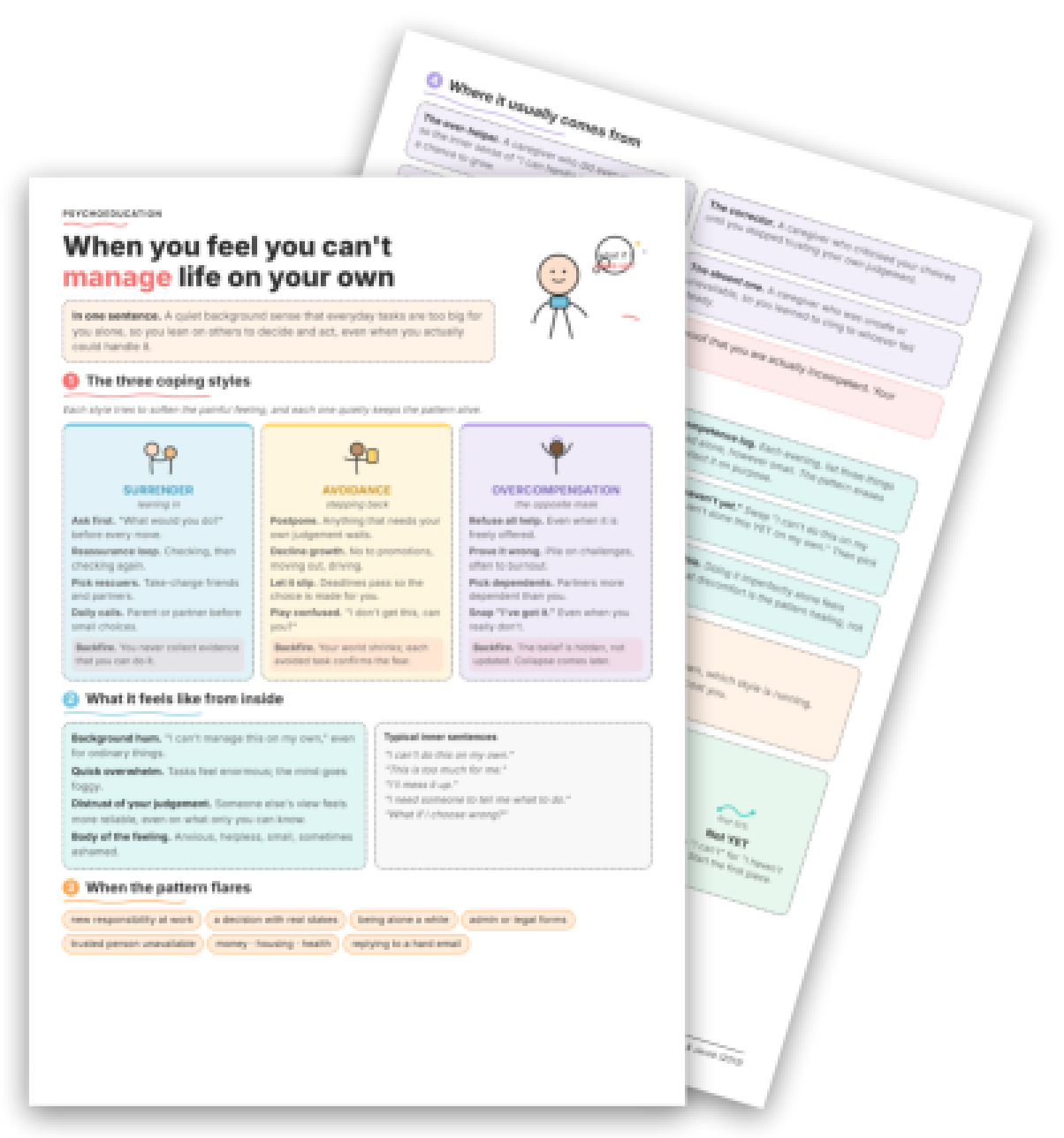
What the Worksheet Contains: A Visual Map of the Schema
The fiche is organized into six numbered panels, each addressing a distinct clinical dimension.
The opening panel defines the schema in one economical sentence: "a quiet background sense that everyday tasks are too big for you alone." Panel 1 maps the three coping styles in parallel columns, each ending with a Backfire row that shows precisely how the coping strategy perpetuates the schema. This is the mechanism that is genuinely difficult to convey in words and immediately legible on paper: the patient can see that the reassurance loop prevents them from ever accumulating evidence of competence. For patients already working on reassurance-seeking patterns, this panel reinforces what they already know in a schema-level frame.
Panel 2 covers phenomenology: background hum, quick overwhelm, distrust of one's own judgement, and somatic markers. The typical inner sentences ("I'll mess it up," "What if I choose wrong?") provide an immediate identification anchor. Panel 3 lists situational triggers (new professional responsibility, admin or legal forms, trusted person unavailable). Panel 4 maps four developmental caregiver profiles, a section worth spending time on with patients who carry significant shame, because it shifts the locus from character to context. Panel 5 presents six behavioral and cognitive tools: the "competence log", the "24-hour rule", and the "can't vs. haven't yet" reframe, among others. Panel 6 offers three structured discussion prompts the clinician can use directly to open a reflective conversation in session.
> Key point: The fiche is a visual support that facilitates the explanation of the Dependence/Incompetence Schema in session. It is not a questionnaire the patient completes alone; it is a psychoeducation anchor the clinician uses to make a complex pattern visible, build a shared vocabulary, and give the patient a concrete reference to take home.
750+ clinical tools
A library built with and for clinicians, ready to use in session and extend between appointments.
Access all the toolsHow and When to Introduce the Worksheet
The fiche fits naturally in the psychoeducation phase, once the case formulation has flagged the schema. In schema therapy terms, it sits comfortably after the schema inventory and before beginning experiential work. A low-threshold introduction: "I want to show you a diagram that maps a pattern we've been circling around. Tell me what resonates and what doesn't." That framing keeps the patient in the role of expert on their own experience rather than passive recipient of a clinical label.
For patients presenting in overcompensation mode, open directly to Panel 1 and point to the third column before they read the surrender descriptions. Patients carrying high shame will need Panel 4 addressed early so the schema feels contextualized, not character-defining. For patients who are ready to examine the relational dimension in more depth, the emotional dependency self-reflection exercise makes a natural between-session follow-up, and the approval-seeking behavior worksheet is worth introducing when the two schemas co-occur.
The competence log from Panel 5 connects naturally to behavioral activation principles and can be assigned as structured homework. The behavioral experiments in the same panel align well with assertiveness behavioral experiment tools when the patient's avoidance overlaps with interpersonal passivity. For a broader view of how schemas and modes interact, the 12 ACT Schemas and Modes worksheet offers a useful complement, and core beliefs psychoeducation can reinforce the conceptual layer before you move into experiential work.
The fiche does not replace the clinical formulation or the chair work central to schema therapy; it makes the conceptual layer clear, reduces the time spent on verbal scaffolding, and gives the patient a labeled map of their own pattern to return to between sessions.
Use it with your patients
Share this tool in the mobile app and follow the work between sessions.
Sources
- Young, J. E., Klosko, J. S., & Weishaar, M. E. (2003). Schema Therapy: A Practitioner's Guide. Guilford Press.
- Rafaeli, E., Bernstein, D. P., & Young, J. E. (2011). Schema Therapy: Distinctive Features. Routledge.
- Arntz, A., Rijkeboer, M., Chan, E., Fassbinder, E., Karaosmanoglu, A., Lee, C. W., Panzeri, M., Pfohl, B., Renneberg, B., Reubsaet, R., Schweiger, U., Spinhoven, P., Stevenson, J., & Farrell, J. (2021). Towards a reformulated theory underlying schema therapy: Position paper of an international workgroup. Cognitive Therapy and Research, 45, 1007-1020.
Your session continues in your patients' pocket
Use with a patientYour resources, available everywhere
The handouts, exercises, programs and audios above: you choose which ones to make available to your patients, in the mobile app dedicated to them.
And far more than a library
The app goes well beyond resources, to support your patients every day:
Related categories
Explore other clinical resources by category.

Identity
Clinical resources for self-identity work in therapy: CBT, ACT, schema tools for clinicians addressing self-concept, core beliefs, and identity disruption.

Relationships
Clinical worksheets and tools on relational functioning: attachment, schemas, assertiveness, and communication skills for therapists. Printable PDF resources.

Understand
Clinical hub for the therapeutic aim 'Understand': worksheets and tools to build patient insight across CBT, ACT, schema therapy and more.

Build awareness
Clinical worksheets and tools to build awareness in therapy: cognitive distortions, schemas, emotions, ACT and CBT resources for practitioners.

Schema therapy
Schema therapy clinical resources for practitioners: worksheets, exercises, and programs targeting early maladaptive schemas, core beliefs, and schema modes.

Anxiety
Clinical hub for anxiety disorders: CBT and ACT worksheets, psychoeducation sheets, and exercises for assessment and treatment across the anxiety spectrum.