
Clinical picture. A., a woman in her early forties, presents with persistent exhaustion and resentment in close relationships, describing a pattern of overextending herself until she withdraws abruptly. Her childhood was marked by a mother with untreated depression who was physically present but emotionally unavailable. In session, the clinician introduced the five core needs framework as a shared reference, inviting A. to identify which felt most absent growing up. A. located herself quickly under safety and love, recognising that her over-giving had functioned as a bid for the reliable warmth she never received. She left with a modest reflective task: to notice, once daily, a moment when she gave something she had not first checked she actually had to give.
Unmet Emotional Needs: PDF Worksheet, Tools and Exercises
A printable PDF fiche, clinical tools, and exercises to explain unmet childhood needs in session and help patients connect early gaps to present-day patterns.
Clinical vignettes
Recognising a Safety Need in Chronic Over-Giving
Self-Expression Need and Conflict Avoidance
Clinical picture. T., a man in his late thirties, sought help after a second relationship ended with the same complaint from his partner: that he never said what he wanted. He described a childhood home where displays of anger or distress were met with cold withdrawal by his father, leading him to suppress needs early and reliably. The clinician used the informational sheet to normalise this adaptation, framing his silence not as a character deficit but as a well-learned strategy that had once protected him. T. responded with visible relief, noting that he had always assumed something was simply wrong with him. Work shifted toward small, low-stakes experiments in naming a preference aloud, with the explicit acknowledgment that early attempts would feel disproportionately risky.
Explaining unmet emotional needs verbally in session is reliably useful and reliably incomplete. Patients grasp the concept intellectually, then struggle to locate it in their own history, or they protect their parents so firmly that the clinical thread goes nowhere. This fiche PDF gives you a structured visual scaffold to work from, turning a dense theoretical construct into something patients can actually point to.
Use this resource with your patients
Handout, exercises and materials ready to use, right inside SessionFuel.
Why Unmet Needs Are Hard to Explain in Session
The core difficulty is not conceptual complexity. It is emotional proximity. When you describe, for instance, the need for self-expression going unmet, the patient who learned to hide anger at age seven rarely connects that to the silence they fall into during conflict today. The developmental gap feels too distant, the current symptom too immediate.
A second block is the de-pathologizing step. Patients arrive primed to either blame their caregivers or defend them entirely. Before the clinical work on early maladaptive schemas can begin, they need a framework that holds both truths at once: the need was real, and the parent was probably doing their best. Trying to deliver that nuance verbally, mid-session, while also tracking alliance and formulation, is genuinely costly. A visual support absorbs some of that load.
There is also a temperament variable most patients have never considered: two children in the same household can emerge with different unmet needs because a more sensitive child required more soothing than the parenting environment could provide. Without a concrete frame, that distinction gets lost.
What the Fiche Contains, and What the Visual Layout Does
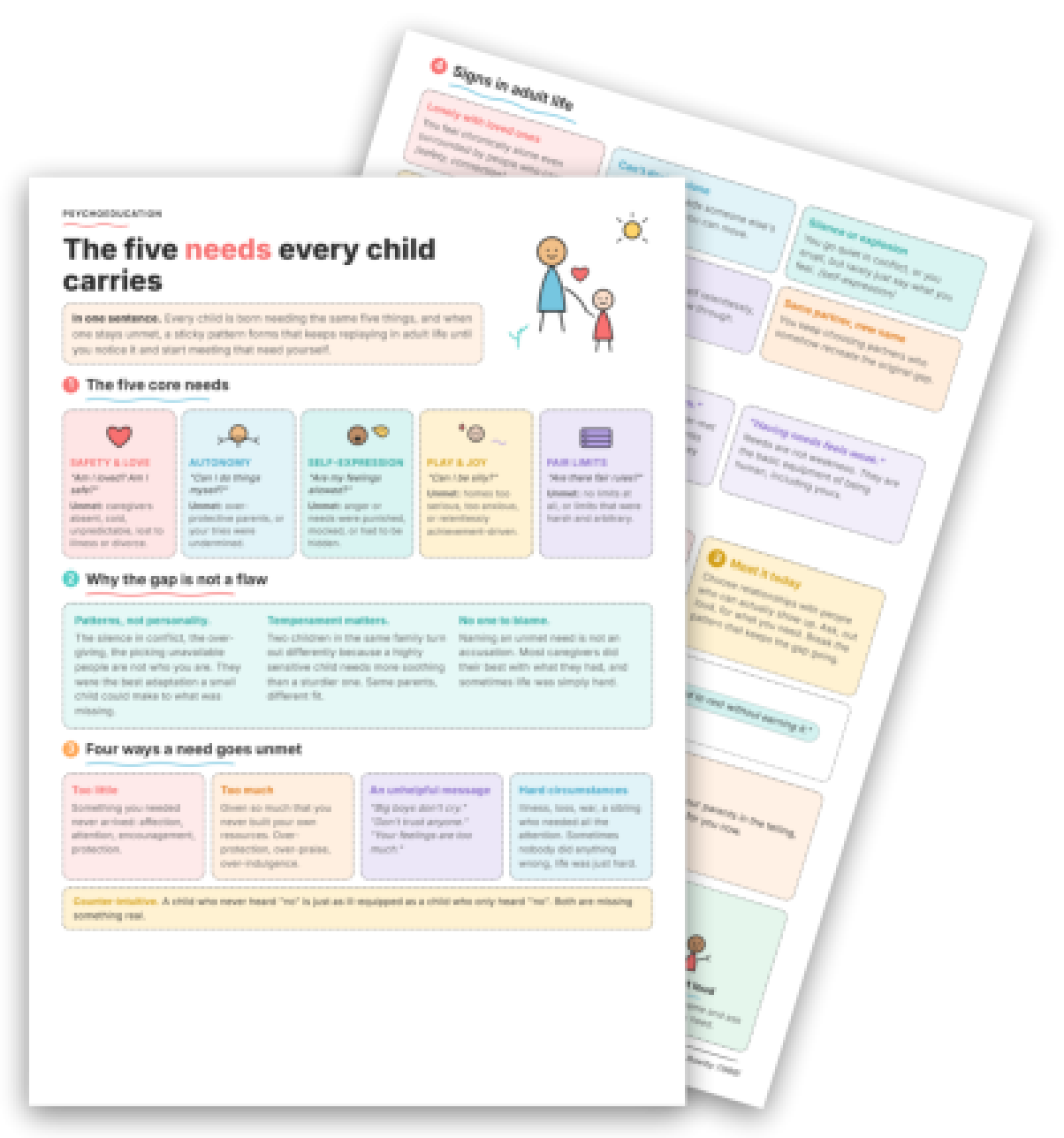
The fiche PDF is organised into six panels, each building on the last. Panel one names the five core needs with their orienting questions: "Am I loved? Am I safe?" for safety and connection; "Can I do things myself?" for autonomy; "Are my feelings allowed?" for self-expression; "Can I be silly?" for play and joy; "Are there fair rules?" for fair limits. Having these laid out simultaneously lets you point to the specific need your patient's history implicates, rather than enumerating a list verbally.
Panel two, "Why the gap is not a flaw", carries the de-pathologizing work the fiche does for you: "Naming an unmet need is not an accusation." Panel three maps four distinct ways a need goes unmet (too little, too much, an unhelpful message, hard circumstances), including the counter-intuitive observation that over-indulgence creates the same gap as deprivation. This is the moment patients who describe a "fine" childhood sometimes suddenly pause.
Panel four maps six adult presentations directly to the five needs: chronic loneliness in relationships, decision-making paralysis, silence or explosion in conflict, guilty rest, driven-or-stuck motivation, and the pattern of choosing partners who recreate the original gap. Seeing these clustered visually often does more case-formulation work in three minutes than a full verbal explanation. Panel five addresses common blocks to recognition, and panel six offers a three-step path forward: recognise the need, comfort the child, meet it today, with ready-to-borrow phrases patients can take home.
The "To discuss in session" prompts at the end are not homework items; they are your debriefing anchors for the consultation.
> Key point: this fiche is a visual psychoeducation support for use in session; the clinician guides it, the patient doesn't fill it in alone. Its value is in externalising the formulation onto a shared page, creating a common vocabulary before deeper schema work begins.
750+ clinical tools
A library built with and for clinicians, ready to use in session and extend between appointments.
Access all the toolsWhen and How to Introduce It
The fiche fits naturally after initial anamnesis, once you have enough developmental material to know which of the five needs is most likely implicated. It is particularly well-suited to work on self-sacrifice patterns, emotional deprivation, approval-seeking schemas, and shame-based presentations, anywhere the presenting difficulty traces back to a childhood relational environment.
You might introduce it as: "I'd like to share a framework that often helps make sense of the patterns we've been describing. It's not a quiz, we'll go through it together." That framing positions it as a collaborative map, not an assessment.
During the session, move panel by panel, slowing at whichever need resonates. Watch for the micro-pause, the shift in posture, the "that sounds familiar." Those are your debriefing cues. The behaviour-emotion-underlying-need link can be revisited in later sessions as schema work progresses, alongside tools for understanding how past experience shapes present reactions and building more secure relational patterns.
One limit worth noting: for patients with active attachment dysregulation or significant dissociation, the childhood imagery in panel six (comforting the child) may require more careful pacing than a single session allows. Introduce the concept, hold the imagery work.
The fiche does not replace formulation or alliance. It makes the explanation cleaner and leaves the patient with a concrete reference point they can return to between sessions.
Use it with your patients
Share this tool in the mobile app and follow the work between sessions.
Sources
- Young, J. E., Klosko, J. S., & Weishaar, M. E. (2003). Schema Therapy: A Practitioner's Guide. Guilford Press.
- Webb, J., & Musello, C. (2012). Running on Empty: Overcome Your Childhood Emotional Neglect. Morgan James Publishing.
- Rafaeli, E., & Rafaeli, A. K. (2024). Needs, Modes, and Stances: Three Cardinal Questions for Psychotherapy Practice and Training. Clinical Psychology in Europe, 6(Special Issue), Article e12753.
Your session continues in your patients' pocket
Use with a patientYour resources, available everywhere
The handouts, exercises, programs and audios above: you choose which ones to make available to your patients, in the mobile app dedicated to them.
And far more than a library
The app goes well beyond resources, to support your patients every day:
Related categories
Explore other clinical resources by category.
Anxiety
Clinical hub for anxiety disorders: CBT and ACT worksheets, psychoeducation sheets, and exercises for assessment and treatment across the anxiety spectrum.

Mood
Evidence-based worksheets and clinical tools for mood disorders: CBT, ACT, and positive psychology resources for psychologists and therapists.

Identity
Clinical resources for self-identity work in therapy: CBT, ACT, schema tools for clinicians addressing self-concept, core beliefs, and identity disruption.

Relationships
Clinical worksheets and tools on relational functioning: attachment, schemas, assertiveness, and communication skills for therapists. Printable PDF resources.

Understand
Clinical hub for the therapeutic aim 'Understand': worksheets and tools to build patient insight across CBT, ACT, schema therapy and more.

Build awareness
Clinical worksheets and tools to build awareness in therapy: cognitive distortions, schemas, emotions, ACT and CBT resources for practitioners.