
Clinical picture. A, a 38-year-old senior project manager, was referred after a second episode of work-related burnout within four years, despite consistently receiving top performance ratings. She described spending two to three hours each evening re-reading documents she had already submitted, convinced that a missed error would reveal her as fundamentally incompetent. During psychoeducation using the Unrelenting Standards informational sheet, the clinician introduced the three coping modes; A immediately recognized her pattern as predominantly surrender, noting that meeting each deadline brought only a brief exhale before the next benchmark silently shifted upward. She engaged with the body-cues checklist and, for the first time, named chronic jaw tension and Sunday restlessness as signals of the schema rather than signs she was simply "not working hard enough." No behavioral change was contracted at this stage; the session closed with A agreeing to observe, without intervening, one instance of the re-reading compulsion before the next appointment.
Unrelenting Standards Schema: PDF Worksheet, Tools and Exercises
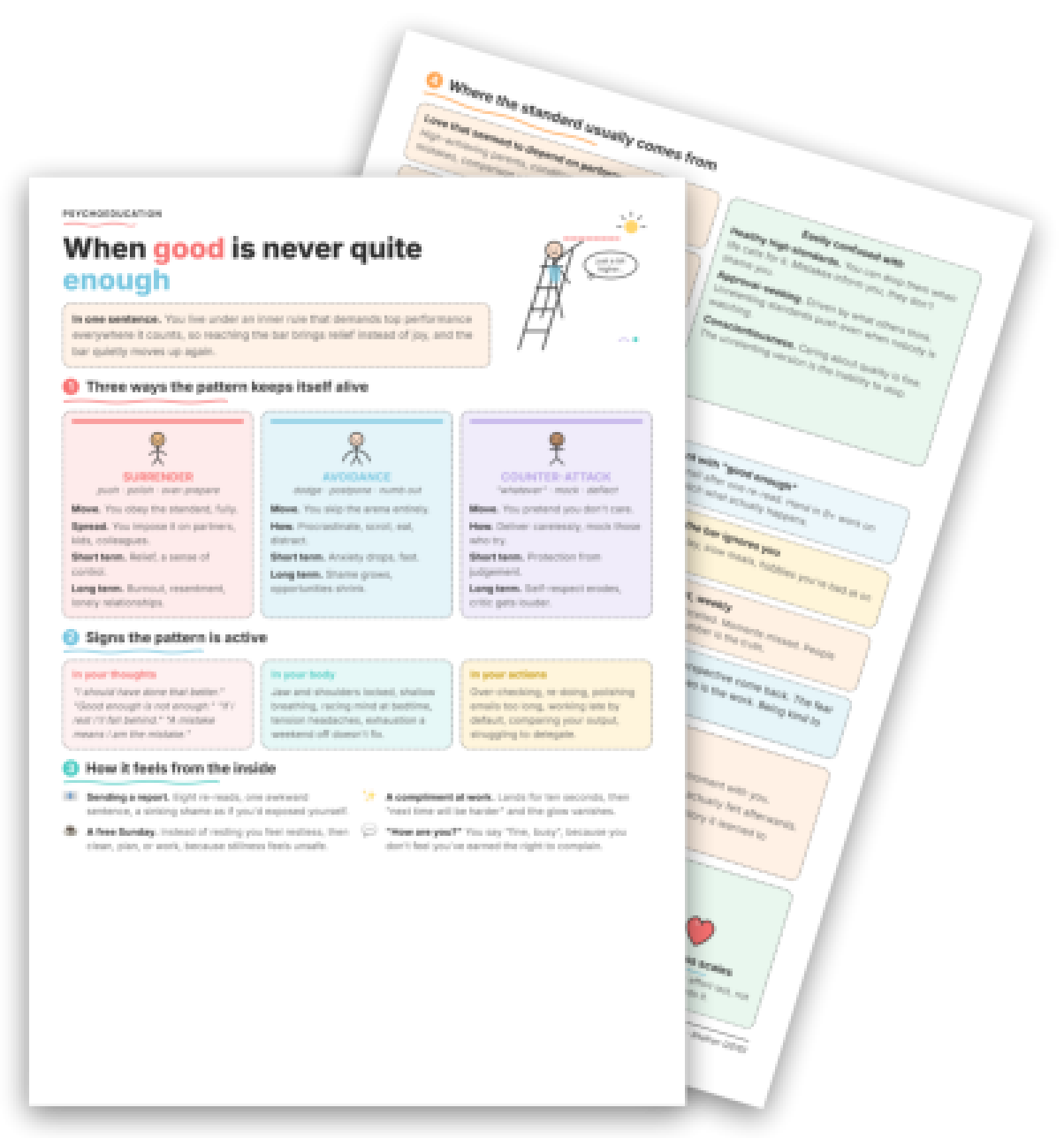
A printable visual aid to help clinicians explain the unrelenting standards schema in session, name its three coping modes, and give patients a concrete reference to take home.
Clinical vignettes
Burnout Behind a Flawless Record
Procrastination Masking Perfectionism
Clinical picture. M, a 29-year-old doctoral candidate, presented with persistent procrastination and low mood, reporting that he had not submitted a single chapter draft in eight months despite substantial written material on his hard drive. He attributed the block to laziness until the clinician used the Unrelenting Standards sheet to explore the avoidance coping mode; M recognized that postponing submission protected him from the judgement he was certain a less-than-exceptional chapter would invite. The internal-thought examples on the sheet, particularly "a mistake means I am the mistake," prompted a visible shift in his affect and a spontaneous account of high-achieving parents whose approval had reliably tracked his grades. The clinician did not reframe avoidance as irrational but invited M to consider its short-term function alongside its documented cost, leaving space for ambivalence. A modest between-session task was agreed: noting each time the urge to postpone arose, with no requirement to override it yet.
Patients who present with the unrelenting standards schema rarely struggle to describe their exhaustion. What they resist is the formulation: naming the pattern as a schema, understanding why meeting the bar never brings lasting relief, and grasping how avoidance and counter-attack are just as much expressions of it as relentless over-preparation is. This fiche PDF gives you a shared visual language to make that explanation stick in a single session.
Use this resource with your patients
Handout, exercises and materials ready to use, right inside SessionFuel.
Why the Unrelenting Standards Schema Is Hard to Explain at the Whiteboard
The central difficulty with this schema is that patients experience it as virtue, not pathology. High drive, conscientiousness, attention to quality, these are socially rewarded, and your patient knows it. Framing the problem verbally tends to produce polite agreement followed by quiet resistance: "But surely having high standards isn't a problem?"
The second sticking point is the ratchet mechanism (addressed directly in the Perfectionism Ratchet Effect resource): the moment a standard is met, it rises. Describing this verbally in session is plausible; showing it in a diagram is clarifying. Patients who dismiss the verbal account will often pause at a visual that maps exactly their own sequence of push, temporary relief, bar elevation, repeat.
Third, the three coping styles in schema therapy, surrender, avoidance, counter-attack, sit in tension with each other in ways that are genuinely counterintuitive. A patient may recognise their over-preparation but not see their procrastination or their contempt for "people who try too hard" as belonging to the same schema.
750+ clinical tools
A library built with and for clinicians, ready to use in session and extend between appointments.
Access all the toolsWhat the Fiche Contains: A Visual Reference for the Session
The fiche is structured across five substantive panels and closes with a "To discuss in session" prompt block, making it an active support for the psychoeducation conversation, not a self-report tool the patient fills out alone.
- "Three ways the pattern keeps itself alive" maps surrender, avoidance, and counter-attack, with the short- and long-term consequences of each. The entry "Long term: burnout, resentment, lonely relationships" for the surrender coping mode often lands harder visually than the same sentence spoken aloud, worth pausing on.
- "Signs the pattern is active" lists cognitive, somatic, and behavioural markers: "racing mind at bedtime, exhaustion a weekend off doesn't fix", over-checking, re-doing, difficulty delegating. This panel functions as a brief phenomenology inventory during the session, much like the Demanding Standards resource does for the CBT perfectionism model.
- "Where the standard usually comes from" covers developmental origins: conditional praise, high-achieving parents, or an unpredictable home where performing well was the only route to safety. This panel supports the historical narrative work in schema-focused cognitive restructuring without requiring a full longitudinal formulation at this point in treatment.
- "What loosening its grip looks like" offers six concrete micro-interventions: naming the demanding voice as distinct from the self (a direct ACT-style defusion move, also covered in ACT cognitive defusion), scheduling unearned rest, running deliberate "good enough" experiments. "Send the email after one re-read. Hand in B+ work on purpose. Watch what actually happens." This language is usable as a between-session instruction.
- The "To discuss in session" block closes the fiche with three prompts: noticing when the bar moves on arrival at the goal, debriefing a "good enough" experiment, and tracing what guilt around rest has learned to say. These structure the following session's opening naturally.
> Key point: The fiche is a visual support that facilitates the explanation of the unrelenting standards schema during the session; it is not an assessment questionnaire. The clinician uses it to anchor the conversation, then the patient takes it home as a concrete reference.
Use it with your patients
Share this tool in the mobile app and follow the work between sessions.
When and How to Introduce It
This fiche fits naturally in the psychoeducation phase of schema therapy, after initial schema identification, typically sessions two to four, once you have a working hypothesis and enough alliance to name the schema without triggering defensive rationalisation. It integrates well alongside the broader early maladaptive schemas overview if you are mapping several schemas simultaneously.
For patients whose presentation sits at the burnout end of the clinical spectrum, the fiche is particularly useful early: the somatic signs panel gives an entry point that bypasses the "high standards are fine" objection entirely. For those with prominent perfectionism anxiety or obsessive features, you may want to pair it with the Clinical Perfectionism CBT model to show the maintaining cycle in parallel.
A neutral introduction avoids activating schema-driven defensiveness: "I want to show you something that describes a pattern I think we're seeing. Tell me what fits and what doesn't." Debrief by pausing on the coping mode the patient is least likely to own, usually avoidance or counter-attack, and on the developmental panel, which often shifts the tone from self-blame to curiosity.
One limit to flag: for patients with comorbid punitiveness schema, introducing the fiche too early can read as another standard to fail. In that case, lead with self-compassion work first, and return to the unrelenting standards fiche once the inner critic is named and somewhat externalised.
The fiche does not replace the formulation or the therapeutic relationship. What it does is compress a complex schema explanation into something the patient can hold, re-read, and bring back to the following session with their own annotations.
Your session continues in your patients' pocket
Use with a patientYour resources, available everywhere
The handouts, exercises, programs and audios above: you choose which ones to make available to your patients, in the mobile app dedicated to them.
And far more than a library
The app goes well beyond resources, to support your patients every day:
Related categories
Explore other clinical resources by category.

Anxiety
Clinical hub for anxiety disorders: CBT and ACT worksheets, psychoeducation sheets, and exercises for assessment and treatment across the anxiety spectrum.

Mood
Evidence-based worksheets and clinical tools for mood disorders: CBT, ACT, and positive psychology resources for psychologists and therapists.

Identity
Clinical resources for self-identity work in therapy: CBT, ACT, schema tools for clinicians addressing self-concept, core beliefs, and identity disruption.

Behaviours
Clinical hub for behaviors in therapy: worksheets and tools for coping, eating disorders, CBT formulation, and maladaptive behavioral patterns.

Cognition
Printable cognitive therapy worksheets and clinical tools for therapists: CBT, ACT, schema work, defusion, distortions, and belief restructuring.

Understand
Clinical hub for the therapeutic aim 'Understand': worksheets and tools to build patient insight across CBT, ACT, schema therapy and more.