
Clinical picture. A, a postgraduate student in her late twenties, was referred for low mood and chronic exhaustion after achieving consistently high marks throughout her degree. She reported feeling no satisfaction after results arrived, describing each grade as "proof I chose an easy question" rather than evidence of ability. In session, the clinician used the informational sheet to map her maintenance cycle: self-worth contingent on performance, selective attention to any minor error, and a pattern where each success was immediately re-rated as insufficient. A recognised the ratchet metaphor without prompting, noting that her target mark had quietly shifted from 65 to 70 to 75 over two years without any conscious decision. This shared formulation opened space to examine what function the moving bar was serving, without yet challenging the standards themselves.
Clinical Perfectionism: PDF Worksheet, Tools and Exercises
A visual CBT psychoeducation tool based on Shafran, Cooper & Fairburn's model to explain the self-fuelling perfectionism loop and contingent self-worth in session.
Clinical vignettes
The Moving Bar in Academic Performance
Perfectionism Maintaining Work Avoidance
Clinical picture. M, a forty-year-old project manager, presented with procrastination severe enough to place his employment at risk; he described spending three to four hours revising brief client emails before sending them. The clinician introduced the informational sheet to distinguish healthy high standards from clinical perfectionism, focusing on the three markers: contingent self-worth, inflexible standards, and the absence of consolidation after success. M had assumed his behaviour reflected low confidence and was surprised to identify it instead as a self-protective loop, where not submitting preserved the possibility of a perfect outcome. Naming the avoidance branch of the cycle, rather than the standards themselves, reduced his shame noticeably within the session. He left with the sheet as a between-session reference, agreeing to note one instance of the inner phrase "that doesn't count" before the next appointment.
Explaining clinical perfectionism verbally tends to produce a familiar impasse: the patient agrees their standards are high, nods along, and then immediately reframes this as a character strength. The conceptual move that matters, that success raises the bar instead of consolidating into "enough", rarely lands from words alone. This PDF worksheet, grounded in Shafran, Cooper, and Fairburn's 2002 CBT model, gives you a visual architecture to make that move legible during the session itself.
Use this resource with your patients
Handout, exercises and materials ready to use, right inside SessionFuel.
Why Clinical Perfectionism Resists Explanation in Session
The clinical difficulty is not definitional. Most patients who meet criteria are already aware they hold high standards. What they cannot see without external scaffolding is the maintenance loop: the way contingent self-worth, biased self-evaluation, and the upward ratchet of standards mutually reinforce each other regardless of actual performance outcomes.
Oral psychoeducation tends to flatten this into a single cause ("you're too hard on yourself"), which patients who over-identify with their striving experience as invalidating. The more pernicious mechanism, self-worth hooked on achievement, stays invisible. And without naming it precisely, interventions targeting behaviour (avoidance, procrastination, checking) land on the surface without addressing the schema-level driver that Shafran's model places at the top of the cycle.
All-or-nothing thinking, hypervigilant checking, and reassurance-seeking behaviour are all common secondary presentations that clinicians correctly identify, but tracing them back to the contingent self-worth node requires a shared map. That is exactly what the fiche provides.
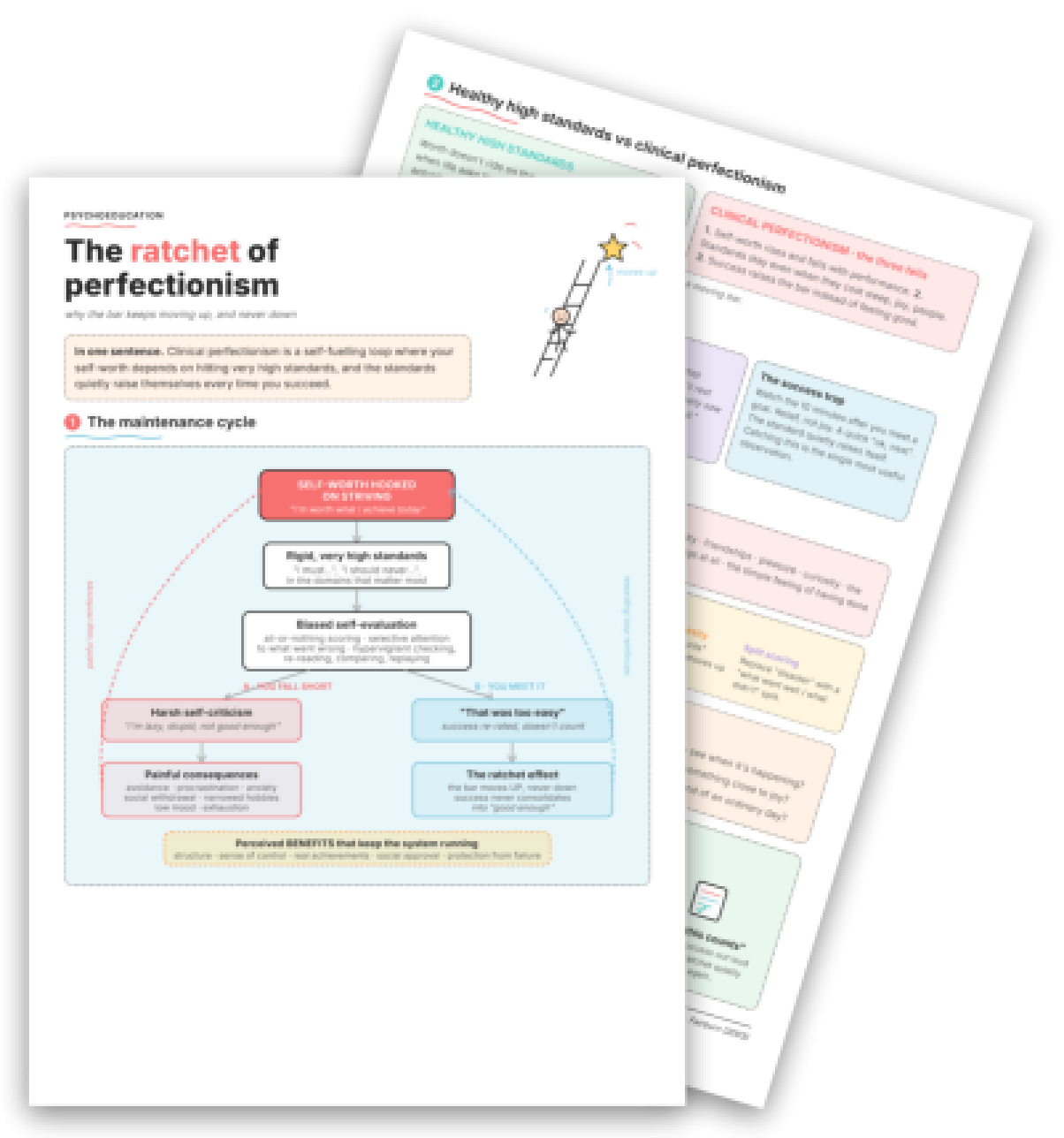
What the Worksheet Contains: A Visual Map of "The Ratchet"
The fiche PDF is organised into four panels that build sequentially, and its primary clinical asset is the labelled maintenance cycle in panel 1. The diagram shows two branching outcomes when a standard is approached: path A (falling short) leads to harsh self-criticism and painful consequences; path B (meeting it) triggers the ratchet effect, where the standard quietly moves up and "success is re-rated, doesn't count". Both arrows feed back into the cycle. Showing a patient that success and failure produce the same result (the bar goes up either way) is far more efficient with a diagram than with language.
Panel 2 operationalises the distinction between healthy high standards and clinical perfectionism through three specific tells: self-worth that rises and falls with performance; standards that hold even when they cost sleep, joy, or relationships; and the ratchet. The fiche states plainly: "The marker isn't high standards. It's the contingent self-worth and the moving bar." This single sentence, visible on the page, typically produces more genuine recognition than several minutes of verbal exploration.
Panel 3 anchors the model in lived experience with brief scene descriptions (getting 19/20 and fixating on the missing point; redoing a workout because focus wasn't "properly") and inner phrases ("If I stop pushing I'll become lazy"). These sharpen the patient's self-observation capacity before you reach the intervention phase.
Panel 4 offers a structured cost-benefit, listing concretely what perfectionism gives (structure, social approval, a sense of control) alongside what it takes, then proposes five graduated behavioural experiments: broadening worth across domains, doing tasks at 80%, dropping one checking behaviour per week, re-rating successes in writing before the bar moves, and splitting "disaster" appraisals into what went well and what didn't. These map directly onto the perfectionism self-reflection exercise you can assign between sessions. Three discussion prompts at the bottom are designed to be read aloud in session, including: "What happens inside you in the ten minutes after you actually meet a standard? Relief, or something close to joy?"
> Key point: This fiche is a visual support for in-session explanation, not a self-administered questionnaire. Its value is that you and the patient look at the same diagram together, trace the arrows in real time, and build a shared vocabulary before any intervention is introduced.
750+ clinical tools
A library built with and for clinicians, ready to use in session and extend between appointments.
Access all the toolsHow and When to Introduce the Worksheet
The fiche works best from the second or third session, once the anamnèse has surfaced the performance-worth link and you have enough rapport to name it directly. It fits naturally after the CBT cognitive model has been introduced, as a domain-specific application of that broader framework.
For patients presenting primarily with low self-esteem, impostor syndrome, or work-related procrastination, it resolves the formulation ambiguity quickly: the cycle makes visible whether avoidance is driven by fear of failure, by the anticipated lack of relief upon success, or by both simultaneously.
A neutral introduction works better than a diagnostic framing: "I want to show you a map of a pattern I see a lot in high-functioning people. Tell me where you recognise yourself." This preserves alliance by letting the patient locate themselves in the diagram rather than receiving a label.
For debrief, focus on which arrow the patient finds hardest to observe in the moment: most will immediately identify path A (harsh self-criticism after failure) but resist path B (the ratchet after success). That asymmetry is itself clinically informative. You can then assign the "Do it at 80%" or self-compassion after mistakes exercises as structured homework to begin interrupting the loop behaviourally.
One limitation worth noting: for patients in whom perfectionism is embedded in a schema of defectiveness or unrelenting standards, the fiche provides a useful entry point but will need to be followed by deeper schema-level work. The psychoeducation it delivers is necessary; it is rarely sufficient on its own.
The fiche does not replace case formulation, but it makes the Shafran model legible in under ten minutes and leaves the patient with a concrete, named reference they can return to between sessions.
Use it with your patients
Share this tool in the mobile app and follow the work between sessions.
Sources
- Shafran, R., Egan, S., & Wade, T. (2010). Overcoming Perfectionism: A self-help guide using scientifically supported cognitive behavioural techniques. Constable and Robinson.
- Egan, S. J., Wade, T. D., Shafran, R., & Antony, M. M. (2014). Cognitive-Behavioral Treatment of Perfectionism. Guilford Press.
- Centre for Clinical Interventions (CCI). Perfectionism Resources for Clinicians.
Your session continues in your patients' pocket
Use with a patientYour resources, available everywhere
The handouts, exercises, programs and audios above: you choose which ones to make available to your patients, in the mobile app dedicated to them.
And far more than a library
The app goes well beyond resources, to support your patients every day:
Related categories
Explore other clinical resources by category.

Anxiety
Clinical hub for anxiety disorders: CBT and ACT worksheets, psychoeducation sheets, and exercises for assessment and treatment across the anxiety spectrum.

Identity
Clinical resources for self-identity work in therapy: CBT, ACT, schema tools for clinicians addressing self-concept, core beliefs, and identity disruption.

Behaviours
Clinical hub for behaviors in therapy: worksheets and tools for coping, eating disorders, CBT formulation, and maladaptive behavioral patterns.

Cognition
Printable cognitive therapy worksheets and clinical tools for therapists: CBT, ACT, schema work, defusion, distortions, and belief restructuring.

Understand
Clinical hub for the therapeutic aim 'Understand': worksheets and tools to build patient insight across CBT, ACT, schema therapy and more.

Build awareness
Clinical worksheets and tools to build awareness in therapy: cognitive distortions, schemas, emotions, ACT and CBT resources for practitioners.