
Clinical picture. M., a 34-year-old woman presenting with recurrent depressive episodes, described a pervasive sense of never being capable enough, without being able to situate its origin. The clinician introduced the guided exercise, asking her to identify the significant figures across childhood, adolescence, and early adulthood and to note what belief she had absorbed from contact with each one. Working through the questions between sessions, M. traced the belief to her primary school teacher's frequent public corrections and, separately, to a university supervisor who consistently minimised her contributions. Naming these two distinct sources allowed her to observe that the belief had been reinforced at different developmental moments by different people, rather than reflecting a stable personal truth. She came to the following session with her worksheet and noted, with some surprise, that no one in early adulthood had challenged the belief.
Tracing the Origin of Core Beliefs: A Guided Clinical Exercise
Help patients map the key figures and formative experiences that shaped their core beliefs across childhood, adolescence, and early adulthood.
Clinical vignettes
Mapping a Belief of Inadequacy Across Decades
Adolescent Peer Influence on Self-Worth Beliefs
Clinical picture. T., a 28-year-old man referred for social anxiety, held a firm conviction that he was fundamentally uninteresting to others. The clinician offered the belief-origin exercise as structured homework, focusing his attention on the adolescence period first, given that his difficulties appeared to consolidate during secondary school. T. identified a peer group that had excluded him at age 14 and an older brother who habitually dismissed his opinions at the dinner table during those same years. Completing the written questions gave him a concrete account of how two overlapping influences had consolidated the belief during a period of particular vulnerability to social comparison. In session, the clinician and T. examined whether any figures from early adulthood had offered disconfirming relational experiences, which opened a productive discussion about selective attention to negative feedback.
Why belief origins resist verbal explanation alone
Most patients arrive in therapy holding rigid core beliefs about themselves, others, and the world without any felt sense of where those beliefs actually came from. Telling someone that their beliefs were shaped by early experience is rarely enough. The information lands intellectually but does not move them. What shifts something is the patient's own act of tracing, in their own words, the specific people and moments that left a mark.
This is the clinical gap the exercise addresses. Core beliefs function as invisible lenses, and as the Core Beliefs About Self, Others, and World fiche shows, patients resist updating them partly because they have never made the lens itself visible. The Negative Parenting Styles) fiche offers a psychoeducation anchor for that relational history, but the exercise below asks the patient to do the archeological work themselves, which is where the clinical value lies.
Early maladaptive schemas) do not form in a vacuum. They crystallize around key attachment figures, repeated relational messages, and the conclusions a younger self drew from them. A written, structured reflection makes that process tangible in a way that no oral explanation can replicate.
Use this resource with your patients
Handout, exercises and materials ready to use, right inside SessionFuel.
What the exercise contains
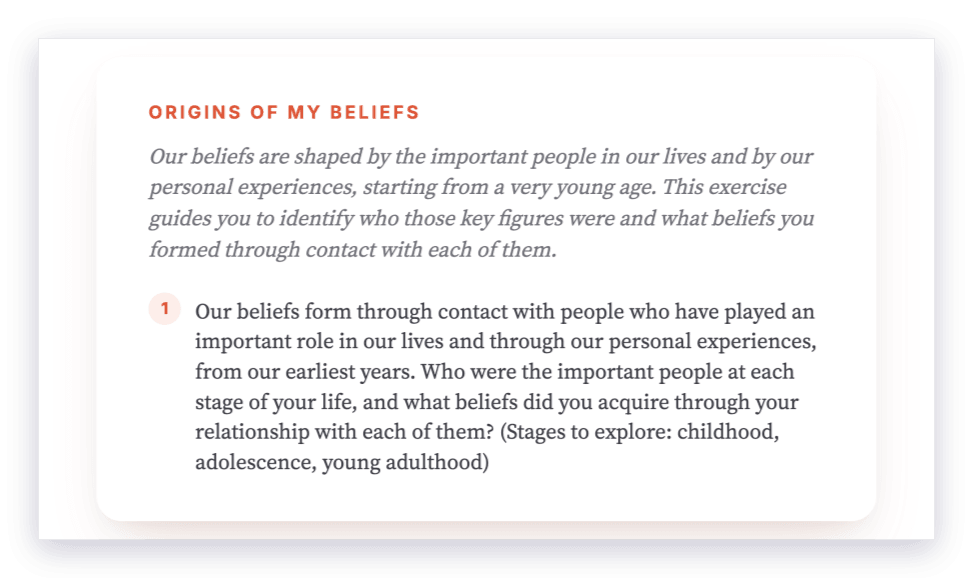
The exercise consists of a single, carefully structured prompt. The image above lists that question as it appears in the tool.
This image is a static preview of the question only. The full guided exercise, including patient-facing instructions and dedicated space for written reflection, is experienced by the patient on their own inside the app, not here.
The question walks the patient through three chronological periods: childhood, adolescence, and early adulthood. For each period, they are invited to name the people who played a significant role and to articulate the beliefs they formed through contact with each of them. The structure is deliberately longitudinal, mirroring the developmental logic of a 5 Ps case formulation) and complementing the cognitive case formulation) map a clinician might already be building with a patient.
Key insight: Belief origins become therapeutically workable the moment they are named and located in time. A belief that was acquired from a specific person, in a specific period, is no longer a universal truth. It becomes a hypothesis formed by a younger self trying to make sense of a particular relational world.
By writing down their own answers, patients produce datable, personally authored evidence about how their belief system took shape, which is precisely the kind of material that makes restructuring a negative core belief) possible.
This exercise is available to patients through the mobile application that is the dedicated patient-side interface of SessionFuel: you assign it directly from your SessionFuel account, and your patient completes it on their own phone, between appointments, at their own pace.
750+ clinical tools
A library built with and for clinicians, ready to use in session and extend between appointments.
Access all the toolsUse it with your patients
Share this tool in the mobile app and follow the work between sessions.
Assigning the exercise and putting the patient's work to use
This exercise works best as autonomous homework assigned between two consultations, when a patient has already engaged with the idea that current difficulties are connected to earlier learning. It suits patients working within schema therapy), CBT with a longitudinal formulation, or any approach where belief archaeology is part of the therapeutic process. It is particularly well-suited to patients who find verbal exploration of the past difficult or abstract.
When introducing it, you can frame it simply: "Before our next meeting, I am going to ask you to think about the people who shaped how you see yourself and the world, and to write down what you learned from them." Patients who have already used the How Your Past Affects Your Present) fiche or the Life Story: Past, Present, Future) worksheet will have a natural conceptual bridge.
When the patient returns, what they have written becomes primary clinical material. You can explore which belief feels most charged, which figure carries the most emotional weight, and which period produced the beliefs that still govern the patient's relational life today. The output pairs naturally with Clarifying a Core Belief) and My Beliefs: A Guided Core Belief Self-Reflection Exercise), which take the next step of mapping how a named belief operates across current situations. For patients ready to challenge what they have uncovered, the Core Beliefs: Examining the Evidence) worksheet and Reinforcing a New Core Belief) exercise offer a natural therapeutic sequence.
The Personal Values: PDF Worksheet) can also be introduced alongside this exercise for patients who are beginning to distinguish beliefs they have genuinely chosen from those they absorbed without awareness, a distinction that often emerges spontaneously from this kind of historical mapping.
Your session continues in your patients' pocket
Use with a patientYour resources, available everywhere
The handouts, exercises, programs and audios above: you choose which ones to make available to your patients, in the mobile app dedicated to them.
And far more than a library
The app goes well beyond resources, to support your patients every day:
Related categories
Explore other clinical resources by category.

Anxiety
Clinical hub for anxiety disorders: CBT and ACT worksheets, psychoeducation sheets, and exercises for assessment and treatment across the anxiety spectrum.

Mood
Evidence-based worksheets and clinical tools for mood disorders: CBT, ACT, and positive psychology resources for psychologists and therapists.

Identity
Clinical resources for self-identity work in therapy: CBT, ACT, schema tools for clinicians addressing self-concept, core beliefs, and identity disruption.

Behaviours
Clinical hub for behaviors in therapy: worksheets and tools for coping, eating disorders, CBT formulation, and maladaptive behavioral patterns.

Cognition
Printable cognitive therapy worksheets and clinical tools for therapists: CBT, ACT, schema work, defusion, distortions, and belief restructuring.

Build awareness
Clinical worksheets and tools to build awareness in therapy: cognitive distortions, schemas, emotions, ACT and CBT resources for practitioners.