
Clinical picture. A., a 34-year-old woman, presented with recurrent conflict in her relationship, describing episodes in which a minor perceived slight from her partner triggered hours of intense distress she could not explain. During a session, the clinician introduced the Here and Now worksheet to trace one specific episode: her partner's three-hour silence on a Tuesday evening. Working through the five steps together, A. identified a tight chest and frozen stomach, then a childhood memory of being left in her room without explanation when her mother was distressed; the unmet need was to be reassured she still mattered. The belief that surfaced was "I'm not worth checking on," and her coping had been to send repeated messages and then withdraw, a surrender-then-avoidance sequence that left her more convinced of the schema. She left the session with a clearer language for the loop rather than a sense of resolution, which the clinician framed as a realistic first step.
Schema Model: Here and Now: PDF Worksheet, Tools and Exercises
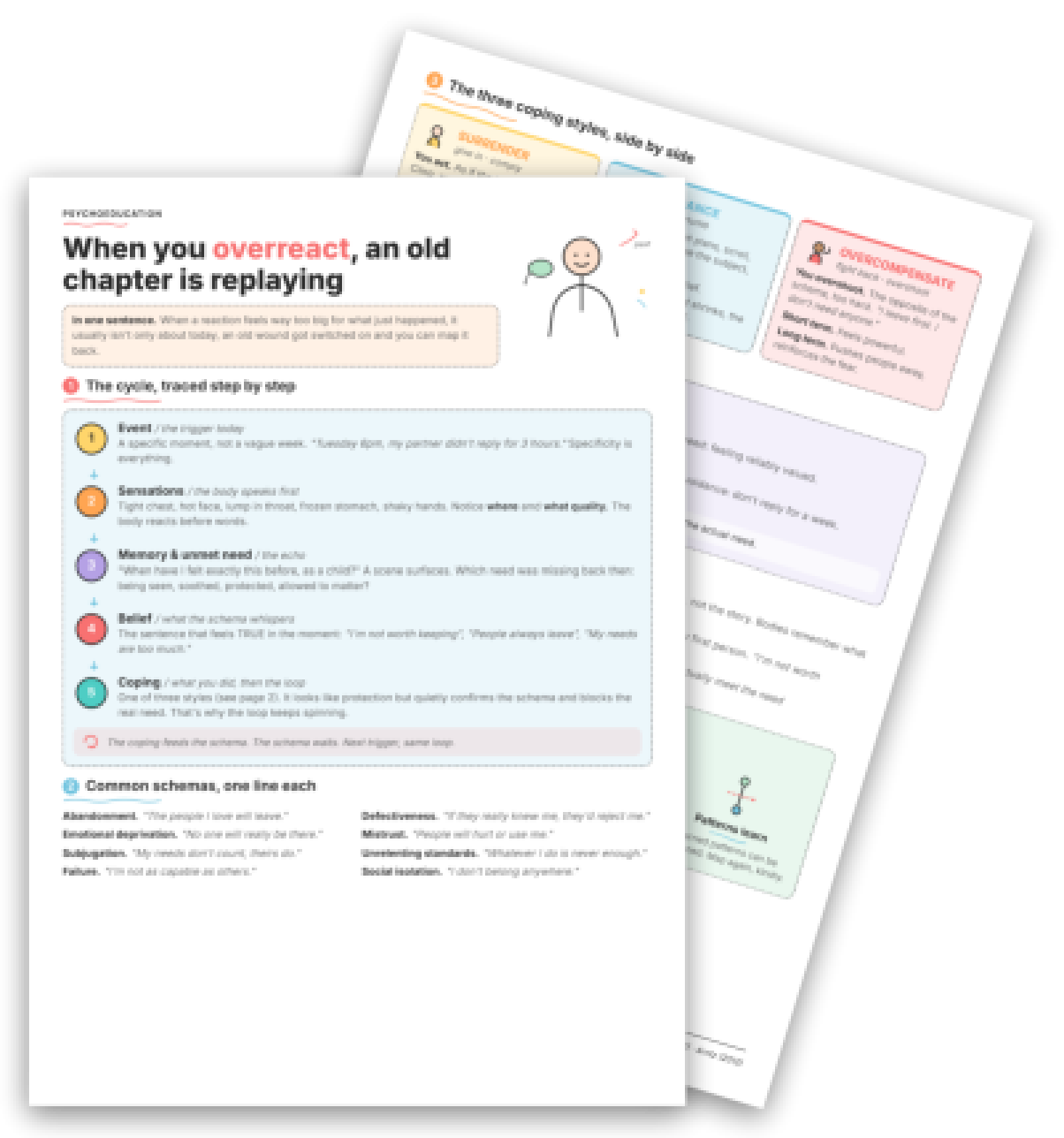
A printable PDF worksheet with tools and exercises to help clinicians explain schema activation in the present moment and map today's overreaction back to its historical root.
Clinical vignettes
Mapping a Disproportionate Reaction
Schema Cycle in Workplace Context
Clinical picture. R., a 41-year-old man referred for chronic occupational stress, described a pattern of working late every night yet feeling perpetually inadequate after any critical feedback from his manager. The clinician used the Here and Now framework to slow down a recent episode: an email noting a minor error in a report. R. catalogued shaky hands and a hot face before he had finished reading the second sentence, then recalled a school-age memory of his father reviewing his grades and saying nothing, the unmet need being permission to be good enough as he was. The schema whispering "whatever I do is never enough" was immediately recognisable to him as the unrelenting standards pattern described in the sheet. His habitual coping was overcompensation: redrafting the report twice overnight, which temporarily quieted the distress but reinforced the belief that ordinary effort was insufficient. Naming the cycle did not remove it, yet R. noted it reduced the sense that the reaction was simply who he was.
Explaining schema activation to a patient who just described "overreacting" to a minor slight is one of the more technically delicate moments in schema therapy. The concept is clinically clear to you; for the patient, it remains abstract until they can trace the loop themselves. This PDF worksheet gives that explanation a visible architecture, a five-step map the patient can follow in session and carry home.
Use this resource with your patients
Handout, exercises and materials ready to use, right inside SessionFuel.
Why Schema Activation in the Here and Now Resists Verbal Explanation
When patients describe a disproportionate emotional reaction, they typically arrive with the story of the trigger, not with access to the schema beneath it. Explaining the link between a present-day event and an early maladaptive schema purely at a verbal level tends to produce intellectual acknowledgment without felt recognition. The patient nods, but nothing shifts.
Part of the difficulty is sequencing. Clinicians trained in schema therapy know that the body speaks before cognition catches up, yet most psychoeducation starts with the belief rather than the sensation. A second difficulty is the loop itself: the three coping styles (surrender, avoidance, overcompensation) each look like self-protection in the short term, which makes it genuinely counterintuitive that they maintain the schema rather than resolve it. Without a visual that shows the loop closing back on itself, this mechanism is easy to hear and easy to forget.
The fiche addresses both problems directly.
What the Worksheet Contains: A Visual Map of the Schema Loop
The printable is organised across five numbered panels, each corresponding to one step in the activation sequence.
- Step 1: Event/trigger. The fiche prompts specificity: "A specific moment, not a vague week." This immediately shifts the patient from narrative to concrete observation.
- Step 2: Body sensations. Tight chest, frozen stomach, shaky hands. The fiche positions somatic awareness as the entry point, not an afterthought.
- Step 3: Memory and unmet need. The bridge question "When have I felt exactly this before, as a child?" surfaces the historical echo without requiring theoretical explanation.
- Step 4: Schema belief. The patient writes the raw first-person sentence: "I'm not worth keeping," "People always leave." This directly complements work with tools like the Defectiveness/Shame Schema worksheet or the Emotional Deprivation Schema fiche.
- Step 5: Coping style. A side-by-side panel contrasts surrender, avoidance, and overcompensation, showing the short-term payoff and the long-term cost for each. This visual comparison is what makes the schema maintenance cycle tangible rather than theoretical.
The fiche also includes a reference panel listing eight core maladaptive schemas with one-line descriptors, a fully worked example tracing all five steps through a single episode (a friend cancelling dinner), and a brief self-application guide for between-session use.
> To remember: this PDF worksheet is a visual support that facilitates the explanation of schema activation in session. The patient does not fill it out alone; the clinician walks through it together with them, building a shared vocabulary around a moment the patient has already lived.
750+ clinical tools
A library built with and for clinicians, ready to use in session and extend between appointments.
Access all the toolsWhen and How to Propose the Worksheet
This fiche fits best from the third or fourth session onward, once the therapeutic alliance is established and the patient has already described at least one episode of disproportionate reactivity. You can introduce it with something like: "You described a moment where your reaction surprised even you. There's a map that might help us look at what happened, step by step."
For patients with abandonment-schema-driven distress, the worked example on the fiche is particularly close to their experience. For patients who intellectualise or minimise, starting at Step 2 (sensations) rather than Step 1 disrupts the usual avoidance of the body. The fiche pairs naturally with identifying emotional triggers work and feeds forward into schema-focused cognitive restructuring once the loop has been mapped.
One limit worth naming: patients with significant dissociation or acute trauma activation may find Step 3 destabilising if used without adequate grounding. In those cases, complete the How Your Past Affects Your Present worksheet first, and return to this map once the patient can stay regulated while accessing historical material.
The fiche does not replace the formulation work; it makes one specific piece of it visible, revisitable, and the patient's own.
Use it with your patients
Share this tool in the mobile app and follow the work between sessions.
Sources
- Young, J. E., Klosko, J. S., Weishaar, M. E. (2003). Schema Therapy: A Practitioner's Guide. Guilford Press.
- Young, J. E., Klosko, J. S. (1993). Reinventing Your Life: The Breakthrough Program to End Negative Behavior and Feel Great Again. Plume/Penguin.
- Arntz, A., Rijkeboer, M., Chan, E., Fassbinder, E., Karaosmanoglu, A., Lee, C. W., Panzeri, M. (2021). Towards a Reformulated Theory Underlying Schema Therapy: Position Paper of an International Workgroup. Cognitive Therapy and Research.
- Janovsky, T., Rock, A. J., Thorsteinsson, E. B., Clark, G. I., Polad, V., Cosh, S. (2023). Assessing the relationship between early maladaptive schemas and interpersonal problems using interpersonal scenarios depicting rejection. PLOS ONE.
- Koelen, J. A., Eurelings-Bontekoe, E. H. M., Knapen, M., de Wijkerslooth-de Weerdesteijn, M., van der Steen, H., Luyten, P. (2022). Early Maladaptive Schemas and Mental Disorders in Adulthood: a Systematic Review and Meta-analysis. International Journal of Cognitive Behavioral Therapy.
Your session continues in your patients' pocket
Use with a patientYour resources, available everywhere
The handouts, exercises, programs and audios above: you choose which ones to make available to your patients, in the mobile app dedicated to them.
And far more than a library
The app goes well beyond resources, to support your patients every day:
Related categories
Explore other clinical resources by category.

Anxiety
Clinical hub for anxiety disorders: CBT and ACT worksheets, psychoeducation sheets, and exercises for assessment and treatment across the anxiety spectrum.

Trauma
Clinical hub on trauma and PTSD: assessment, differential diagnosis, treatment phases, and printable resources for practitioners. 155 chars.

Mood
Evidence-based worksheets and clinical tools for mood disorders: CBT, ACT, and positive psychology resources for psychologists and therapists.

Identity
Clinical resources for self-identity work in therapy: CBT, ACT, schema tools for clinicians addressing self-concept, core beliefs, and identity disruption.

Cognition
Printable cognitive therapy worksheets and clinical tools for therapists: CBT, ACT, schema work, defusion, distortions, and belief restructuring.

Build awareness
Clinical worksheets and tools to build awareness in therapy: cognitive distortions, schemas, emotions, ACT and CBT resources for practitioners.