
Clinical picture. M., a woman in her early forties, presented with persistent low mood and a sense of stagnation following a divorce and a career change within the same year. She described her recent history as "one thing after another happening to me," with little felt sense of authorship over her own life. The clinician introduced the three-chapter worksheet and invited her to draft each section between sessions, with no expectation of polished prose. On return, M. noted that writing the Past chapter had surfaced a pattern she had not consciously named: she had navigated major transitions before, each time drawing on what she called "quiet stubbornness." Naming that quality as a recurring resource shifted the tone of the Present chapter noticeably, and the Future chapter, though tentative, contained a concrete one-month step she generated herself.
Life Story: Past, Present, Future: PDF Worksheet, Tools and Exercises
A printable PDF worksheet, clinical tools and guided exercises to help patients build a coherent life narrative across past, present, and future chapters.
Clinical vignettes
Reclaiming Agency Through Narrative Structure
Future Chapter as Values Clarification
Clinical picture. T., a man in his late fifties referred for adjustment difficulties after early retirement, completed the Past and Present sections with relative ease but stalled entirely on the Future chapter, stating that writing an "ideal future" felt dishonest given his health constraints. The clinician suggested the worksheet's alternative framing, a "good enough" future anchored in values rather than events, and T. returned the following week with a short paragraph describing the kind of presence he wanted to offer his adult children rather than any specific activity. The exercise did not resolve his ambivalence about retirement, though it gave the subsequent sessions a concrete thread to follow. Both clinician and patient agreed the omissions in the Present chapter, particularly around friendships, warranted direct attention next.
Patients often arrive with their history as a pile, disconnected scenes, a few catastrophic highlights, a blurry future, but no thread running through it. Asking them to narrate their life verbally in session rarely produces more than a chronological list punctuated by self-deprecation. This Life Story: Past, Present, Future PDF worksheet gives the exercise a concrete structure, so the clinician can guide the work visually rather than holding it all in the air.
Use this resource with your patients
Handout, exercises and materials ready to use, right inside SessionFuel.
Why Life Narrative Work Resists Being Done at the Whiteboard
McAdams's work on personal myth, and Pennebaker's research on expressive writing, both converge on the same clinical observation: the act of putting experience into a structured narrative changes its meaning, not just its presentation. Yet that insight is notoriously hard to transmit orally. Patients hear "tell me your story" and either flood (trauma-saturated past, no agency) or dissociate into a flat recitation of facts.
Two specific difficulties come up regularly. First, patients collapse the three temporal registers: past trauma bleeds into present identity, the future stays blank. Second, the agency question goes unasked: they describe what happened to them without ever surfacing what they drew on to survive it. Without a visual scaffold, both problems persist even when the clinician names them directly. Tools like exercises that examine how the past shapes current behavior or guided reflection on the origins of core beliefs address adjacent territory, but the life story fiche holds the full arc in a single page set.
What the Fiche Contains
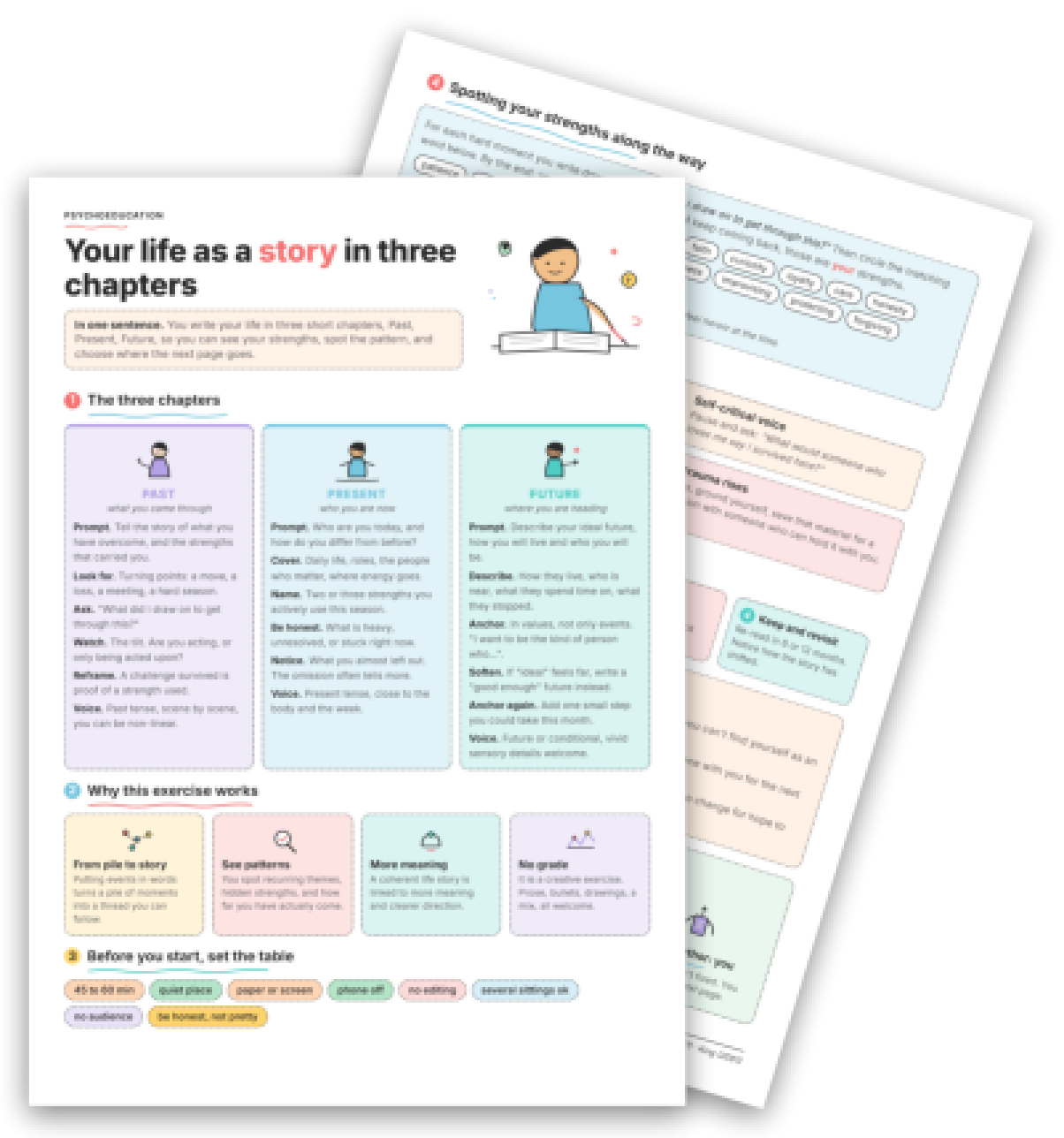
The fiche is organized across six numbered panels, each serving a distinct clinical function.
Panel 1 structures the three chapters explicitly. The Past chapter prompts: "Tell the story of what you have overcome, and the strengths that carried you." A built-in instruction, "Watch. The tilt. Are you acting, or only being acted upon?", directly targets the agency blind spot without the clinician needing to introduce it separately. The Present chapter asks the patient to name two or three strengths actively in use, and to be honest about what is heavy or stuck. The Future chapter is carefully softened: "If 'ideal' feels far, write a 'good enough' future instead," which lowers the threshold for patients whose future chapter stays blank from hopelessness. For those cases, this connects naturally with structured work on maintaining hope.
Panel 4 provides a strength-spotting vocabulary: 18 words (patience, courage, curiosity, resourcefulness, forgiving, and others) that the patient circles each time a hard moment is written. This makes the process of celebrating personal strengths concrete rather than abstract, and it produces a natural segue to values clarification work.
Panel 5 is an "if you get stuck" guide covering four common impasses: blank page on the past, self-critical voice, hopelessness about the future, and, critically, a trauma-surfacing caution: "Stop, ground yourself, save that material for a session with someone who can hold it with you." This keeps the worksheet safely within its scope and avoids the patient going too far alone.
Panel 6 structures what happens after writing: wait and re-read, underline strengths, circle recurring themes, and keep the text to revisit at six or twelve months. Three "to discuss in session" checkpoints flag when the patient should bring the material back rather than processing alone.
> Key point: The fiche is not a self-administered questionnaire. It is a visual support that facilitates the explanation of life narrative work in session, gives the patient a concrete structure to take home, and generates material to debrief at the next appointment.
750+ clinical tools
A library built with and for clinicians, ready to use in session and extend between appointments.
Access all the toolsWhen and How to Propose It
The fiche fits best after the initial anamnèse, once the therapeutic alliance is established and you have a working formulation. It is particularly useful for patients whose presenting problem involves identity confusion, low self-esteem, or a sense that "nothing adds up", profiles where examining core beliefs about self, others, and the world is already part of the care plan.
You might introduce it this way: "I'd like to give you a structured exercise, not to fill in like a form, but to write in three short chapters, past, present, and future. We'll look at what comes up together next time." This framing normalizes the creative register (prose, bullets, drawings are all accepted) and removes performance pressure.
In groups, this worksheet pairs directly with personal narrative group exercises, providing a pre-written individual version that feeds group sharing. For patients working on articulating their future self or clarifying how they want to spend their time going forward, the future chapter of this fiche can be completed in parallel as a complementary exercise.
One contraindication: if active trauma is still unprocessed, the past chapter may destabilize rather than integrate. In those cases, consider completing trauma-focused work first and returning to the life story fiche once a degree of containment is in place.
The fiche does not replace the therapeutic frame. It makes the life narrative exercise explainable, portable, and revisable, leaving the patient with a concrete artefact of their own story rather than a memory of a conversation.
Use it with your patients
Share this tool in the mobile app and follow the work between sessions.
Sources
- McAdams, D. P. (1993). The Stories We Live By: Personal Myths and the Making of the Self. Guilford Press.
Your session continues in your patients' pocket
Use with a patientYour resources, available everywhere
The handouts, exercises, programs and audios above: you choose which ones to make available to your patients, in the mobile app dedicated to them.
And far more than a library
The app goes well beyond resources, to support your patients every day:
Related categories
Explore other clinical resources by category.

Identity
Clinical resources for self-identity work in therapy: CBT, ACT, schema tools for clinicians addressing self-concept, core beliefs, and identity disruption.

Transitions
Clinical hub for life transitions: tools, worksheets and exercises to support psychosocial adjustment, role change and identity work in practice.

Build awareness
Clinical worksheets and tools to build awareness in therapy: cognitive distortions, schemas, emotions, ACT and CBT resources for practitioners.

Engage & motivate
Clinical hub: printable worksheets and exercises to build therapeutic engagement and motivation across ACT, CBT, and integrative practice. For clinicians.
Repair & soothe
Clinical resources for the repair and soothe therapeutic aim: worksheets, exercises and tools to build self-compassion, reduce shame and restore emotional safety.

Humanistic
Printable clinical resources for humanistic therapy: worksheets, exercises, and psychoeducation programs for practitioners using person-centered and experiential approaches.