
Clinical picture. A 64-year-old patient, referred to here as R., presented six months after early retirement with low motivation, irritability, and what he described as "nothing being wrong exactly." He denied depressed mood in the classical sense and initially resisted the idea that social contact might be relevant. The clinician introduced the informational sheet during session, working through the distinction between loneliness, sadness, and depression together rather than assigning it as homework. R. paused at the self-reinforcing loop diagram and identified, without prompting, that he had been declining invitations from former colleagues because he assumed they were inviting him out of obligation. By the following session he had accepted one such invitation and reported that his anticipation had been markedly worse than the actual contact.
Loneliness: PDF Worksheet, Tools and Exercises for Clinical Practice
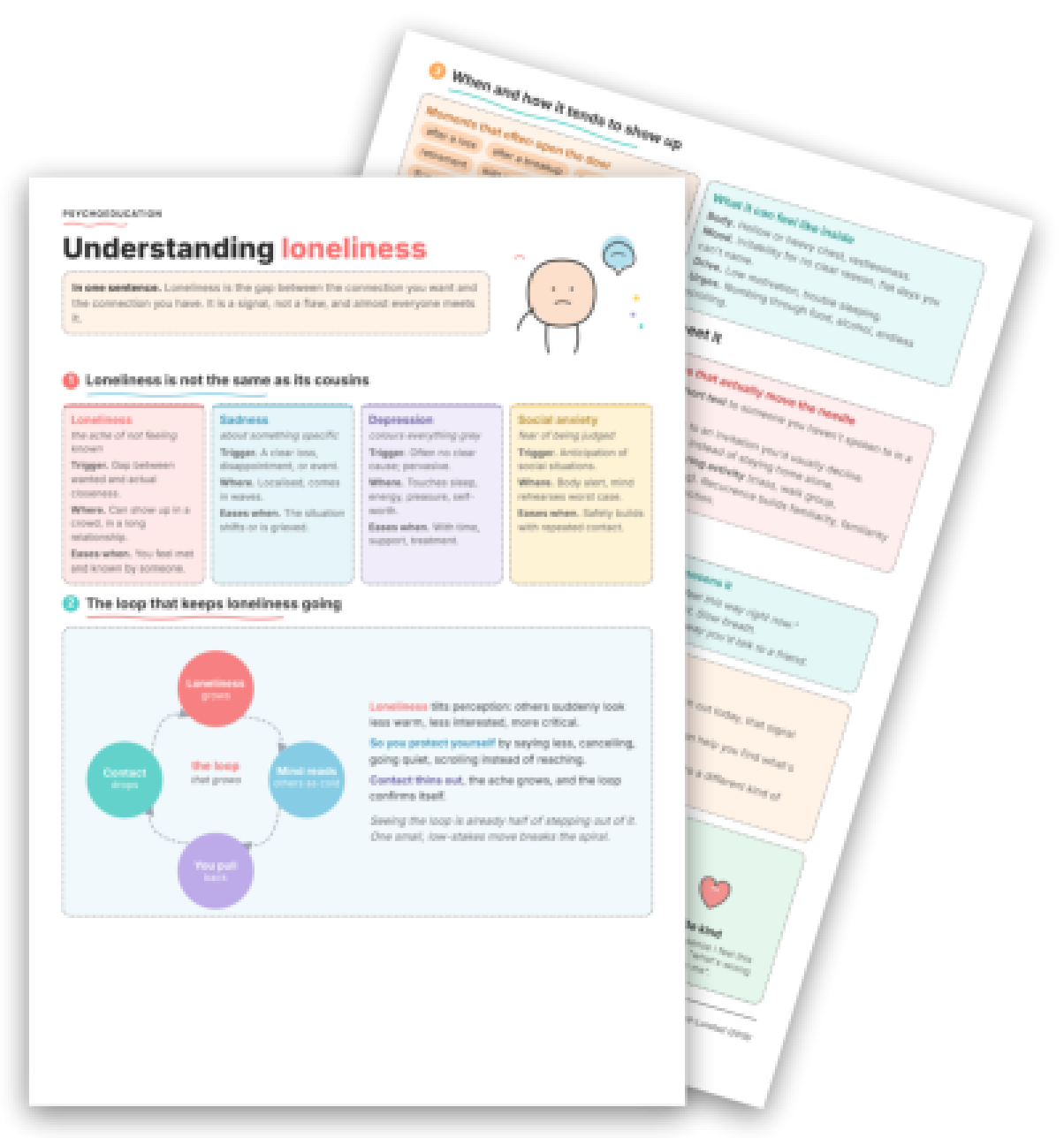
A printable PDF worksheet, tools and exercises to explain loneliness in session, map its self-reinforcing loop, and open the work on shame and reconnection.
Clinical vignettes
Naming the Loop in Retirement
Differentiating Loneliness from Depression
Clinical picture. A 31-year-old patient, referred to here as M., had recently relocated for work and presented with sleep difficulties and low mood that she attributed to a likely depressive episode. A brief review of the psychoeducational sheet allowed the clinician to map her symptoms against the four categories presented: her sleep disruption and flat affect were present, yet pleasure in activities and energy were largely intact, and the onset tracked closely to the move. M. found the framing of loneliness as a signal rather than a personal failing notably relieving, and noted that she had been reading peers' apparent indifference as confirmed rejection rather than as unfamiliarity. The session ended with a modest behavioural goal rather than a clinical formulation oriented around depression, which aligned better with her own account of the difficulty.
Explaining loneliness in session is deceptively difficult: patients often confuse it with depression, dismiss it as a character flaw, or cannot name it at all while showing every sign of it. This fiche PDF gives you a concrete visual support to make the concept clinically precise, fast, without the session drifting into reassurance or stigma.
Use this resource with your patients
Handout, exercises and materials ready to use, right inside SessionFuel.
Why Loneliness Resists Explanation Without a Visual Anchor
The first obstacle is conceptual overlap. When you name loneliness, patients frequently hear depression, introversion, or neediness. The four-way differential between loneliness, sadness, depression, and social anxiety that clinicians carry in their formulation rarely transfers cleanly through speech alone. A patient with social anxiety particularly struggles here: withdrawal looks identical from the outside, yet the internal mechanics differ completely.
The second obstacle is shame. Research by Cacioppo and colleagues has long established that loneliness activates a threat-detection bias: the isolated individual reads social signals as more hostile, withdraws further, and never tests whether the perception matches reality. Naming this loop out loud tends to be met with silence or deflection. The patient has usually told themselves some version of "there must be something wrong with me" long before arriving at your office, and that belief sits between them and any productive work on reconnection. Tools that externalise the mechanism onto paper reduce the immediate sting of self-attribution.
A third complication: loneliness surfaces in contexts patients do not expect. Retirement, parental leave, a relational transition, even the end of a lively social event can open the door. Without a concrete vocabulary, patients describe vague heaviness, restlessness, irritability without cause, and maladaptive coping strategies like numbing through alcohol or compulsive scrolling. The work stalls because neither you nor the patient has named what is actually happening.
What the Fiche Contains, and What the Visual Layout Does
The fiche opens with a single sentence that serves as an instant shared definition: "Loneliness is the gap between the connection you want and the connection you have." From there, five structured panels unfold in a logical clinical sequence.
Panel 1 presents the four-way differential table: loneliness, sadness, depression, and social anxiety each mapped across trigger, where it shows up, and what eases it. Shown visually, the distinctions click in a way that oral explanation rarely achieves, particularly for patients who have been misattributing their experience for years.
Panel 2 diagrams the self-reinforcing loop: loneliness distorts perception of others as cold, which drives withdrawal, which thins social contact, which intensifies the ache. The circular graphic makes the évitement expérientiel legible without requiring the patient to know the term. Paired with the cycle of depression, this panel clarifies why effort alone feels futile.
Panel 3 lists triggering moments (new city, retirement, late nights, post-event flatness) alongside somatic and motivational signs. Panel 4 frames the unmet need explicitly: feeling known, feeling chosen, physical closeness, shared purpose, and offers four small behavioural moves grounded in behavioural activation logic. Panel 5 addresses shame directly, juxtaposing the critical inner voice with a self-compassion prompt ("It makes sense I feel this way right now"), and includes clear criteria for when to escalate care.
> Key takeaway: This fiche is a visual support that facilitates the explanation of loneliness in session. You use it alongside the patient to name the mechanism, externalise the loop, and leave them with a concrete reference, not a questionnaire to complete alone.
750+ clinical tools
A library built with and for clinicians, ready to use in session and extend between appointments.
Access all the toolsHow and When to Introduce It
The fiche fits naturally in early-to-mid psychoeducation work, once the alliance is established and you have some sense of the patient's relational history. It is particularly well-suited for patients presenting with emotional deprivation schema, fear of abandonment, or chronic low mood that resists standard depression reframing.
A simple introduction: "I'd like to show you something that maps what you're describing. Let's look at it together." Orient to the loop diagram first, since it validates the experience without moralising it. The differential panel is most useful when the patient is stuck between "am I just depressed?" and "is this just how I am?"
For patients with shame-driven self-concealment, the Panel 5 section on self-compassion deserves explicit debriefing: ask which voice felt more familiar, and stay with that. Pair the fiche with self-compassion exercises between sessions, or with the Loneliness PDF Worksheet, Tools and Exercises for structured reflection homework.
One limit worth noting: for patients actively experiencing hopelessness alongside loneliness, the "when to reach out" criteria on the fiche should be reviewed together in session, not left to self-assessment.
The fiche does not replace clinical formulation. It gives your explanation a structure patients can return to, and gives the loneliness a name that no longer sounds like a verdict.
Use it with your patients
Share this tool in the mobile app and follow the work between sessions.
Sources
- Cacioppo, J. T., Patrick, W. (2008). Loneliness: Human Nature and the Need for Social Connection. W. W. Norton and Company.
- American Board of Professional Psychology (ABPP) (2025). The Psychological and Cognitive Effects of Loneliness and Social Isolation: A Primer for Clinicians.
Your session continues in your patients' pocket
Use with a patientYour resources, available everywhere
The handouts, exercises, programs and audios above: you choose which ones to make available to your patients, in the mobile app dedicated to them.
And far more than a library
The app goes well beyond resources, to support your patients every day:
Related categories
Explore other clinical resources by category.

Mood
Evidence-based worksheets and clinical tools for mood disorders: CBT, ACT, and positive psychology resources for psychologists and therapists.

Identity
Clinical resources for self-identity work in therapy: CBT, ACT, schema tools for clinicians addressing self-concept, core beliefs, and identity disruption.

Emotions
Clinical resources on emotion regulation: worksheets, coping tools, CBT, REBT, and ACT exercises for therapists working across diagnoses and age groups.

Relationships
Clinical worksheets and tools on relational functioning: attachment, schemas, assertiveness, and communication skills for therapists. Printable PDF resources.

Transitions
Clinical hub for life transitions: tools, worksheets and exercises to support psychosocial adjustment, role change and identity work in practice.

Understand
Clinical hub for the therapeutic aim 'Understand': worksheets and tools to build patient insight across CBT, ACT, schema therapy and more.