
Clinical picture. P., a woman in her early forties, presented with persistent low self-esteem and residual anhedonia following a burnout episode; she minimised her professional achievements and routinely attributed positive outcomes to circumstance or colleagues. After she reported completing a complex work report on her own for the first time in months, the clinician introduced the exercise, inviting her to work through the three questions before the next session. She returned having written that she had planned the task in stages and asked for help only once, recognising these as deliberate choices rather than accidents. Discussing her answers, she noted with some surprise that the exercise made it harder to dismiss the success as luck. A modest but stable shift in internal attribution was recorded over the following two sessions.
Celebrating Personal Successes: A Guided Self-Worth Exercise
Help patients own their achievements, attribute success to themselves, and extract durable self-knowledge through structured autonomous reflection.
Clinical vignettes
Reclaiming Agency After Burnout
Building Self-Worth in Chronic Dysthymia
Clinical picture. T., a man in his late twenties with a long-standing dysthymic disorder, described a pattern of selective attention to failure and near-total neglect of competence evidence. In session, he mentioned almost in passing that he had resolved a conflict with a flatmate without withdrawing or becoming aggressive. The clinician assigned the exercise as structured homework, asking him to answer each question in writing before they met again. T.'s response to the third question, about what the success revealed about him, was brief but specific: he wrote that he could stay present under interpersonal stress. The clinician used this written answer as a concrete anchor in subsequent work on his self-schema, rather than relying solely on verbal recollection.
Why Success Is So Hard to Keep
Patients who struggle with low self-esteem rarely lack achievements. What they lack is a stable mechanism for registering them. The moment a success arrives, disqualifying-the-positive kicks in: "anyone could have done that," "I just got lucky," "it doesn't count." The result is a cognitive asymmetry in which failures accumulate and successes evaporate almost immediately. This pattern is particularly entrenched in depression, perfectionism, and the failure schema, where any evidence of competence is processed as an exception rather than a data point.
Clinicians know this, yet verbal work alone often fails to interrupt it. Saying "you should be proud of yourself" in a session rarely moves the needle, because the patient has not done the attribution work themselves. What creates lasting change is a structured, first-person process in which the patient names their achievement, traces their own contribution to it, and extracts a lesson they can carry forward. That is exactly what this exercise is built to do.
Key insight: Success celebrations are not feel-good extras. They are a clinical corrective for attribution bias, building a genuine, evidence-based self-narrative the patient can return to between sessions and beyond.
Use this resource with your patients
Handout, exercises and materials ready to use, right inside SessionFuel.
What the Exercise Contains
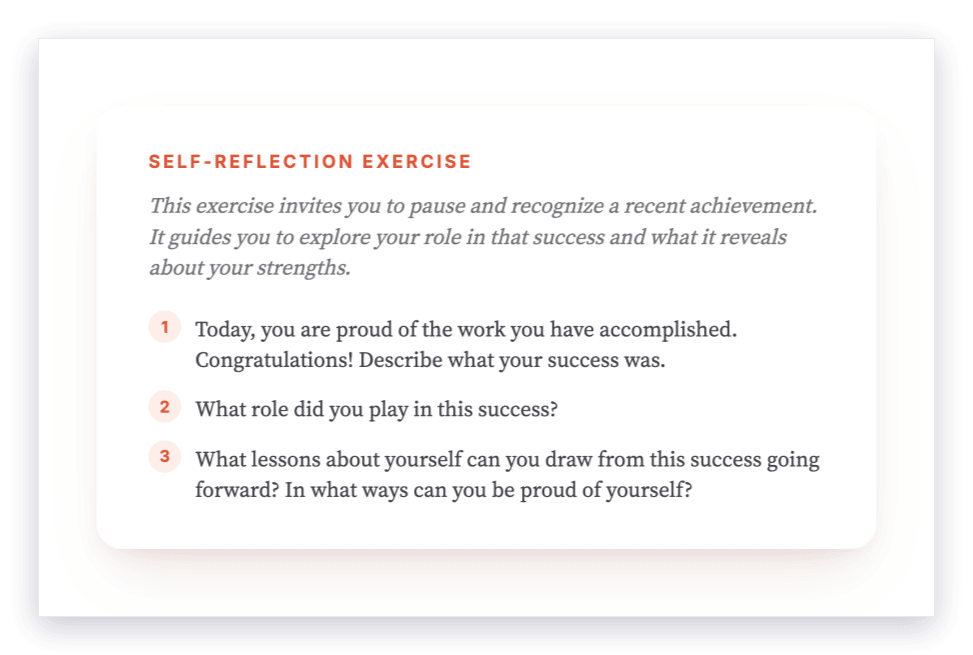
The exercise is built around three focused questions. The first question invites the patient to describe a concrete achievement they feel proud of, naming it in specific terms rather than vague generalities. This step counters the tendency to minimize by requiring descriptive detail.
The second question shifts the lens inward: the patient must articulate the precise role they personally played in producing this outcome. This is where internal attribution is trained, directly targeting the luck-and-circumstance stories that sustain impostor syndrome and erode self-worth.
The third question draws a lasting lesson: what does this success reveal about who the patient is, and what grounds do they now have for genuine pride? This final step converts a single event into durable self-knowledge, of the kind that can anchor work on the Positive Traits Checklist or inform a Strengths Exploration later in treatment.
The image above lists the three questions in order with a brief orienting introduction. Note that this image is a static preview of the question sequence only: the full guided exercise, with patient-facing instructions and dedicated space to write, is experienced by the patient on their own in the app, not from this image.
This exercise is available to patients through the mobile application that is the dedicated patient-side interface of SessionFuel: the clinician assigns it directly from their SessionFuel account, and the patient then completes it autonomously on their phone, between sessions, at their own pace.
750+ clinical tools
A library built with and for clinicians, ready to use in session and extend between appointments.
Access all the toolsHow to Assign It as Between-Session Practice
Which patients benefit most. This exercise suits patients working on low self-esteem recovery, those caught in the loop described in Feeling Not Good Enough, or anyone whose self-narrative is dominated by criticism and failure. It also pairs well with the Self-Image and Self-Esteem program as a regular practice that builds an ongoing archive of evidence. Patients prone to accepting compliments difficulty are strong candidates too.
How to introduce it. Frame the assignment plainly between sessions: explain that noticing and naming a success is a skill, not a personality trait, and that the brain needs deliberate practice to retain positive information the same way it automatically retains negative events. You might connect this to the Finding the Positive psychoeducation if the patient already knows that framework.
What to do with what the patient brings back. The written responses become clinical material. Read the second question's answer carefully: the language a patient uses to describe their own role often reveals how tenuous or conditional their self-attribution still is. If the answer is hedged or deflects credit, that is precisely the point to work on. The third question's output can be added to a personal strengths list, revisited before difficult moments, and fed into longer-horizon work such as Rebuilding Hope or a growth mindset framing. For patients in a depressive episode, this exercise complements the companion tool Celebrating Small Victories in Depression, which uses a closely related structure specifically calibrated to the depression context.
Use it with your patients
Share this tool in the mobile app and follow the work between sessions.
A Note on Frequency and Timing
Assigning this exercise once produces a data point. Assigning it regularly, whenever a meaningful success occurs, builds a body of evidence the patient can inspect and return to. Consider pairing it with the I Am Unique exercise to broaden the patient's self-concept beyond a single domain, and with the Developing a Growth Mindset fiche to consolidate the lesson-extraction habit that question three initiates.
Your session continues in your patients' pocket
Use with a patientYour resources, available everywhere
The handouts, exercises, programs and audios above: you choose which ones to make available to your patients, in the mobile app dedicated to them.
And far more than a library
The app goes well beyond resources, to support your patients every day:
Related categories
Explore other clinical resources by category.

Identity
Clinical resources for self-identity work in therapy: CBT, ACT, schema tools for clinicians addressing self-concept, core beliefs, and identity disruption.

Engage & motivate
Clinical hub: printable worksheets and exercises to build therapeutic engagement and motivation across ACT, CBT, and integrative practice. For clinicians.
Repair & soothe
Clinical resources for the repair and soothe therapeutic aim: worksheets, exercises and tools to build self-compassion, reduce shame and restore emotional safety.
Compassion-focused
CFT clinical tools for practioners: exercises, programs and guided audio on shame, self-criticism, guilt and self-compassion. Ready to use in session.

Positive psychology
Positive psychology clinical resources for therapists: worksheets, exercises & programs on well-being, strengths, gratitude, and resilience-based practice.
Anxiety
Clinical hub for anxiety disorders: CBT and ACT worksheets, psychoeducation sheets, and exercises for assessment and treatment across the anxiety spectrum.