
Clinical picture. T., a man in his late thirties, presented with longstanding social anxiety and a pattern of withdrawing from professional opportunities, reporting that he was "just not the type" to handle pressure. During a session focused on psychoeducation, the clinician introduced the fixed-versus-growth mindset framework and invited T. to map his habitual self-talk onto the fixed column. T. identified three recurrent phrases he used to foreclose effort before it began, including "I've always been bad at this" and "trying once and failing proves it." He was not asked to dispute these thoughts but simply to label them as fixed-mindset statements when they arose. Over the following two weeks he reported a modest but noticeable reduction in the automaticity of the avoidance, describing the labelling as taking the thought less seriously.
Developing a Growth Mindset: PDF Worksheet, Tools and Exercises
A visual PDF worksheet, tools and exercises to help clinicians explain the fixed vs. growth mindset distinction clearly in session and leave patients with a concrete reference.
Clinical vignettes
Fixed Self-Talk in Chronic Avoidance
Reframing Setbacks After Relapse
Clinical picture. M., a woman in her mid-forties being seen for recurrent depression, disclosed that a recent low mood episode after several stable months felt like definitive proof she would never recover. The clinician used the informational sheet to introduce the idea that a setback is a current chapter, not the whole book, and worked with M. to distinguish between feedback about her approach and verdicts on her identity. M. initially resisted, noting that effort in the past had not prevented relapse; the clinician acknowledged this and shifted focus to what the episode might reveal about early warning signals worth monitoring. By the end of the session M. articulated one concrete adjustment to her routine, a small but observable shift from fixed foreclosure toward provisional problem-solving.
Explaining the growth mindset concept verbally in session tends to produce polite nodding rather than genuine shift. Patients hear "your abilities can develop" and agree intellectually, while their inner dialogue keeps running "I'll never be good at it" unchallenged. This PDF worksheet gives you a visual scaffold to make the distinction land, not just register.
Use this resource with your patients
Handout, exercises and materials ready to use, right inside SessionFuel.
Why the Fixed vs. Growth Mindset Is Hard to Explain Orally
The core difficulty is not the concept itself. It is the way patients experience fixed-mindset cognitions as identity statements rather than distortions. When someone says "I'm just not that kind of person," they are not offering a hypothesis; they are reporting a fact about who they are. Standard cognitive restructuring exercises can feel dismissive of that certainty.
The same problem surfaces across presentations. Patients with perfectionism recruit fixed-mindset logic to protect against failure exposure. Those with low self-esteem use it to explain chronic underperformance. Patients prone to all-or-nothing thinking apply it categorically: one setback = permanent verdict. Without a shared vocabulary and a visible structure, the clinician's reframes bounce off those entrenched schemas.
750+ clinical tools
A library built with and for clinicians, ready to use in session and extend between appointments.
Access all the toolsWhat the Fiche Contains, and Why the Visual Format Matters
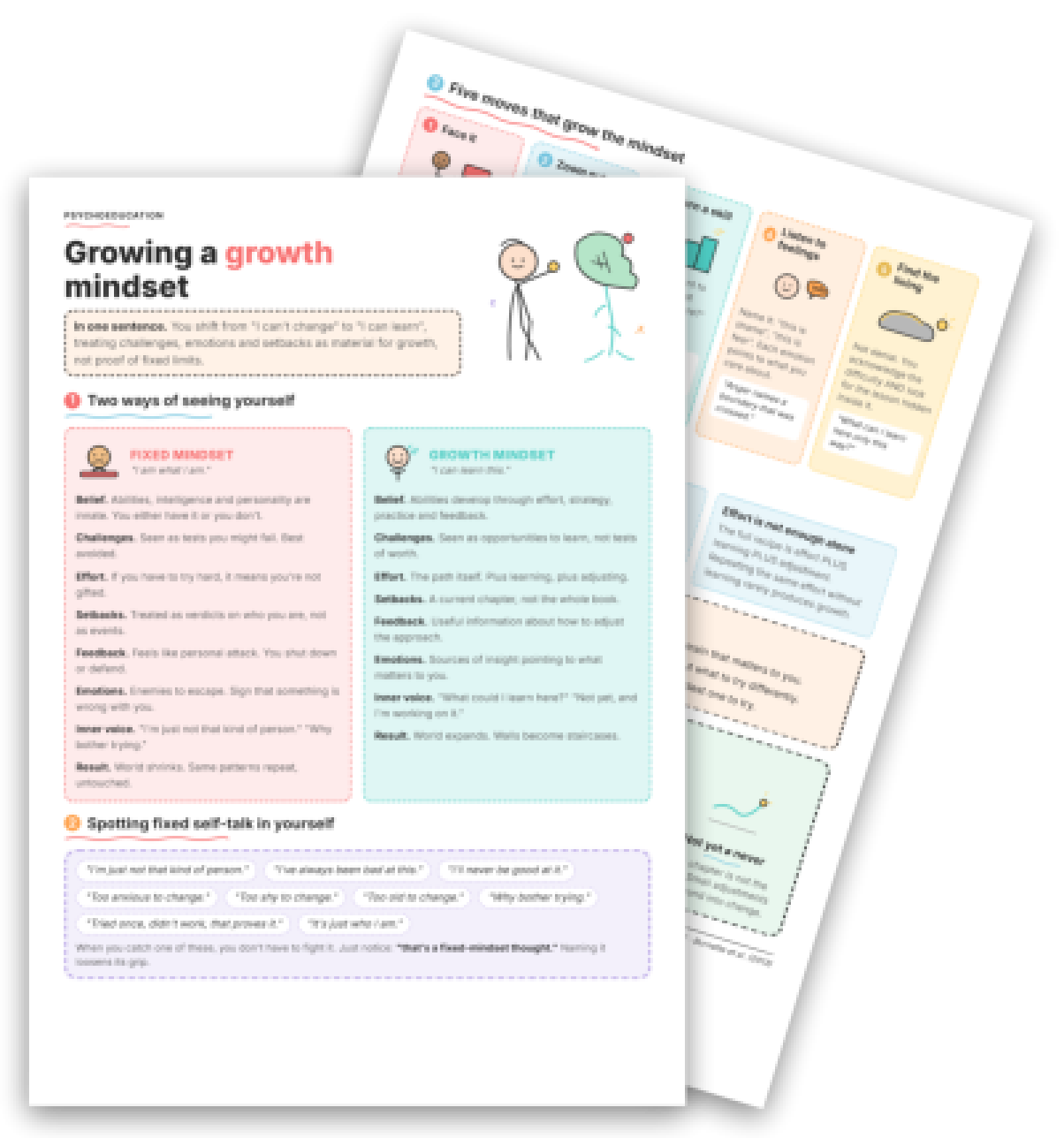
The fiche is organized as four numbered panels. Panel 1 presents a two-column side-by-side grid contrasting Fixed Mindset and Growth Mindset across six dimensions: Belief, Challenges, Effort, Setbacks, Feedback, and Emotions, with an Inner voice row giving the patient verbatim examples of each register. This layout does something oral explanation cannot: it shows both positions simultaneously, so the patient can locate themselves on the spectrum rather than receiving an abstract proposition. A phrase like "Walls become staircases" sits next to "World shrinks. Same patterns repeat, untouched", the contrast is immediate.
Panel 2 lists fixed self-talk examples verbatim ("Too anxious to change," "Tried once, didn't work, that proves it"), making implicit cognitions explicit without the patient needing to generate them alone. This lowers resistance considerably, especially with patients who default to automatic thought suppression. Panel 3 maps five concrete moves (Face it, Zoom out, Learn a skill, Listen to feelings, Find the lining), each paired with a practical prompt the patient can carry into the week. Panel 4 addresses three useful distinctions that prevent common misreadings: growth is not toxic positivity, growth is not simply trying harder, and effort without learning does not produce change. These distinctions also give you a natural segue into adaptive versus maladaptive coping work.
A dedicated "To discuss in session" section at the base closes the fiche with three ready-made debrief prompts, so the consultation focus is built in.
> Key takeaway: this fiche is a visual support that facilitates the explanation in session, not a self-guided questionnaire. Use it alongside the patient, pointing to specific rows and prompts, so the concept takes form in dialogue rather than being assigned as reading.
Use it with your patients
Share this tool in the mobile app and follow the work between sessions.
When and How to Introduce the Worksheet
The fiche fits naturally from the second or third session onward, once the initial case formulation is in place. It is particularly well-suited to:
- Patients early in behavioral activation who believe effort is pointless because change is impossible
- Perfectionist profiles where avoidance is maintained by fear of exposing fixed limits
- Adolescents and young adults working on identity consolidation, alongside resources like building new habits or identifying growth axes
Introduce it without framing it as a diagnosis: "I'd like to show you something that might put words to what we've been describing." Work through Panel 1 together before handing over the sheet. Ask the patient to mark the row in the fixed column that resonates most, then move directly to Panel 3. The five-move section connects naturally to comfort and stretch zone work if graded exposure is already part of the plan.
For debrief, the "To discuss in session" prompts on the fiche do the heavy lifting: "Which of the five tips feels hardest for you right now, and what makes it the hardest one to try?" is the kind of question that opens genuine formulation material. Pair it with celebrating personal successes exercises as the patient begins accumulating evidence against the fixed-mindset narrative.
One limit to keep in mind: patients in an acute depressive episode may experience the growth frame as invalidating. In those cases, prioritize emotional validation and maintaining hope work before introducing the fiche. The distinction between growth and toxic positivity in Panel 4 helps, but the timing still matters.
Your session continues in your patients' pocket
Use with a patientYour resources, available everywhere
The handouts, exercises, programs and audios above: you choose which ones to make available to your patients, in the mobile app dedicated to them.
And far more than a library
The app goes well beyond resources, to support your patients every day:
Related categories
Explore other clinical resources by category.

Mood
Evidence-based worksheets and clinical tools for mood disorders: CBT, ACT, and positive psychology resources for psychologists and therapists.

Identity
Clinical resources for self-identity work in therapy: CBT, ACT, schema tools for clinicians addressing self-concept, core beliefs, and identity disruption.

Emotions
Clinical resources on emotion regulation: worksheets, coping tools, CBT, REBT, and ACT exercises for therapists working across diagnoses and age groups.

Understand
Clinical hub for the therapeutic aim 'Understand': worksheets and tools to build patient insight across CBT, ACT, schema therapy and more.

Build awareness
Clinical worksheets and tools to build awareness in therapy: cognitive distortions, schemas, emotions, ACT and CBT resources for practitioners.

Restructure
Clinical hub for cognitive restructuring worksheets: distortion identification, belief disputation, ABC model, and schema work for evidence-based practice.