
Clinical picture. M., a man in his early forties, was referred following redundancy and a subsequent depressive episode. He described himself in session as "fundamentally unemployable" and dismissed any suggestion that his situation might shift over time. The clinician introduced the growth-mindset informational sheet and invited M. to read the side-by-side comparison of fixed and growth appraisals, pausing on the job-loss example. M. recognised his own inner voice in the fixed column almost immediately, which opened a brief but productive discussion about the difference between a behaviour ("I lost this job") and a global identity claim ("I am a failure"). By the following session he had begun to use the word "yet" when describing gaps in his skills, a small but clinically meaningful shift in self-talk.
Growth Mindset: PDF Worksheet, Tools and Exercises for Clinicians
A visual psychoeducation fiche PDF to explain the growth mindset concept in session, with tools and exercises clinicians can use immediately.
Clinical vignettes
Fixed Self-Label After Job Loss
Uneven Mindset Across Life Domains
Clinical picture. T., a woman in her late twenties presenting with chronic low self-esteem, held a demonstrably flexible view of her professional abilities yet described her capacity for close relationships as "just broken, the way I am." The clinician used the informational sheet to introduce the concept that fixed and growth mindsets operate unevenly across domains, often outside conscious awareness. T. found it useful to map her own pattern on paper: growth-oriented in work, fixed in attachment. This reframing reduced the globalising quality of her self-criticism without minimising the relational difficulties she was genuinely experiencing. Subsequent sessions could then address the fixed appraisal in the relational domain more directly, rather than working against a belief that her entire self was static.
Explaining the growth mindset concept verbally in session often produces polite nodding without genuine uptake. The patient agrees intellectually, then returns the following week using identical self-labelling language. This fiche PDF gives you a concrete visual support to make the distinction between fixed and growth thinking land, not just register.
Use this resource with your patients
Handout, exercises and materials ready to use, right inside SessionFuel.
Why Growth Mindset Is Difficult to Explain in Session
The term itself creates an obstacle. Patients with a strong failure schema or entrenched low self-esteem often hear "growth mindset" as motivational noise, something from a podcast, not a clinical framework. Their fixed-mindset beliefs are frequently ego-syntonic: "I'm just like that" functions as a stable identity anchor, not a thought they experience as distressing.
The second difficulty is conceptual abstraction. The fixed-growth distinction is easy to state and genuinely hard to feel. At the verbal level, the patient hears two abstract poles. What they struggle to see is how the same situation, word for word, generates two completely different appraisals, and that their own appraisal pattern has a name and, critically, a direction it can move. That gap between hearing the concept and seeing how it operates on their own material is exactly where cognitive distortions like all-or-nothing thinking and catastrophizing stay invisible.
What the Fiche Contains: A Visual Map of Two Appraisal Systems
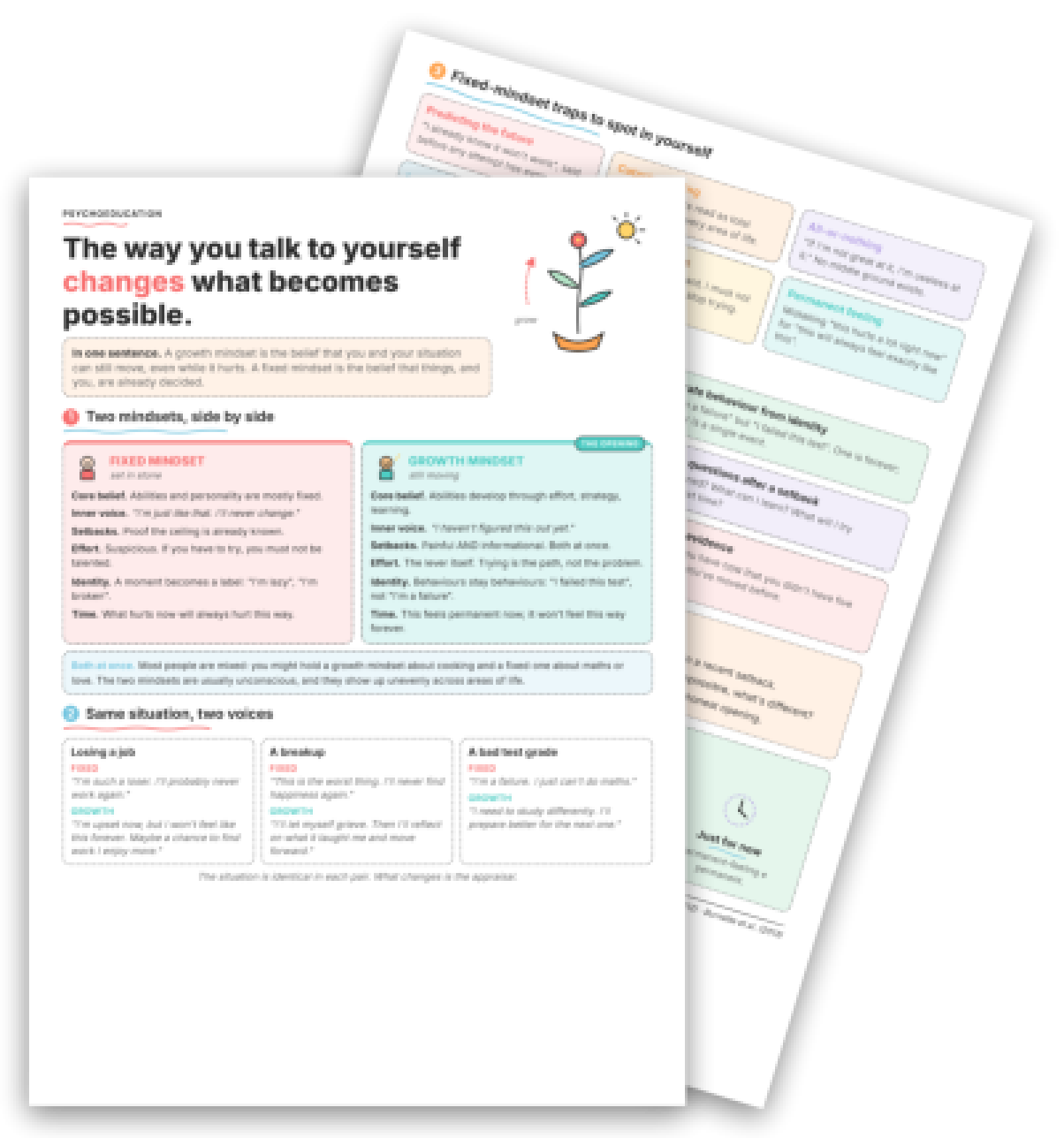
The fiche is organized into four working panels, all grounded in Dweck's original framework and the subsequent Yeager & Dweck and Burnette et al. literature.
Panel 1 opens with a single-sentence anchor: "A growth mindset is the belief that you and your situation can still move, even while it hurts." That formulation is clinically precise enough to use directly with a patient who conflates growth mindset with forced optimism.
Panel 2 is the visual centrepiece: a side-by-side comparison of fixed and growth responses across six dimensions: core belief, inner voice, setbacks, effort, identity, and time. Laid out on the page, the contrast between "I'm just like that" and "I haven't figured this out yet" becomes structurally visible in a way that no oral reformulation achieves alone. The fiche also notes explicitly that most patients hold a mixed profile, growth in some domains, fixed in others, which immediately defuses resistance.
Panel 3 applies the same framework to three concrete scenarios (job loss, relationship ending, poor exam result) with paired fixed and growth responses side by side. This is where the psychoeducation shifts from concept to pattern recognition: the patient can locate themselves in the fixed column without you having to say so.
Panel 4 names six fixed-mindset traps (permanent feeling, labelling, all-or-nothing, effort-as-weakness, catastrophising, fortune-telling) and six corresponding concrete moves, including the "yet" reframe, the behaviour-versus-identity separation, and a structured three-question post-setback routine. The fiche closes with a "To discuss in session" section, three prompts your patient brings into the next appointment rather than leaving behind on the printout.
> Key point: The fiche is not a self-help handout patients complete alone. It is a visual support that facilitates the in-session explanation of an abstract concept, and it leaves the patient with a concrete reference to return to between appointments.
750+ clinical tools
A library built with and for clinicians, ready to use in session and extend between appointments.
Access all the toolsWhen and How to Introduce It in Session
This fiche fits most naturally in the early psychoeducation phase, typically after an initial anamnèse has surfaced self-labelling language or a pervasive sense of personal immutability. It is particularly useful with patients presenting perfectionism, chronic avoidance of effortful tasks, or rigid core beliefs organised around inadequacy.
You can introduce it without framing the patient's thinking as pathological: "I'd like to show you something that maps two different ways people tend to interpret setbacks. Tell me where you recognise yourself." That entry keeps the alliance intact and positions the fiche as a shared tool rather than a clinical verdict.
During the debrief, the Panel 3 scenarios are reliable starting points: ask which column felt familiar and which felt foreign, then trace the appraisal back to the automatic thoughts or inner self-talk the patient described earlier in the session. The "To discuss in session" prompts on the fiche work well as between-session reflection questions, particularly the one targeting areas where "yet" feels honest versus areas where it feels impossible.
A practical limit to flag: for patients in acute depressive episodes, the growth-mindset framing can briefly activate self-criticism if they read their fixed-thinking patterns as further evidence of personal failure. In those cases, pair this fiche with resilience psychoeducation or defer it until motivational engagement is stable. For most presentations, though, the visual layout does the heavy lifting: it externalises the appraisal system, names it, and opens the door to work like developing a growth mindset or the structured exercises in Growth Mindset: PDF Worksheet, Tools and Exercises for Clinical Practice.
The fiche does not replace the formulation or the therapeutic relationship. It makes one specific and genuinely difficult idea visible, fast, and something the patient can hold onto after the door closes.
Use it with your patients
Share this tool in the mobile app and follow the work between sessions.
Sources
- Dweck, C. S. (2006). Mindset: The New Psychology of Success. Ballantine Books.
Your session continues in your patients' pocket
Use with a patientYour resources, available everywhere
The handouts, exercises, programs and audios above: you choose which ones to make available to your patients, in the mobile app dedicated to them.
And far more than a library
The app goes well beyond resources, to support your patients every day:
Related categories
Explore other clinical resources by category.

Anxiety
Clinical hub for anxiety disorders: CBT and ACT worksheets, psychoeducation sheets, and exercises for assessment and treatment across the anxiety spectrum.

Mood
Evidence-based worksheets and clinical tools for mood disorders: CBT, ACT, and positive psychology resources for psychologists and therapists.

Identity
Clinical resources for self-identity work in therapy: CBT, ACT, schema tools for clinicians addressing self-concept, core beliefs, and identity disruption.

Cognition
Printable cognitive therapy worksheets and clinical tools for therapists: CBT, ACT, schema work, defusion, distortions, and belief restructuring.

Understand
Clinical hub for the therapeutic aim 'Understand': worksheets and tools to build patient insight across CBT, ACT, schema therapy and more.

Build awareness
Clinical worksheets and tools to build awareness in therapy: cognitive distortions, schemas, emotions, ACT and CBT resources for practitioners.