
Clinical picture. T., a 34-year-old secondary school teacher, presented with health anxiety and recurrent episodes of panic that had led him to seek emergency care twice in the preceding year, each time with normal cardiac findings. During a structured psychoeducation session, the clinician introduced the escalation staircase using a recent episode: a moment of chest tightness during a staff meeting had rapidly become, in T.'s mind, evidence of an imminent cardiac event. Mapping the chain aloud, T. recognised for the first time that each "what if" had felt logically derived from the one before, and that his body alarm had then been read as confirmation rather than consequence. The clinician introduced the concept of the two hidden moves, noting how T. had simultaneously treated the worst case as the most probable one and had discounted a decade of normal test results. T. left with the worksheet and agreed to track the trigger and the first "what if" on three occasions before the next session, without attempting to resolve the chain.
Catastrophizing: PDF Worksheet, Tools and Exercises for Clinical Practice
A printable PDF worksheet, clinical tools, and exercises to explain catastrophizing clearly in session and help patients interrupt the spiral.
Clinical vignettes
Chest Tightness as Proof of Danger
Unanswered Message, Assumed Rupture
Clinical picture. M., a woman in her late twenties with a longstanding pattern of anxious attachment and low self-efficacy in close relationships, described a recurring cycle triggered whenever a friend delayed replying to a message. Within seconds, she reported, silence became proof of anger, anger became a permanent rupture, and rupture became confirmation that she was fundamentally difficult to be around. The clinician used the psychoeducation sheet to externalise the sequence, drawing attention to how threat inflation and coping deflation operated simultaneously: the delayed reply was treated as certain rejection, while M.'s own history of repaired friendships was absent from her mental picture. Naming the pattern as catastrophising, rather than as accurate social reading, introduced a small but useful gap between the trigger and the full cascade. M. noted that simply labelling the moment "there is that what-if mind again" had, on one occasion during the week, reduced the duration of the episode, though she remained sceptical that the technique would hold under stronger distress.
Catastrophizing is one of those cognitive patterns patients readily recognise in a friend but rarely catch in themselves mid-spiral. Oral psychoeducation tends to land as information without traction: the patient understands the word, yet the mechanism stays opaque. This PDF worksheet on catastrophizing gives you a structured visual support to make the explanation stick during the session itself, rather than relying on a verbal account the patient will half-remember by the following week.
Use this resource with your patients
Handout, exercises and materials ready to use, right inside SessionFuel.
Why catastrophizing resists verbal explanation in session
The core clinical challenge is speed. The fiche states it plainly: "all of this often happens in 2 to 5 seconds, faster than you can notice." When threat appraisal runs that fast, retrospective verbal accounts flatten the chain into a single leap ("I just panicked"), erasing the sequential logic that drove it. Without a visible structure, psychoeducation stays abstract.
A second difficulty arises consistently: patients conflate useful contingency planning with catastrophizing. The two feel identical from the inside. Separating them verbally, in real time, risks triggering the very anxiety response you are trying to explain and often derails the session. A visual support on the page sidesteps that problem entirely.
There is also the question of the felt certainty that Beck termed the truth-value of automatic cognitions. Cognitive restructuring introduced before the patient has a named map of their spiral can feel dismissive and damages the alliance. The fiche provides that map first. For patients whose catastrophizing is entangled with automatic thoughts carrying high conviction, this sequencing matters.
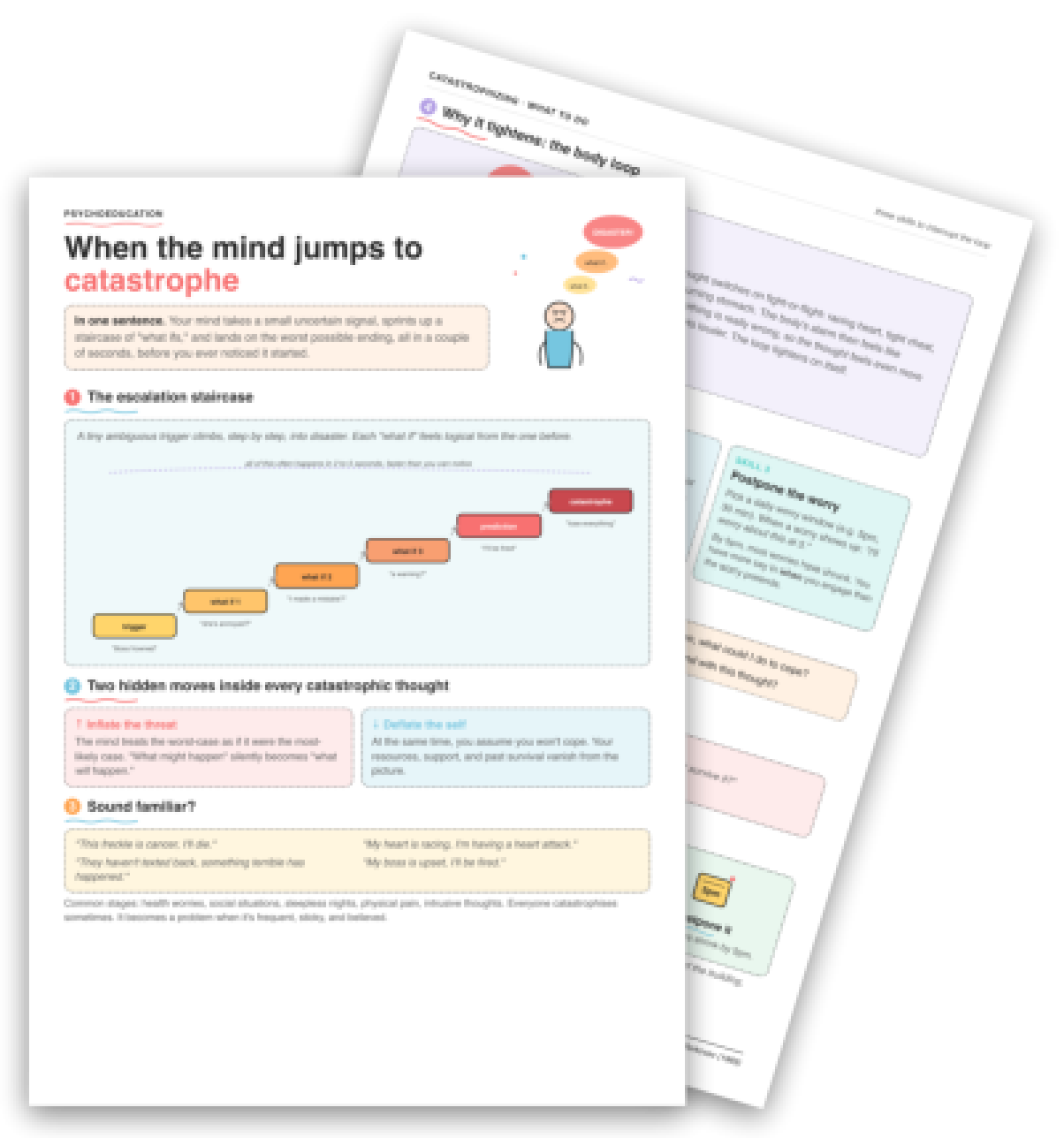
What the fiche contains: a visual map of the full loop
The fiche is organised into seven numbered panels, walking from trigger to intervention in a fixed order. The clinical payoff of the visual layout is immediate: a patient can point to exactly where on the page their spiral typically accelerates, which produces a richer formulation in five minutes than the anamnesis alone usually yields.
The centrepiece is the escalation staircase (panel 1): a trigger ("Boss frowned") climbs through sequential "what if" steps to catastrophe ("lose everything"), each link shown as a discrete rung. This single diagram does more explanatory work than an extended verbal description, because it externalises a process the patient experienced as one overwhelming wave.
Panel 2 names two hidden moves inside every catastrophic thought: inflating the threat ("what might happen" silently becomes "what will happen") and simultaneously deflating the self (resources, support, and past survival vanish from view). Patients presenting with health anxiety or low self-esteem often find the second move the more clinically resonant of the two.
Panel 4 shows the body loop: the catastrophic thought activates fight-or-flight, the somatic alarm is then read as evidence the threat is real, which amplifies the thought, which amplifies the alarm. This diagram is particularly useful for patients who have already attempted cognitive restructuring and found it ineffective, because it explains why the somatic signal hijacks the cognitive correction. It pairs naturally with your existing work on panic attacks or with the autonomic nervous system framing.
Panels 5 and 6 introduce three interruption skills, catch and name the thought, soothe the body with paced breathing and grounding, and postpone the worry to a fixed daily window, followed by four perspective questions ordered so that somatic regulation precedes cognitive work. Panel 7 offers a clean side-by-side contrast: useful planning ("What's likely, and what would I do?") versus catastrophizing ("What's the worst, and I couldn't survive it?"), a distinction that lands far more cleanly in visual form than as a verbal explanation.
> Key point: the fiche is a visual support that facilitates the explanation of catastrophizing in session. It is not a self-administered questionnaire. The patient leaves with a concrete reference they can return to, not a homework task to complete alone.
750+ clinical tools
A library built with and for clinicians, ready to use in session and extend between appointments.
Access all the toolsWhen and how to introduce it
The fiche fits best in the early-to-middle phase of treatment, once the alliance is established and the patient has already named catastrophizing in the anamnesis. It works across presentations: GAD, health anxiety, social anxiety, panic, and chronic pain with an anxiety component.
A low-pressure introduction: "I have a one-page diagram that maps how these spirals build. Let us look at it together and see whether any part matches what you described last week." Walking through the staircase and asking the patient to locate their own trigger at the base takes around five minutes and anchors the session on concrete shared vocabulary.
After the session, the fiche supports between-session work with the decatastrophizing CBT exercise and pairs naturally with anticipatory fear work. For patients who also present with intolerance of uncertainty, the worry-postponement skill on panel 5 connects directly to that protocol. The fortune-telling cognitive distortion exercise and the decatastrophizing worksheet both extend the work naturally across sessions.
One clinical caveat: with patients whose catastrophizing is fused with trauma-based hypervigilance, introduce the body loop panel carefully. Naming the somatic alarm as a feedback loop, rather than a genuine danger signal, requires a sufficiently secure base. Use the worry and attention capture exercise to scaffold the skill-building gradually in those cases.
The fiche does not replace the formulation. It makes the explanation faster, more precise, and leaves the patient with a language they can actually use between sessions.
Use it with your patients
Share this tool in the mobile app and follow the work between sessions.
Sources
- Beck, A. T., Rush, A. J., Shaw, B. F., Emery, G. (1979). Cognitive Therapy of Depression. The Guilford Press.
- Lazarus, R. S., Folkman, S. (1984). Stress, Appraisal, and Coping. Springer.
Your session continues in your patients' pocket
Use with a patientYour resources, available everywhere
The handouts, exercises, programs and audios above: you choose which ones to make available to your patients, in the mobile app dedicated to them.
And far more than a library
The app goes well beyond resources, to support your patients every day:
Related categories
Explore other clinical resources by category.

Anxiety
Clinical hub for anxiety disorders: CBT and ACT worksheets, psychoeducation sheets, and exercises for assessment and treatment across the anxiety spectrum.

Trauma
Clinical hub on trauma and PTSD: assessment, differential diagnosis, treatment phases, and printable resources for practitioners. 155 chars.

Cognition
Printable cognitive therapy worksheets and clinical tools for therapists: CBT, ACT, schema work, defusion, distortions, and belief restructuring.

Health
Somatic health clinical resources for practitioners: worksheets, psychoeducation, and exercises for somatic symptom disorder, chronic pain, and more.

Understand
Clinical hub for the therapeutic aim 'Understand': worksheets and tools to build patient insight across CBT, ACT, schema therapy and more.

Build awareness
Clinical worksheets and tools to build awareness in therapy: cognitive distortions, schemas, emotions, ACT and CBT resources for practitioners.