
Clinical picture. M., a 34-year-old secondary school teacher, was referred by his GP after two visits to the emergency department in six weeks for chest tightness, racing heart, and a sensation of impending death, each resolving within twenty minutes and with no cardiac finding on either occasion. The clinician introduced the informational sheet at the second session, walking through the 13-symptom checklist together and noting that M. had endorsed nine items during each episode. Reviewing the panic-versus-cardiac comparison helped M. understand why the episodes felt life-threatening yet resolved so quickly; he described this reframe as "the first thing that actually made sense." He continued to endorse some residual fear of recurrence, which became the focus of subsequent work, though his emergency department attendances stopped.
Panic Attacks: PDF Worksheet, Tools and Exercises for Clinical Practice
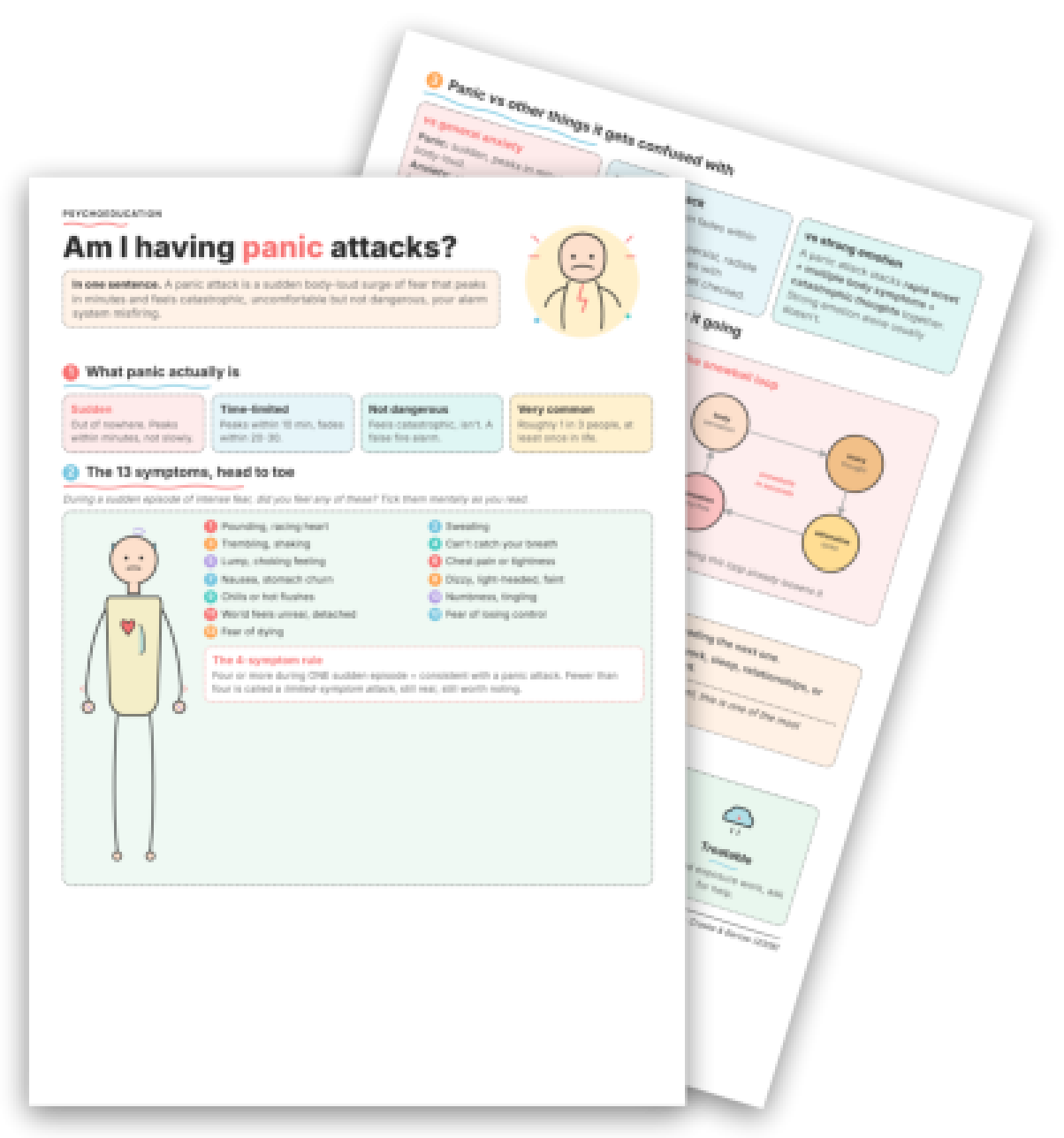
A printable PDF fiche, clinical tools, and exercises to explain panic attacks clearly in session, build a shared vocabulary with patients, and support psychoeducation from the very first contact.
Clinical vignettes
Chest Symptoms, Ruled Out Cardiac
Recurrent Episodes Mistaken for Anxiety
Clinical picture. A., a 27-year-old postgraduate student, presented describing herself as "just a very anxious person" after months of sudden, discrete episodes involving dizziness, shortness of breath, numbness in her hands, and a strong urge to flee lecture halls. She had not previously connected these episodes to any specific clinical entity. The clinician used the informational sheet to draw the distinction between the slow, diffuse quality of generalised worry and the abrupt, body-loud onset that characterises a panic attack; A. identified four to five symptoms occurring together within a single short window, meeting the sheet's four-symptom threshold. She also recognised, unprompted, that she had begun sitting near exits and declining seminars, illustrating the avoidance pattern the sheet describes as maintaining a disorder rather than a single attack. This recognition shifted her understanding of the problem and allowed the pair to agree on a more targeted treatment rationale.
When a patient arrives convinced they are having heart attacks, dying, or losing their mind, the oral explanation of panic physiology rarely lands cleanly. The concepts are simple, but the patient's hypervigilance and catastrophic ideation actively compete with any verbal information you offer. This fiche PDF provides a structured visual support that does the explanatory heavy lifting in session, so you and the patient can focus on the therapeutic work rather than on defining terms from scratch.
Use this resource with your patients
Handout, exercises and materials ready to use, right inside SessionFuel.
Why Panic Attacks Resist Explanation in Session
The central difficulty is cognitive narrowing under threat activation. A patient who has lived through even a handful of attacks arrives with a consolidated belief that something is genuinely wrong with their body. Explaining at that stage that the alarm system is misfiring (the phrase used verbatim in the fiche) runs straight into a well-entrenched interpretive bias: body sensations feel like evidence of danger, so any reassurance reads as dismissal.
A second obstacle is symptom heterogeneity. Patients frequently anchor on one or two symptoms (chest tightness, dissociation) without recognising the episode as a coherent syndrome. This makes it harder to distinguish panic from generalised anxiety disorder, from health anxiety, or from a legitimate cardiac event that warrants medical investigation. Without a clear map, the psychoeducation stays abstract and the anticipatory anxiety that sustains the disorder goes unaddressed.
A visual, structured document cuts through both obstacles. It gives the patient something concrete to hold and scan, rather than a lecture to receive while already dysregulated.
What the Fiche Contains: a Visual Scaffold for the In-Session Explanation
The fiche is organised into five numbered panels, each targeting a distinct explanatory layer. Panel 1 names the four defining features of a panic attack: sudden onset, time-limited duration (peaks within 10 minutes, fades within 20-30), absence of physical danger, and prevalence (roughly one in three people experience at least one in their lifetime). Panel 2 lists all 13 DSM-5-TR symptoms head to toe, with the instruction to "tick them mentally as you read", which immediately transforms a passive reading into an active recognition exercise. The 4-symptom rule is stated plainly: four or more concurrent symptoms during a sudden episode is consistent with a panic attack.
Panel 3 offers a differential table across three common confusions: panic versus generalised anxiety (sudden and body-loud versus slow and diffuse), panic versus cardiac event (the fiche explicitly advises medical assessment when unsure), and panic versus strong emotion. This panel is where the visual format earns its keep: a clinician can point to the columns and anchor the comparison rather than juggling it verbally.
Panel 4 introduces the distinction between a single attack and panic disorder, spelling out the three conditions that mark the shift to a clinical picture: recurrence, anticipatory worry, and avoidance. The snowball loop diagram (body sensation to scary thought to adrenaline spike to amplified sensation) makes the maintenance cycle immediately visible and names it in terms any patient can recall between sessions. The final panel lists four criteria for seeking help, followed by a brief reminder block: "uncomfortable, not dangerous", "peaks and passes, always has, always will".
> Key takeaway: this fiche is a visual support that facilitates the explanation of panic attacks in session; it is not a self-report questionnaire the patient completes alone. You use it alongside the patient to build shared vocabulary, anchor psychoeducation, and leave a concrete reference they can consult between appointments.
750+ clinical tools
A library built with and for clinicians, ready to use in session and extend between appointments.
Access all the toolsWhen and How to Introduce It
The fiche fits naturally at the psychoeducation stage, typically in the first or second session once the presenting complaint is established. For patients already engaged in a structured panic psychoeducation programme, it works as a session-zero anchor. For patients presenting with medically unexplained symptoms or undifferentiated anxiety, it provides a low-stakes entry point before you introduce the full anxiety psychoeducation programme.
A useful framing: "I'd like to show you something that describes what you've been experiencing. As we go through it together, tell me which parts fit and which don't." This positions the fiche as a shared inquiry rather than a diagnosis handed down, which protects the therapeutic alliance and elicits active engagement rather than passive compliance.
After working through the visual, direct debriefing questions carry the work forward. Does the patient recognise the snowball loop in their own episodes? Do they place themselves in the "one attack" or "anticipatory dread" category? Their responses orient your next steps: interoceptive exposure work, building a graded exposure hierarchy, or targeting the decatastrophizing layer first. Patients with prominent somatic focus may benefit from a grounding exercise in parallel; those with high intolerance of uncertainty often need the uncertainty-focused programme running alongside the panic work. Progress can be tracked between sessions with the anxiety check-in exercise.
One limit worth noting: the differential on the cardiac panel is deliberately brief. For patients with a genuine cardiology history or active somatic preoccupation, pair the fiche with an explicit acknowledgement that you are not dismissing the physical, and ensure medical clearance is in place before focusing exclusively on the panic model. The fiche does state this directly and you can point to it.
The fiche does not replace the case formulation or the therapeutic frame. What it does is make one hard-to-hold concept legible, fast, and patient-owned.
Use it with your patients
Share this tool in the mobile app and follow the work between sessions.
Sources
- American Psychiatric Association (2022). Diagnostic and Statistical Manual of Mental Disorders, Fifth Edition, Text Revision (DSM-5-TR). American Psychiatric Association Publishing.
- Barlow, D. H. (2002). Anxiety and Its Disorders: The Nature and Treatment of Anxiety and Panic (2nd ed.). Guilford Press.
Your session continues in your patients' pocket
Use with a patientYour resources, available everywhere
The handouts, exercises, programs and audios above: you choose which ones to make available to your patients, in the mobile app dedicated to them.
And far more than a library
The app goes well beyond resources, to support your patients every day:
Related categories
Explore other clinical resources by category.
Anxiety
Clinical hub for anxiety disorders: CBT and ACT worksheets, psychoeducation sheets, and exercises for assessment and treatment across the anxiety spectrum.

Understand
Clinical hub for the therapeutic aim 'Understand': worksheets and tools to build patient insight across CBT, ACT, schema therapy and more.

CBT
CBT worksheets, cognitive restructuring exercises & behavioral tools for clinicians. Evidence-based resources for every phase of cognitive behavioral therapy.

Trauma
Clinical hub on trauma and PTSD: assessment, differential diagnosis, treatment phases, and printable resources for practitioners. 155 chars.

Mood
Evidence-based worksheets and clinical tools for mood disorders: CBT, ACT, and positive psychology resources for psychologists and therapists.

Identity
Clinical resources for self-identity work in therapy: CBT, ACT, schema tools for clinicians addressing self-concept, core beliefs, and identity disruption.