
Clinical picture. M., a 22-year-old university student, was referred for low mood after her academic performance declined sharply. She denied any eating difficulty, describing her habits as "just clean eating" and insisting her weight was unremarkable. Her therapist introduced the informational sheet midway through the third session, framing it explicitly as a mirror rather than a diagnosis, and asked M. to read it at her own pace in the room. M. circled six items, pausing visibly at question 8 (self-worth tied to weight) and question 4 (fear of losing control if eating freely), and said quietly that she had not expected so many to feel true. This opened a first, tentative conversation about seeking a nutritional and medical assessment alongside the psychological work already underway.
Anorexia: PDF Worksheet, Tools and Exercises for Clinical Practice
A printable PDF worksheet with 10 targeted questions and visual psychoeducation tools to support early identification and frank in-session conversations about anorexia.
Clinical vignettes
Reluctant Recognition in a Young Adult
Normalisation of Restriction in an Older Patient
Clinical picture. R., a 47-year-old man seen for generalised anxiety, mentioned almost in passing that he had lost roughly 8 kg over the previous two months after "cutting out junk." He was dismissive when weight was raised directly, noting that others had far worse problems. His psychologist offered the sheet as a shared reading exercise rather than a questionnaire to score, normalising the internal doubts described in section one before R. engaged with the ten items. R. acknowledged strong resonance with questions 2, 7, and 9, which prompted him to reconsider the narrative that discipline alone explained his behaviour. A referral to his general practitioner was agreed upon so that a physical review could be completed before the next session.
Among eating disorder presentations, anorexia may be the condition most systematically described by the patient before they ever name it. Minimization, ego-syntonic reasoning, and a near-universal conviction of "not being ill enough" make direct clinical questioning far less effective than it is in most other presentations. This PDF worksheet gives you a concrete visual anchor to bring into session: ten structured questions and supporting psychoeducation that let the patient hold the mirror themselves, before you need to name anything.
Use this resource with your patients
Handout, exercises and materials ready to use, right inside SessionFuel.
Why Anorexia Resists the Oral Explanation
The central clinical obstacle is not information but anosognosia-adjacent cognition. Patients will acknowledge facts ("I have lost weight") while simultaneously dismissing their clinical relevance ("but I still eat sometimes, so it's not that bad"). That pattern, where the threshold for "serious enough" keeps moving, is part of the symptomatic picture itself, not a sign that the patient is not ready to engage.
When you explain this verbally, you position yourself as the authority asserting that something is wrong. The patient's cognitive immune system activates immediately. A structured visual tool sidesteps that dynamic: the patient reads the items, ticks what applies, and arrives at the tension themselves. The worksheet makes the contradiction visible on paper, which is qualitatively different from hearing it from a clinician.
This is also a practical entry point before diagnostic thresholds are formally met. All-or-nothing thinking around weight ("if I am not visibly underweight, it does not count") is one of the most common barriers to help-seeking, and the worksheet directly addresses it.
750+ clinical tools
A library built with and for clinicians, ready to use in session and extend between appointments.
Access all the toolsWhat the Worksheet Contains
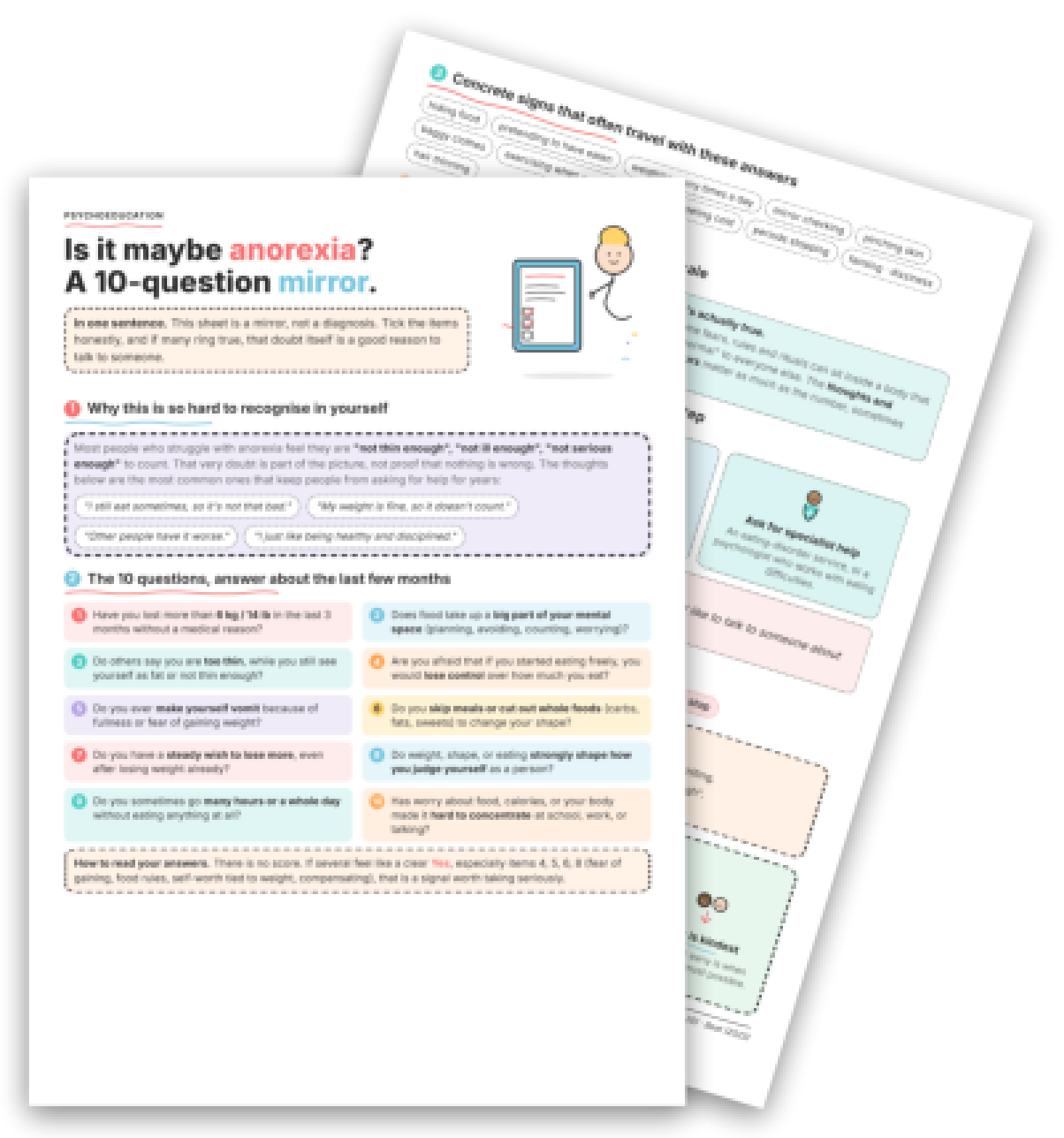
The fiche PDF is organised across six clearly delimited panels, making it usable as a shared visual during the consultation rather than a questionnaire handed out between sessions.
- Panel 1 names the cognitive barrier explicitly, listing the four most common thoughts that delay help-seeking: "I still eat sometimes, so it's not that bad", "My weight is fine, so it doesn't count", and two others. Seeing these thoughts printed normalises them without validating them.
- Panel 2 presents the 10 diagnostic-adjacent questions, phrased in plain language, covering the last few months. Items range from weight loss and cognitive preoccupation with food to compensatory behaviours, body-image distortion, and the self-worth/weight fusion that Beck's schema model would frame as a core belief. The scoring note is intentional: "There is no score. If several feel like a clear Yes, especially items 4, 5, 6, 8" the worksheet instructs the patient to take that seriously.
- Panel 3 lists concrete behavioural and somatic signs (hiding food, mirror-checking, hair thinning, amenorrhoea, fainting) that often co-occur, giving the patient a secondary recognition layer beyond the 10 questions.
- Panel 4 addresses the weight-normalcy myth directly. This is the panel most worth pausing on in session: "The same fears, rules and rituals can sit inside a body that looks 'normal' to everyone else." For patients with atypical anorexia or those early in the illness trajectory, this reframe is clinically significant.
- Panels 5 and 6 offer a graded next-step structure and explicit red flags (fainting, chest pain, vomiting blood, amenorrhoea) with clear urgency framing.
> To retain: this worksheet is a visual support that facilitates your explanation in session, not a take-home self-assessment. Its value lies in being read together, with you present to pause, observe the patient's non-verbal response, and debrief what each item activates.
The same mechanisms that drive perfectionism in therapy and negative self-labeling appear across the items, which makes the worksheet a natural bridge to deeper schema-level work.
Use it with your patients
Share this tool in the mobile app and follow the work between sessions.
When and How to Introduce It
Timing. The worksheet is well-suited to a second or third session, once the therapeutic alliance is sufficiently established to tolerate some confrontation. It also works in a first session with a patient who has self-referred specifically around eating concerns and has already done some cognitive work on their own.
Profiles. Consider it with patients who are using adaptive and maladaptive coping patterns around food without having named a disorder, with adolescents where a family member has raised concern, and with patients already in treatment for anxiety or OCD-spectrum presentations where eating rituals have surfaced as secondary.
Introducing it. A neutral framing works better than a clinical label at this stage: "I'd like us to go through a short list of questions together. You don't need to have a view on what it means yet, just tick what feels accurate." Avoid front-loading the word "anorexia" before they have seen the items.
Debrief. After working through the questions, ask the patient which items they almost skipped, not just which they ticked. Hesitation is data. For patients working on core belief clarification or shame around self-image, the worksheet connects directly to that ongoing work. Pair it with the CBT model of bulimia if purging behaviours are present, or with self-image and self-esteem psychoeducation as the next explicit step.
One limit to hold in mind. The worksheet is explicitly framed as "a mirror, not a diagnosis", and you will need to reinforce that boundary clearly with patients who are either catastrophising or, more commonly, using the absence of a formal diagnosis to continue minimising. The tool opens the conversation; it does not close it.
Your session continues in your patients' pocket
Use with a patientYour resources, available everywhere
The handouts, exercises, programs and audios above: you choose which ones to make available to your patients, in the mobile app dedicated to them.
And far more than a library
The app goes well beyond resources, to support your patients every day:
Related categories
Explore other clinical resources by category.

Behaviours
Clinical hub for behaviors in therapy: worksheets and tools for coping, eating disorders, CBT formulation, and maladaptive behavioral patterns.

Understand
Clinical hub for the therapeutic aim 'Understand': worksheets and tools to build patient insight across CBT, ACT, schema therapy and more.

CBT
CBT worksheets, cognitive restructuring exercises & behavioral tools for clinicians. Evidence-based resources for every phase of cognitive behavioral therapy.

Anxiety
Clinical hub for anxiety disorders: CBT and ACT worksheets, psychoeducation sheets, and exercises for assessment and treatment across the anxiety spectrum.

Trauma
Clinical hub on trauma and PTSD: assessment, differential diagnosis, treatment phases, and printable resources for practitioners. 155 chars.

Mood
Evidence-based worksheets and clinical tools for mood disorders: CBT, ACT, and positive psychology resources for psychologists and therapists.