
Clinical picture. A patient in her mid-thirties, referred to here as S., presented with persistent low self-worth in the context of a recent promotion she described as "undeserved." After a meeting in which she lost her train of thought, she had privately labelled herself "incompetent" and "a fraud." Working through the four questions as a between-session exercise, she identified that she had, in fact, prepared the agenda and fielded three queries accurately before faltering; question three prompted her to note that the meeting had not derailed and that her preparation had limited the damage. By the following session, she arrived with a written phrase she had chosen to use as self-encouragement, a modest but notable shift from her baseline self-appraisal.
Self-Criticism and Negativity Bias: A Clinical Exercise
A structured four-question homework tool helping patients challenge harsh self-labels, counter negativity bias, and rebuild genuine self-encouragement.
Clinical vignettes
Reframing a Workplace Stumble
Countering Parenting Self-Blame
Clinical picture. M., a man in his early forties seen for generalised anxiety, reported a weekend incident in which he raised his voice at his child and then spent two days describing himself as "a bad father" and "useless." The clinician introduced the exercise as written homework, noting that the negativity bias framework gave M. a cognitive rationale for why that single episode had eclipsed an otherwise attentive weekend. Question three was the most generative: M. wrote at length about having repaired the interaction the same evening, which he had entirely discounted. His responses were reviewed collaboratively in session, and he acknowledged, with some reservation, that "bad father" was not a workable or accurate summary of his behaviour.
The Clinical Need: When Inner Criticism Feels Like a Verdict
Patients who feel chronically not good enough rarely lack insight into their pattern. They can often name it. What they cannot do, without structured support, is interrupt it at the right moment and examine it with any precision. The negativity bias, the brain's tendency to assign more weight to negative information than to positive, gives harsh inner judgments a visceral authority that a brief explanation in a consultation cannot easily dismantle. When a patient walks out of the room saying "I'll try to be less hard on myself," little changes: the bias is still running, and the self-critical label ("I'm incompetent," "I'm pathetic," "I always mess up") is still doing its work unchallenged.
This is where a concrete, guided structure between sessions makes a real difference. Tools like the Constant Self-Comparison: A Guided Self-Criticism Exercise or the Accepting Mistakes: A Guided Self-Compassion Exercise show the same clinical logic: patients need a written scaffold that slows down the self-critical moment and introduces alternative questions before the verdict solidifies. The Labeling Cognitive Distortion: PDF Worksheet can be a useful in-session complement, naming the distortion before the exercise gives the patient a place to practice with it.
Use this resource with your patients
Handout, exercises and materials ready to use, right inside SessionFuel.
What the Tool Contains
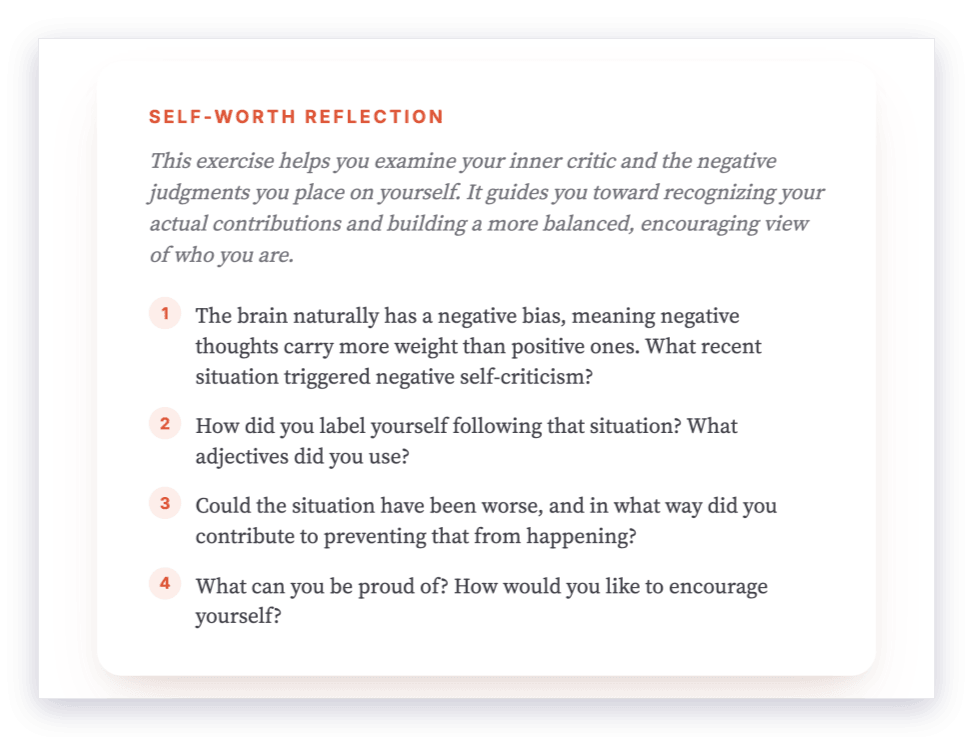
The exercise opens by naming the negativity bias explicitly in the first question, a short piece of psychoeducation that normalises the mechanism before asking the patient to apply it to a specific recent situation. This framing matters: it repositions harsh self-criticism as a brain tendency rather than a moral truth.
The second question asks the patient to name the adjectives they used about themselves following that situation. Externalising the label on paper is often more powerful than recalling it aloud. The third question introduces a genuine cognitive shift: could the situation have been worse, and what did the patient actually do to prevent that? This counters the disqualifying-the-positive distortion and begins redistributing responsibility more honestly, in a way that complements the Responsibility Pie Chart for patients who also carry heavy self-blame.
The fourth question asks what the patient can feel proud of and how they wish to encourage themselves, not reassurance from you, but their own words, in their own voice. This is the hardest question for many patients, and placing it at the end, after the preceding steps, gives it traction.
The image above lists the four questions in order. It is a static preview only. The full guided exercise, with patient-facing instructions and space to write, is what your patient actually experiences on their own in the app. That interactive version is not visible here.
This exercise is available to patients through the patient app of SessionFuel, the mobile companion reserved for the patients of clinicians who use SessionFuel: you assign the exercise directly from your clinician account, and your patient completes it autonomously on their phone between sessions.
Key clinical insight: Naming a self-critical label on paper, then being asked whether the situation could have been worse, breaks the all-or-nothing logic that makes the label feel final.
750+ clinical tools
A library built with and for clinicians, ready to use in session and extend between appointments.
Access all the toolsUse it with your patients
Share this tool in the mobile app and follow the work between sessions.
How to Integrate It as Between-Session Homework
This exercise suits a wide range of patients: those presenting with low self-esteem, chronic self-criticism, perfectionism, or an underlying defectiveness/shame schema. It works naturally alongside programs such as Self-Image and Self-Esteem: A 4-Lesson Psychoeducation Program or Inner Dialogue Psychoeducation: A 4-Lesson Clinical Program.
Introduce it after a session where the patient has described a moment of harsh inner judgment, the timing creates immediate relevance. Frame the assignment plainly: "Before our next meeting, I'd like you to complete this exercise on your own, about the kind of situation we talked about today." The question about self-labels pairs especially well with prior work on the Labeling Cognitive Distortion or Global Judgments in CBT: A Cognitive Restructuring Exercise.
When the patient returns, the written answers become working material. The adjectives from question two often reveal a cognitive distortion pattern worth mapping together. The self-encouragement from question four can be explored with resources like the Positive Traits Checklist or the Celebrating Personal Successes: A Guided Self-Worth Exercise. For patients who also struggle to receive positive input from others, the Accepting Compliments: A Guided Self-Worth Exercise makes a natural follow-up assignment.
The exercise also travels well across presentations: it fits the patient managing impostor syndrome just as readily as the one working through perfectionist patterns or recurring feelings of being useless.
Your session continues in your patients' pocket
Use with a patientYour resources, available everywhere
The handouts, exercises, programs and audios above: you choose which ones to make available to your patients, in the mobile app dedicated to them.
And far more than a library
The app goes well beyond resources, to support your patients every day:
Related categories
Explore other clinical resources by category.

Identity
Clinical resources for self-identity work in therapy: CBT, ACT, schema tools for clinicians addressing self-concept, core beliefs, and identity disruption.

Cognition
Printable cognitive therapy worksheets and clinical tools for therapists: CBT, ACT, schema work, defusion, distortions, and belief restructuring.

Build awareness
Clinical worksheets and tools to build awareness in therapy: cognitive distortions, schemas, emotions, ACT and CBT resources for practitioners.

Restructure
Clinical hub for cognitive restructuring worksheets: distortion identification, belief disputation, ABC model, and schema work for evidence-based practice.

Repair & soothe
Clinical resources for the repair and soothe therapeutic aim: worksheets, exercises and tools to build self-compassion, reduce shame and restore emotional safety.

CBT
CBT worksheets, cognitive restructuring exercises & behavioral tools for clinicians. Evidence-based resources for every phase of cognitive behavioral therapy.